
Choosing the correct liquid filter bag micron size becomes much easier when the filtration requirement is viewed as a range rather than a single number.
A 1 micron filter bag is designed for a very different job from a 100 micron or 200 micron filter bag.
As a quick starting point: 1–10 micron is used for fine filtration and polishing, 20–50 micron for general process filtration, 75–150 micron for equipment protection and pre-filtration, and 200–500 micron for coarse screening.
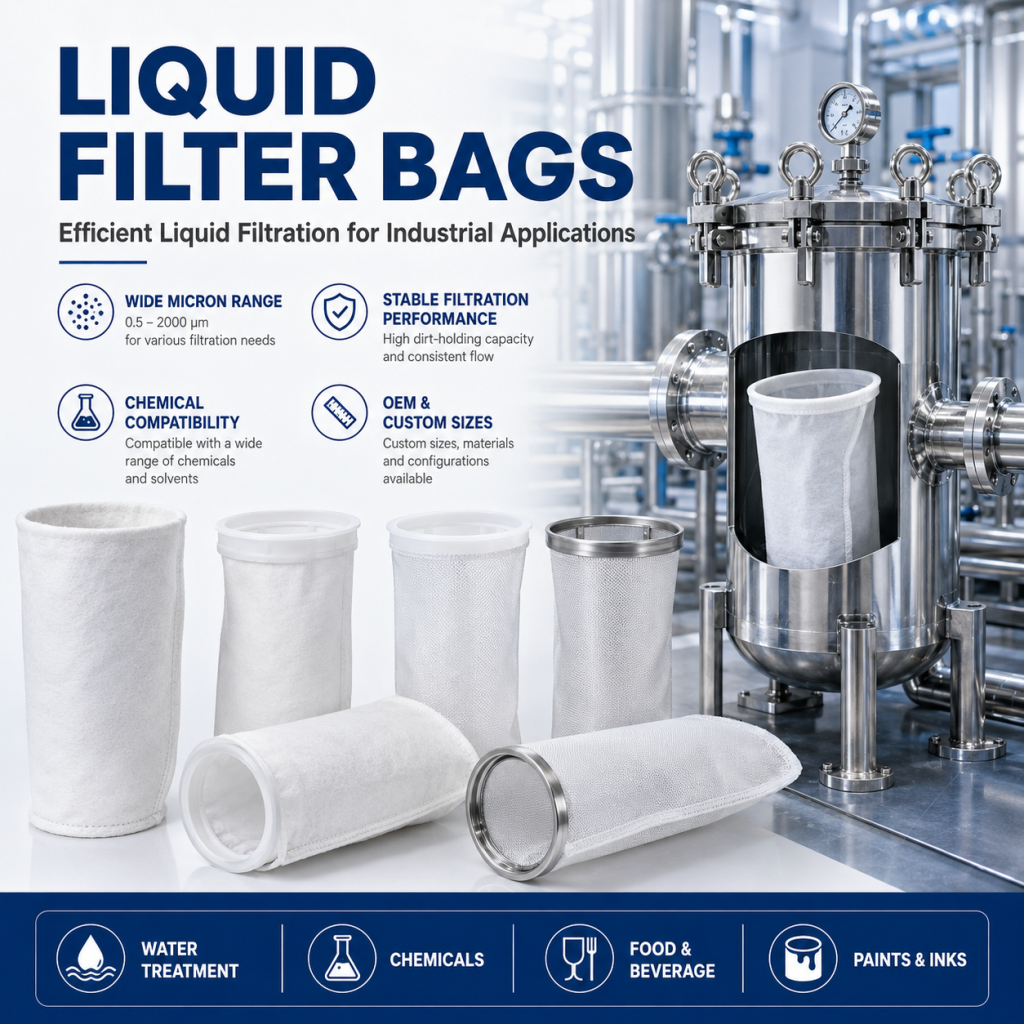
INCE filtration supplies industrial liquid filter bags in polypropylene, polyester, nylon, PTFE and other media across fine, medium and coarse filtration applications.
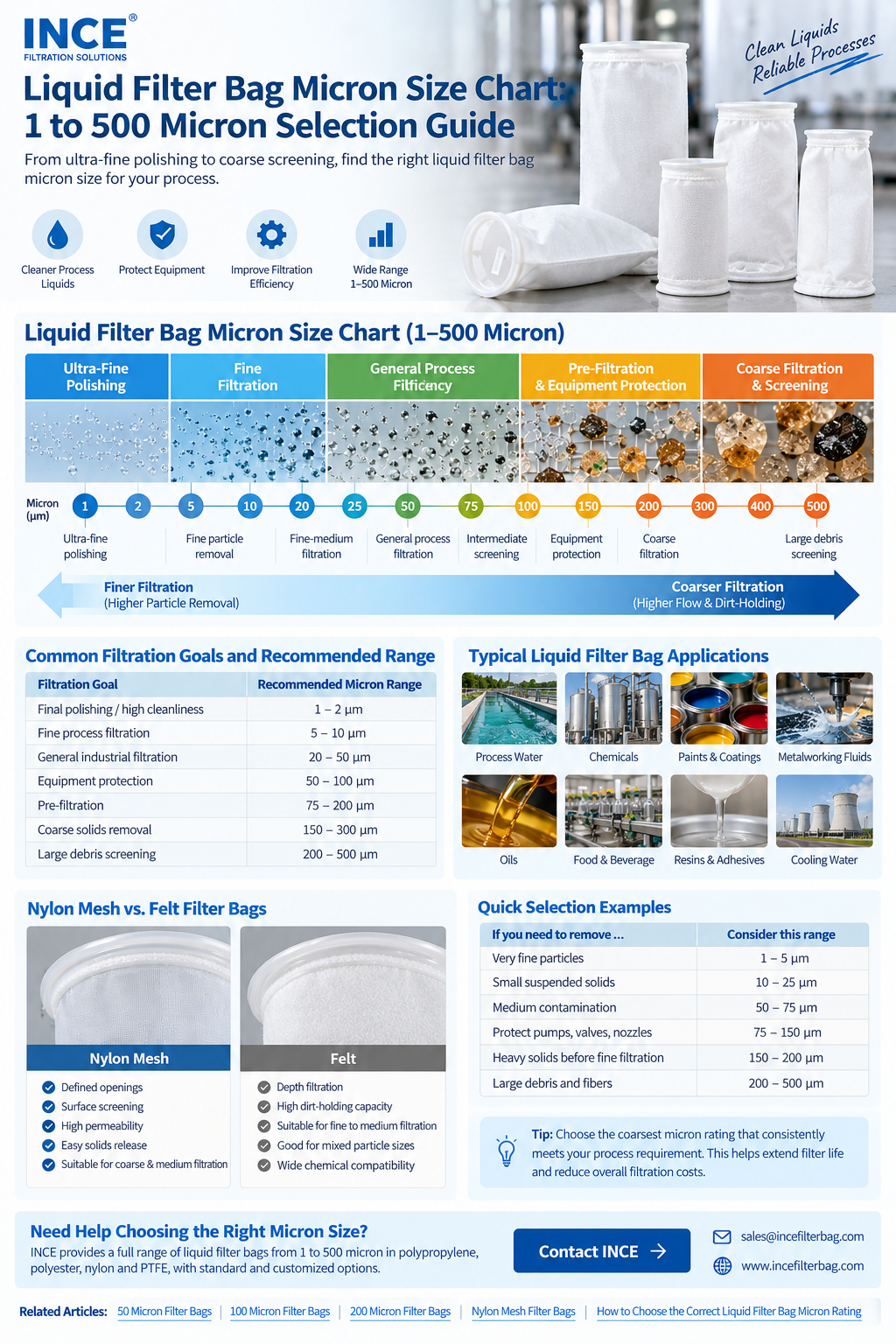
Liquid Filter Bag Micron Size Chart
| Micron Rating | Filtration Level | Typical Role | Typical Contaminants |
|---|---|---|---|
| 1 µm | Ultra-fine | Final polishing | Very fine suspended solids |
| 2 µm | Precision fine | Fine process polishing | Fine residues and small particles |
| 5 µm | Fine | Fine particle removal | Fine sediment and process contamination |
| 10 µm | Fine | Precision process filtration | Small suspended solids |
| 20 µm | Fine-medium | Industrial fluid filtration | Metal fines and process debris |
| 25 µm | Fine-medium | General fine filtration | Sediment and small solids |
| 50 µm | Medium | General process filtration | Rust, debris and coating contamination |
| 75 µm | Medium | Intermediate screening | Medium particles and agglomerates |
| 100 µm | Coarse-medium | Pre-filtration | Rust flakes, scale and sediment |
| 150 µm | Coarse | Equipment protection | Large suspended solids |
| 200 µm | Coarse | Coarse liquid screening | Fibers, debris and large solids |
| 300 µm | Very coarse | Upstream screening | Large debris and process fragments |
| 400 µm | Very coarse | Heavy solids separation | Large suspended contaminants |
| 500 µm | Screening | First-stage filtration | Very large debris and coarse solids |
These values are selection starting points rather than universal retention guarantees. For a more detailed engineering method, see How to Choose the Correct Liquid Filter Bag Micron Rating.
1–5 Micron: Fine and Ultra-Fine Filtration
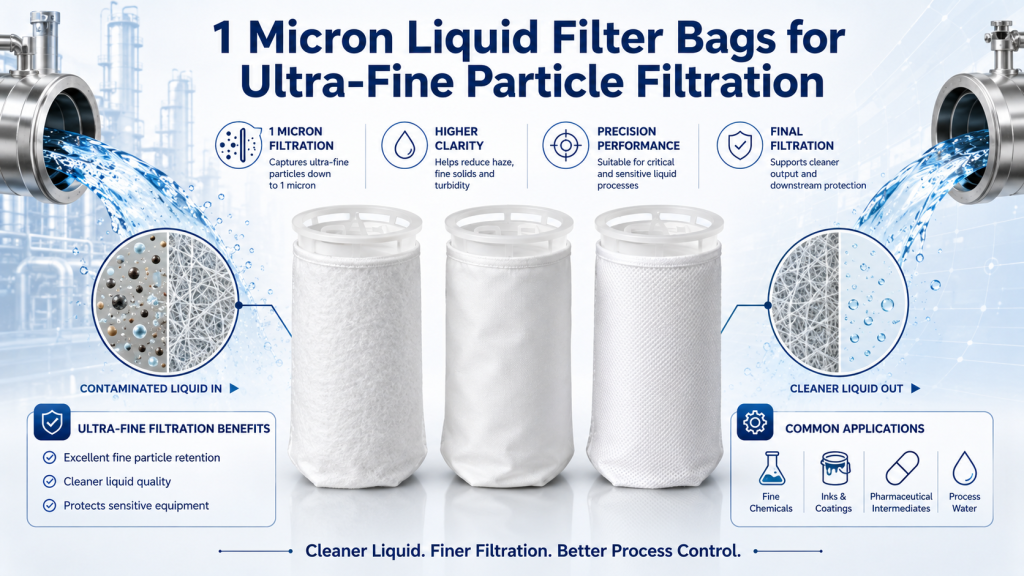
The 1–5 micron range is used where small suspended particles must be controlled. Typical roles include liquid polishing, fine sediment removal and protection of sensitive downstream equipment.
1 micron filtration is best reserved for genuine ultra-fine requirements. 2 micron filtration can bridge the gap between 1 and 5 micron, while 5 micron filter bags are a practical fine-filtration choice when 10 micron is not sufficient.
10–25 Micron: Precision Process Filtration
This range provides a useful balance between particle removal and practical service life. 10 micron filter bags are widely used for fine process filtration, while 20 micron and 25 micron filter bags are useful for general industrial fluids, process water, coolants and chemicals.
50 Micron: General Process Filtration
50 micron filter bags provide medium-level particle removal while generally creating less restriction than finer grades. They are useful for process water, coatings, oils, cleaning fluids and metalworking systems.
Fifty micron is especially relevant when a process needs meaningful solids removal without the loading rate associated with 10 or 25 micron filtration.
75–100 Micron: Intermediate and Pre-Filtration
75 micron filtration is useful for process stabilization and intermediate screening. 100 micron filtration is commonly used to protect pumps, valves, heat exchangers, spray nozzles and downstream filters.
At this range, the objective is often equipment protection rather than visual liquid clarity.
150–200 Micron: Coarse Particle Removal
These ratings are mainly used where larger contamination is the primary concern. A 150 micron grade offers tighter coarse filtration, while 200 micron liquid filter bags are particularly useful for coarse screening, heavy-solids pre-filtration, batch transfer, resins and adhesives. For applications that need a coarser screening step while retaining a defined monofilament mesh opening, compare our 250 micron nylon filter bags.
300–500 Micron: Coarse Screening
The 300–500 micron range is primarily used for mechanical screening of large debris, fibers, product fragments and large agglomerates. These grades are commonly used as the first filtration stage before finer bag or cartridge filtration.
A 500 micron bag should not be expected to improve fine liquid clarity; its purpose is to stop very large contamination while maintaining an open flow path.
Filter Bag Micron Size by Filtration Goal
| Filtration Goal | Typical Starting Range |
|---|---|
| Ultra-fine polishing | 1–2 micron |
| Fine particle removal | 5–10 micron |
| Precision process filtration | 10–25 micron |
| General industrial filtration | 25–50 micron |
| Equipment protection | 50–150 micron |
| Pre-filtration | 75–200 micron |
| Coarse solids removal | 150–300 micron |
| Large-debris screening | 200–500 micron |
Micron Size Does Not Equal Filtration Efficiency
Two bags labeled 10 micron may not provide identical retention. Micron size must be considered together with media structure, nominal or absolute efficiency, particle shape, flow velocity and solids concentration.
Micron size tells you how fine the filtration is; efficiency tells you how consistently particles at that size are retained.
For critical applications, both values matter.
Felt vs. Mesh Across the Micron Range
Needle felt is widely used for fine and medium filtration because it works mainly through depth filtration. It can capture particles throughout the thickness of the media and is useful when contamination contains a broad particle-size distribution.
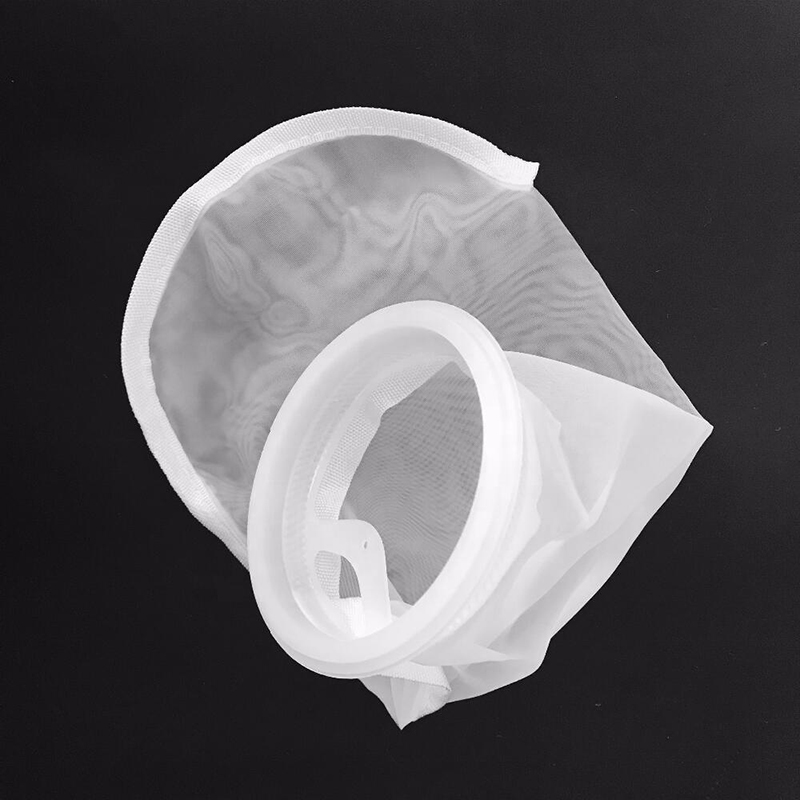
Monofilament mesh works mainly through surface filtration and becomes increasingly relevant at medium and coarse ratings where defined openings, high permeability and easy solids release are important.
| Requirement | Felt | Mesh |
|---|---|---|
| Fine filtration | Very suitable | Limited at very fine grades |
| Depth loading | Excellent | Limited |
| Defined opening | Moderate | Excellent |
| Large particle screening | Suitable | Excellent |
| Easy solids release | Moderate | Better |
Quick Micron Comparisons
1 vs. 5 Micron
Choose 1 micron when very fine polishing is required. Choose 5 micron when fine filtration is sufficient and longer service life is important.
10 vs. 25 Micron
Choose 10 micron when fine suspended solids matter. Choose 25 micron when general industrial filtration is sufficient and solids loading is higher.
50 vs. 100 Micron
Choose 50 micron for medium particle removal and general process filtration. Choose 100 micron when equipment protection and upstream pre-filtration are the primary goals.
200 vs. 500 Micron
Choose 200 micron when coarse solids still need meaningful control. Choose 500 micron when only very large debris matters and the bag is acting as a first-stage screen.
Do Not Select Micron Size by Flow Rate Alone
Larger micron ratings can offer lower resistance in comparable media, but actual flow also depends on filter bag size, media permeability, liquid viscosity, solids loading, differential pressure and housing design.

A properly sized multi-bag 25 micron system may process more total liquid than an undersized single 100 micron bag system. Select micron rating for particle control first, then size the filtration area for flow.
Micron Selection for Common Industrial Applications
| Application | Typical Starting Range |
|---|---|
| Process water | 25–100 micron |
| Cooling water | 50–150 micron |
| Paints and coatings | 25–200 micron |
| Chemical processing | 1–100 micron |
| Metalworking fluids | 10–100 micron |
| Oils | 5–100 micron |
| Resins and adhesives | 75–500 micron |
| Food process straining | 50–500 micron |
A Simple 1–500 Micron Selection Method
Step 1: Identify the smallest particle that must be removed
This establishes the approximate micron range.
Step 2: Define the filtration goal
Polishing generally points toward 1–10 micron, general filtration toward 20–75 micron, pre-filtration toward 75–200 micron, and screening toward 200–500 micron.
Step 3: Check solids loading
If solids loading is high, use coarse pre-filtration before the fine stage rather than sending all contamination directly to a small micron bag.
Step 4: Choose felt or mesh
Use felt for depth loading and mixed particle sizes; use mesh for defined surface screening and larger particles.
Liquid Filter Bag Micron Size FAQ
What is the most common liquid filter bag micron size?
There is no single universal size. For general industrial filtration, 25, 50 and 100 micron are common starting grades depending on the process.
Is 1 micron finer than 5 micron?
Yes. A 1 micron rating is finer and is used for smaller particle removal.
Is 50 micron finer than 100 micron?
Yes. A 50 micron filter provides tighter particle control than a 100 micron filter under comparable conditions.
What micron is considered coarse filtration?
Approximately 100–500 micron is commonly used for coarse filtration, pre-filtration and screening applications.
Does a smaller micron rating always filter better?
No. It filters finer, but it can also increase pressure drop and reduce service life when the process does not require that level of filtration.
How to Use This Micron Chart in a Real Filtration System
A liquid filter bag micron size chart should be used as a starting tool rather than a final engineering specification.
The most practical rule is: choose the coarsest micron rating that reliably removes the particles causing the process problem.
Then verify media compatibility, retention efficiency, solids loading, flow, viscosity and housing fit.
INCE filtration supplies industrial liquid filter bags across these filtration ranges. If you need a more detailed engineering selection process, also read How to Choose the Correct Liquid Filter Bag Micron Rating.
For selection, provide INCE filtration with your liquid type, target contaminant, approximate particle size, current micron rating, required flow, viscosity, operating temperature and filter bag dimensions.
Contact INCE filtration for liquid filter bag micron selection, replacement matching, OEM manufacturing or custom industrial filtration solutions.
 WhatsApp