
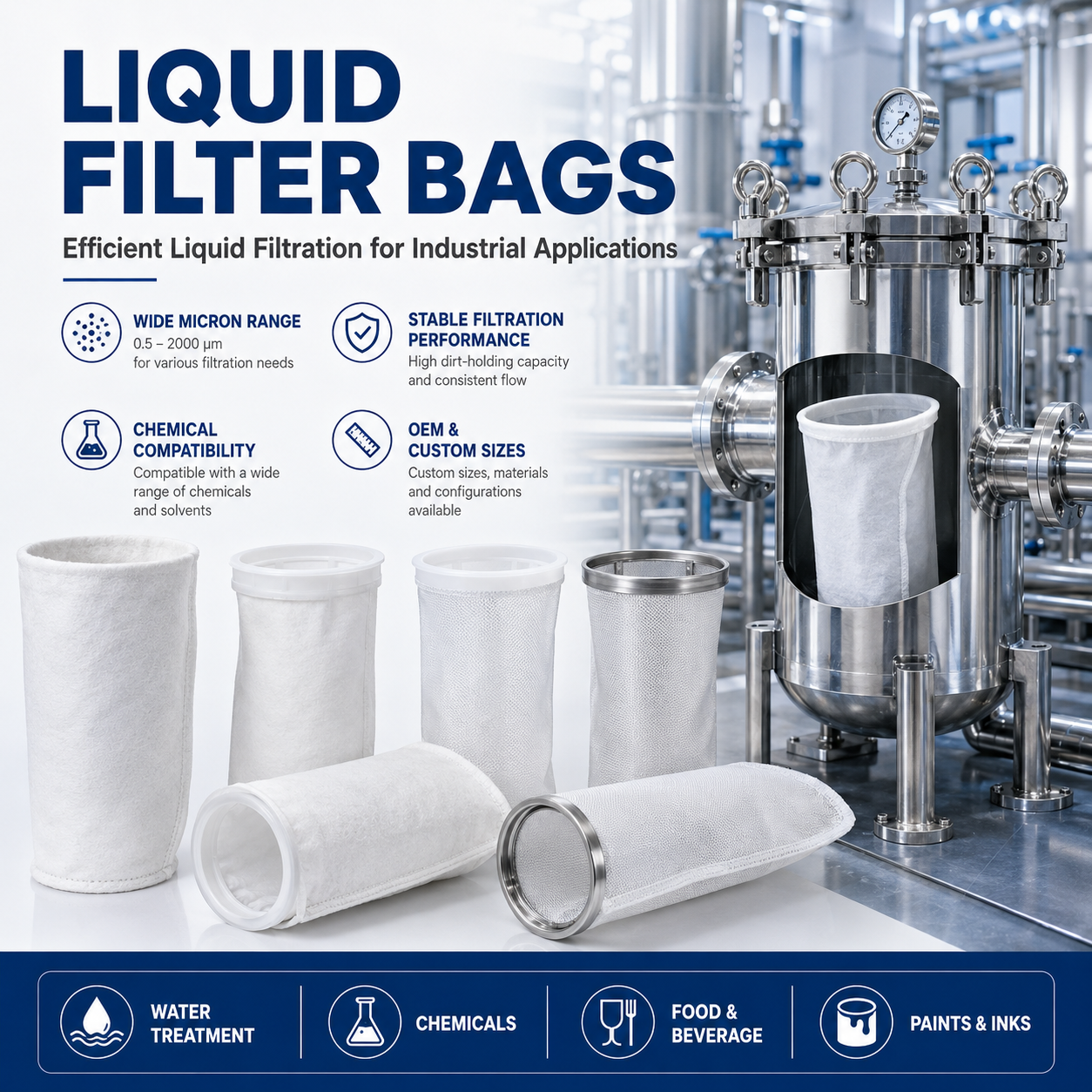
A 200 micron liquid filter bag is designed for coarse liquid filtration where the main objective is to remove relatively large suspended solids before they interfere with pumps, valves, downstream filters or production equipment.
Unlike 10, 25 or 50 micron filtration, a 200 µm filter is generally not intended for liquid polishing.
Its role is more practical:
- Capture larger debris
- Reduce heavy solids loading
- Protect downstream filtration stages
- Improve process stability
- Screen liquids during transfer
- Maintain high process throughput
This makes 200 micron filtration especially useful in industrial processes where large particles create operational problems but fine suspended solids can remain in the liquid.
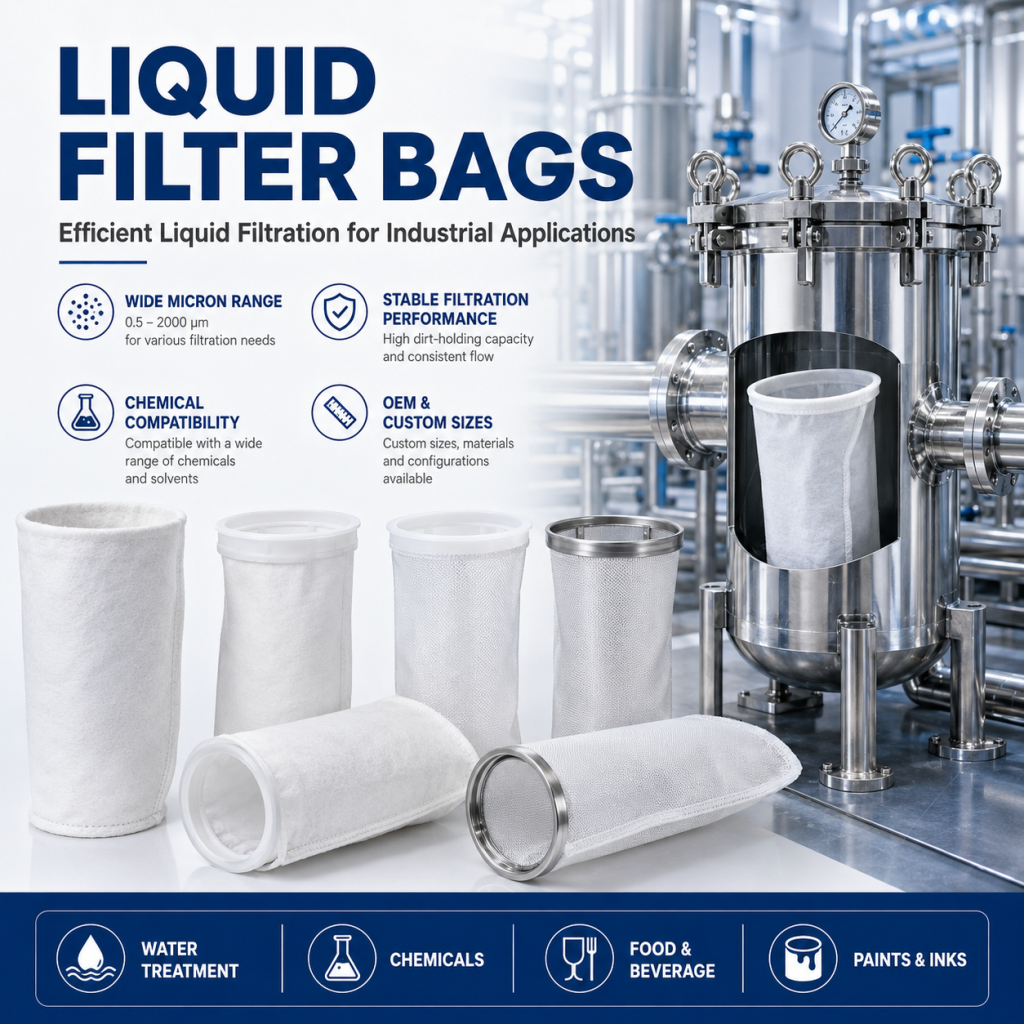
INCE filtration manufactures 200 micron liquid filter bags in multiple media, including polypropylene, polyester, nylon and PTFE, with standard and customized configurations for industrial filtration systems.
What Does 200 Micron Mean?
A micron, or micrometer, equals 0.001 millimeter.
Therefore:
200 micron = 0.20 mm
At this level, filtration is focused on relatively large contamination rather than fine particles.
Typical solids may include:
- Tank debris
- Rust flakes
- Fibers
- Paint skins
- Resin fragments
- Metal chips
- Coarse sediment
- Undissolved process material
- Large agglomerates
- Pipeline contamination
Whether a particle is retained still depends on its shape, flexibility and the structure of the filtration media.
A long fiber, for example, may behave differently from a rigid round particle with the same nominal dimension.
Where 200 Micron Fits in a Filtration System
It is helpful to think of micron ratings as different jobs rather than simply different levels of “cleanliness.”
A typical sequence might look like:
500 micron → 200 micron → 50 micron → final filtration
Each stage removes a different portion of the solids load.
The 200 micron stage is especially useful when the incoming liquid contains enough coarse contamination that sending it directly to a fine filter would waste filter capacity.
In many systems, the job of the 200 micron bag is therefore: remove the bulk of the large contaminants before precision filtration begins.
150 vs. 200 vs. 300 Micron Filtration
These neighboring grades are all used for coarse filtration, but they solve slightly different problems.
| Process Need | 150 Micron | 200 Micron | 300 Micron |
|---|---|---|---|
| Medium-large particle control | Strong | Good | Limited |
| Large debris removal | Good | Very suitable | Excellent |
| Heavy solids screening | Moderate | Good | Very good |
| Upstream protection | Strong | Balanced | Basic |
| Maximum coarse throughput | Good | Very good | Highest |
| General coarse filtration | Very suitable | Very suitable | Coarse screening |
Choose 150 micron when:
Particles below 200 µm still create downstream problems.
Choose 200 micron when:
You need dependable large-particle removal without moving unnecessarily fine.
Choose 300 micron when:
Very coarse debris is the main concern and retaining smaller particles provides little process benefit.
If you need an intermediate coarse-screening grade between 200 and 300 µm, compare the 250 Micron Filter Bags range.
The correct choice depends on the smallest particle that can safely remain downstream.

200 Micron for High-Solids Liquids
One of the strongest applications for 200 micron filtration is liquid containing a relatively high concentration of coarse solids.
Fine bags can plug quickly in these conditions.
A 200 micron bag allows larger particles to be removed without forcing the process through a much finer filtration structure.
This can be useful when the liquid contains production debris, coarse sediment, fibrous material, large precipitates, tank contamination or process agglomerates.
The purpose is often to reduce the solids burden before the liquid reaches another treatment stage.
Coarse Screening Before Fine Filtration
Suppose a process ultimately requires 25 micron filtration.
If the incoming stream also contains a large amount of 200–500 micron debris, sending everything directly through the 25 micron bag can shorten service life dramatically.
A better arrangement may be:
200 micron → 25 micron
The first stage captures the large material. The second stage handles the smaller contamination.
This staged approach can reduce premature fine-filter loading, increase downstream filter life, reduce bag changes, make differential-pressure behavior more predictable and lower total consumable use.
The same principle applies before cartridge filtration.
For example:
200 micron bag → 50 micron bag → fine cartridge
The exact number of stages should always be justified by the actual solids distribution.
200 Micron Nylon Mesh for Defined Screening
At 200 micron, nylon monofilament mesh is especially relevant.
Unlike felt, monofilament mesh has woven openings and works mainly as a surface-screening medium.
Particles larger than the openings remain primarily on the media surface.
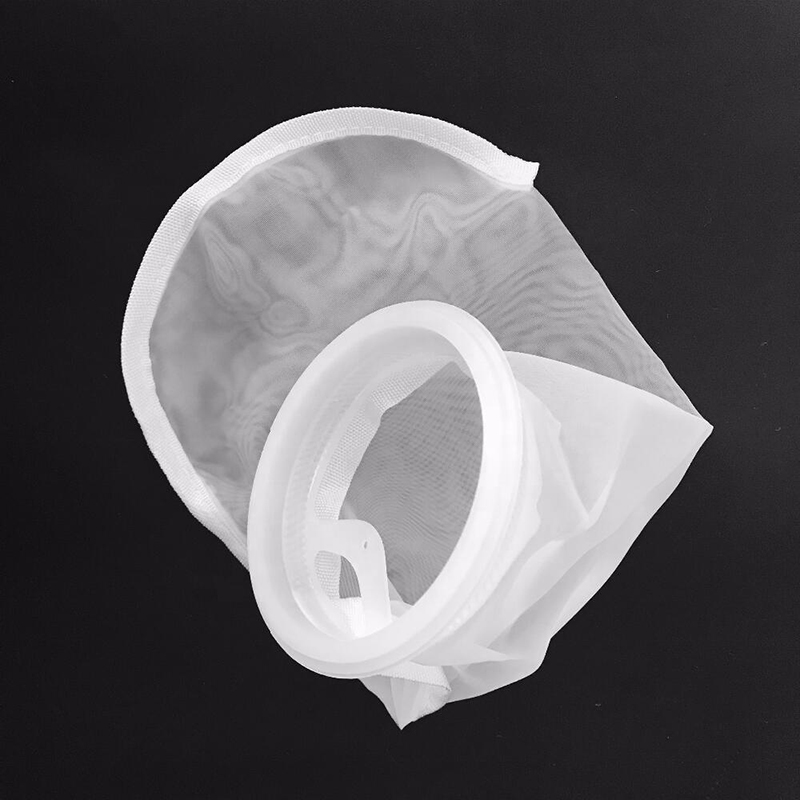
Advantages can include defined openings, high liquid permeability, easy release of coarse solids, good visual inspection, potential cleaning in suitable processes and low resistance compared with finer depth media.
This makes 200 micron nylon mesh useful for coarse liquid straining, process transfer, food-related screening, paint filtration, industrial water, resin and coating processing.
INCE filtration already manufactures dedicated 200 micron nylon liquid filter bags in several actual sizes and ring-top configurations.
When 200 Micron Felt Makes More Sense
Mesh is not automatically better.
Felt provides a different filtration mechanism.
Instead of retaining most particles at a single surface, felt provides a three-dimensional fiber structure where solids can become trapped at different depths.
A 200 micron felt bag may be preferred when particle sizes vary significantly, dirt-holding capacity is important, contamination is irregular, disposable filtration is preferred, or some smaller particles also need to be captured within the media structure.
The choice between mesh and felt should therefore follow the contaminant characteristics.
Mesh vs. Felt at 200 Micron
| Feature | 200 Micron Mesh | 200 Micron Felt |
|---|---|---|
| Filtration mechanism | Surface screening | Depth filtration |
| Opening definition | More defined | More nominal |
| Coarse solids release | Easier | Less easy |
| Dirt loading | Mainly on surface | Through media depth |
| Broad particle distribution | Moderate | Better |
| Cleaning potential | Often higher | Usually lower |
| Best use | Screening | Coarse depth filtration |
At 200 micron, this media decision can be more important than choosing between two nearby micron numbers.
Batch Transfer Filtration
Many liquids become contaminated during transfer between tanks.
Possible sources include tank walls, mixer residue, pipeline contamination, packaging debris, raw-material handling and dried product fragments.
A 200 micron filter bag can be installed temporarily during batch transfer to remove large debris before the liquid reaches another process vessel, a filling line, a holding tank or a finer filtration stage.
This provides a simple way to improve process cleanliness without installing permanent fine filtration.
Paint and Coating Pre-Screening
Paints and coatings can contain larger unwanted defects such as skins, gel particles, agglomerates, dried product fragments and mixing debris.
A 200 micron bag can be used as a coarse screening stage before finer product filtration.
This is particularly useful when the process first needs to remove large defects without exposing a fine filter to unnecessary solids loading.
A possible sequence is:
200 micron screening → 50 or 100 micron production filtration
The actual sequence depends on formulation requirements. Care must always be taken not to remove desirable product components.
Resin and Adhesive Filtration
Resins and adhesives often create filtration challenges because of their viscosity.
Common contamination can include gel particles, cured resin, tank skins, foreign material and raw-material agglomerates.
Very fine filtration can create excessive pressure drop.
A 200 micron bag can remove larger defects while allowing the process liquid to move through the system more easily.
For viscous liquids, filtration design should consider temperature, viscosity, pump capability, required transfer rate and available filter area.
The micron rating should never be selected independently of these process variables.
Industrial Water with Heavy Sediment
Process or recycled water can contain significant amounts of sand, rust, scale, organic debris and tank sediment.
Using a fine bag as the first stage may lead to frequent replacement.
A 200 micron filter can serve as the initial barrier against large solids before the water enters finer filtration equipment.
Examples include 200 micron → 50 micron or 200 micron → cartridge filtration.
This can be particularly useful in systems where incoming water quality varies significantly.
Wastewater and Process-Recovery Applications
Coarse filter bags may also be used in process-recovery or wastewater streams where the first objective is simply to separate large suspended solids.
A 200 micron filter can help remove fibers, larger precipitated solids, manufacturing debris and product fragments before finer treatment.
However, bag filtration alone should not be treated as a complete wastewater-treatment process.
Chemical treatment, settling, membranes or other separation technologies may still be required depending on the discharge or reuse requirement.
Protecting Pumps and Valves
Large hard particles can interfere with rotating or moving equipment.
A 200 micron pre-filter can reduce the amount of coarse contamination reaching pumps, valves, flow meters and transfer equipment.
This is especially useful when the process can tolerate smaller suspended particles but not larger debris.
The correct micron rating should be based on the equipment’s passage dimensions and tolerance to contamination.

Protecting Downstream Filters
A common misconception is that adding a coarse filter is unnecessary when a fine filter already exists.
In high-solids systems, the opposite can be true.
A fine filter has limited capacity. If large debris occupies that capacity first, the filter may be replaced before its fine-filtration capability is fully utilized.
Installing a 200 micron pre-filter can shift the larger contaminant load upstream.
This allows the finer stage to perform the job it was actually selected for.
When 200 Micron Is Too Fine
A 300, 400 or 500 micron screen may be better when:
- Only very large debris matters
- Solids are extremely coarse
- Maximum throughput is required
- 200 micron bags load unnecessarily quickly
- Smaller particles do not affect the process
For these applications, finer filtration adds cost without improving the final result.
When 200 Micron Is Too Coarse
Choose 150, 100, 75 or 50 micron when:
- Medium-sized particles still reach sensitive equipment
- Downstream filters continue to load too quickly
- Product defects remain
- Nozzle blockage continues
- Liquid quality requires tighter particle control
The correct filtration grade should be selected from the actual downstream problem.
200 Micron Is Not a Final Polishing Grade
This is important for setting the correct expectation.
A 200 micron filter bag can effectively remove coarse contaminants, but it should not be expected to produce highly clarified liquid.
Fine suspended particles will still pass through.
If the final process requires improved clarity or fine particle removal, the system should include another downstream stage.
For example: 200 micron → 100 micron → 25 micron or simply 200 micron → 25 micron, depending on the contamination profile.
Particle Loading Matters More Than It Appears
Two liquids can contain the same total amount of suspended solids but behave very differently during filtration.
Liquid A may contain mostly particles above 300 micron. Liquid B may contain mostly particles between 50 and 150 micron.
A 200 micron filter will capture a much larger portion of the solids in Liquid A.
Understanding particle-size distribution therefore helps determine whether 200 micron is actually the correct stage.
When this information is unavailable, practical filtration trials can be valuable.
How to Evaluate a 200 Micron Filter Stage
A successful coarse filter should improve downstream operation.
Useful indicators include:
- Amount of coarse debris captured
- Downstream bag life
- Cartridge replacement frequency
- Pump maintenance
- Valve blockage
- Product defects
- Process interruptions
- Cleaning frequency
If the filter captures almost nothing but downstream problems continue, it may be too coarse.
If it loads extremely quickly but fine filtration is not required, a coarser rating may be more economical.
Choosing Ring and Housing Configuration
Coarse filtration still requires a proper seal.
If liquid bypasses the filter bag around the ring or collar, even large particles can reach the clean side.
For replacement selection, confirm bag diameter, bag length, ring type, collar geometry and housing basket dimensions.
This is especially important for OEM and non-standard filtration equipment.
The existing INCE filtration 200 micron product pages contain detailed size, ring and model information and should be used for exact replacement specifications rather than duplicating those tables here.
What Information Should Be Provided for Selection?
For a 200 micron application, provide:
- Liquid type
- Main contaminant
- Approximate particle size
- Solids concentration
- Required downstream cleanliness
- Flow rate
- Viscosity
- Temperature
- Equipment being protected
- Current filtration stage
- Existing bag dimensions
- Preference for mesh or felt, if known
This helps determine whether 200 micron should be used as the main filter, a pre-filter or an intermediate screening stage.
200 Micron Liquid Filter Bag FAQ
What does a 200 micron filter bag remove?
It is mainly used to remove larger suspended solids such as coarse sediment, rust flakes, fibers, process debris, paint skins and agglomerates.
Is 200 micron considered coarse filtration?
Yes. In industrial liquid filtration, 200 micron is generally considered a coarse filtration or screening grade.
Is 200 micron finer than 300 micron?
Yes. A 200 micron filter retains smaller particles than a 300 micron filter.
Is 200 micron coarser than 100 micron?
Yes. A 100 micron filter provides tighter particle retention.
Is nylon mesh good for 200 micron filtration?
Yes. Nylon monofilament is well suited to 200 micron surface screening where defined openings and high permeability are useful.
Should I choose mesh or felt?
Choose mesh when defined coarse screening and easy solids release are priorities. Choose felt when broad particle distributions and depth loading are more important.
Can 200 micron filtration protect finer filters?
Yes. Removing larger solids upstream can reduce premature loading of fine bags and cartridges.
Can 200 micron bags be cleaned?
Some mesh constructions may be reusable where process conditions permit. Felt bags are more commonly treated as disposable. Actual cleaning suitability depends on the contaminant and media.
Can INCE filtration supply 200 micron filter bags?
Yes. INCE filtration manufactures 200 micron liquid filter bags in PP, polyester, nylon, PTFE and customized media for industrial applications.
Using 200 Micron Filtration as the First Line of Defense
A 200 micron liquid filter bag is most effective when it is used as the first barrier against large process contamination.
Its job is not to perform precision filtration.
Its job is to stop larger solids from consuming downstream filtration capacity or interfering with industrial equipment.
Typical uses include:
- Coarse liquid screening
- Heavy-solids pre-filtration
- Batch transfer
- Paint and coating pre-screening
- Resin filtration
- Industrial water
- Equipment protection
- Downstream filter protection
For defined particle screening, 200 micron nylon mesh can be particularly effective.
For broader and irregular solids distributions, felt media may provide better depth loading.
INCE filtration already manufactures a complete 200 micron filter bag range, including dedicated nylon mesh configurations. Exact product dimensions, model codes, rings and OEM options should remain on those existing product pages rather than being duplicated in this application guide.
For process selection, send INCE filtration your:
Liquid type
Contaminant description
Approximate particle size
Solids loading
Required flow
Viscosity
Current filtration system
Downstream equipment
INCE filtration can help determine whether 200 micron filtration is the right first-stage solution or whether a finer or coarser screening grade would provide better process performance.
Contact INCE filtration for coarse liquid filtration selection, replacement bags, OEM manufacturing or application-specific filtration solutions.
 WhatsApp