A pleated element is one part of a filtration assembly. Its usable performance depends on the medium, support structure, end connection and seal as well as the liquid being filtered. Begin with the downstream result you need, then use the material and rating resources to narrow the options. A short description such as fine filtration is not enough to compare quotations.
Buyers often arrive with either a used element or a process problem. A used element provides clues about dimensions and fit; a process problem provides a reason to investigate media, loading or operating conditions. Keep those two kinds of evidence separate. Matching the outside of an element does not establish its retention performance, while a successful medium still needs the right interface for the installed housing.
Start with the information already available
Use the material, rating and buyer-question resources according to the unresolved part of the inquiry. If a qualified element already exists, begin with its drawing and accepted duty. If the problem is short life or an unacceptable filtrate, begin with the operating observations. This keeps the next request focused on evidence that can move the selection forward.
Define the requested construction
The inquiry needs to distinguish the requested configuration from an established performance claim.
An inquiry headed “pleated filter cartridge” should identify the liquid duty and downstream acceptance target. Ask the supplier to state what is offered and what still needs confirmation; the description alone is not approval.
An inquiry headed “pleated filter cartridges” should identify the liquid duty and downstream acceptance target. Ask the supplier to state what is offered and what still needs confirmation; the description alone is not approval.
An inquiry headed “pleated cartridge filter” should identify the liquid duty and downstream acceptance target. Ask the supplier to state what is offered and what still needs confirmation; the description alone is not approval.
An inquiry headed “pleated filter element” should identify the liquid duty and downstream acceptance target. Ask the supplier to state what is offered and what still needs confirmation; the description alone is not approval.
Check fit and exposure
Use a drawing and an exposure record to close the interfaces and materials questions.
For “pleated filter cartridge”, compare the complete element, housing and sealing arrangement before accepting an apparent match. Record any unresolved point on the drawing or materials review instead of leaving it as an installation assumption.
For “pleated filter cartridges”, compare the complete element, housing and sealing arrangement before accepting an apparent match. Record any unresolved point on the drawing or materials review instead of leaving it as an installation assumption.
For “pleated cartridge filter”, compare the complete element, housing and sealing arrangement before accepting an apparent match. Record any unresolved point on the drawing or materials review instead of leaving it as an installation assumption.
For “pleated filter element”, compare the complete element, housing and sealing arrangement before accepting an apparent match. Record any unresolved point on the drawing or materials review instead of leaving it as an installation assumption.
Qualify the process result
Agree what the trial must demonstrate before treating a sample as an approved production element.
Evaluate “pleated filter cartridge” using a representative filtration result. Keep the operating conditions and end-of-run trigger with the result so another reviewer can understand what the evidence actually establishes.
Evaluate “pleated filter cartridges” using a representative filtration result. Keep the operating conditions and end-of-run trigger with the result so another reviewer can understand what the evidence actually establishes.
Evaluate “pleated cartridge filter” using a representative filtration result. Keep the operating conditions and end-of-run trigger with the result so another reviewer can understand what the evidence actually establishes.
Evaluate “pleated filter element” using a representative filtration result. Keep the operating conditions and end-of-run trigger with the result so another reviewer can understand what the evidence actually establishes.
Obtain a comparable commercial offer
Keep the technical scope attached to the quantity, packing and delivery request.
When requesting “pleated filter cartridge”, ask for the requested media range and order scope. Compare offers against the same requirements and list exceptions explicitly, including any item excluded from the quoted scope.
When requesting “pleated filter cartridges”, ask for the requested media range and order scope. Compare offers against the same requirements and list exceptions explicitly, including any item excluded from the quoted scope.
When requesting “pleated cartridge filter”, ask for the requested media range and order scope. Compare offers against the same requirements and list exceptions explicitly, including any item excluded from the quoted scope.
When requesting “pleated filter element”, ask for the requested media range and order scope. Compare offers against the same requirements and list exceptions explicitly, including any item excluded from the quoted scope.
Approve and control repeat orders
Retain the accepted reference and identify changes that need another review.
Before approving “pleated filter cartridge”, retain the approved selection basis. A later change should be checked against that record rather than accepted because the description or outside appearance seems similar.
Before approving “pleated filter cartridges”, retain the approved selection basis. A later change should be checked against that record rather than accepted because the description or outside appearance seems similar.
Before approving “pleated cartridge filter”, retain the approved selection basis. A later change should be checked against that record rather than accepted because the description or outside appearance seems similar.
Before approving “pleated filter element”, retain the approved selection basis. A later change should be checked against that record rather than accepted because the description or outside appearance seems similar.
Separate initial flow from useful service
A clean element test answers only part of the selection question. Once contaminants accumulate, resistance and sometimes filtrate quality change. Record the amount of accepted product processed before the agreed changeout trigger is reached. State whether that trigger is a pressure difference, a quality limit, a batch change or another defined event. This makes the operating interval interpretable instead of reducing the result to a claim that the filter lasted several days.
Keep the comparison at the actual liquid conditions. A warmer liquid or a lower flow can make one run appear easier than another. Record the temperature and viscosity basis where relevant, and identify differences in the feed. If conditions cannot be matched, explain the limitation rather than treating the results as a direct ranking of two products.
Protect the clean side during installation
The element needs the intended support, seating and seal arrangement. Inspect the contact surfaces and use the supplied assembly procedure. Do not assume that a cartridge is correctly installed just because the closure can be fastened. Keep the outlet and clean-side surfaces protected while the housing is open, and make the installed element reference part of the service record.
If particles remain downstream, investigate more than the media label. Consider bypass, a damaged or misplaced seal, installation contamination and changes in the upstream liquid. Preserve the removed element and useful observations for the review. Replacing the cartridge with a finer grade can be an expensive distraction if the real problem is an interface or operating error.
Compare a defined scope of supply
Give suppliers the same drawing revision and process brief. Request the proposed material construction, end connection, seal, retention description and any documents needed by the project. Ask which items are included and which remain to be confirmed. Price, availability, MOQ and delivery are commercial terms for the actual offered configuration; none should be assumed from a general product description.
Keep the approved element and the accepted conditions together after purchase. A change in formulation, cleaning chemistry, operating temperature or housing arrangement may require another review. Having the original basis makes that decision easier and gives maintenance buyers a reliable reference for repeat orders. It also prevents a series of apparently minor substitutions from changing the assembly without anyone reviewing the complete result.
Make the final inquiry traceable
Put a date and drawing revision on the inquiry so technical replies can be tied to the same requirements. State the units beside each flow, temperature, dimension and pressure value. Identify whether a pressure figure refers to the vessel, the line or the difference across the element. Keep a list of agreed deviations with the final offer. These details make later receiving checks and repeat orders easier, especially when several configurations have similar names or several people take part in purchasing.
A selection route when the old cartridge is available
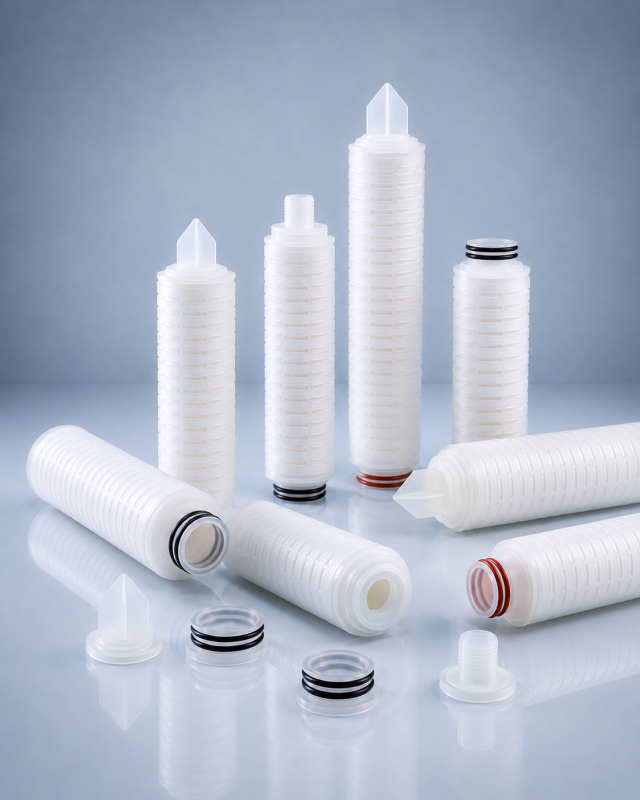
Keep the used element as an identification reference, but separate observations from conclusions. Photographs can show the end arrangement and general construction; measurements can narrow the physical fit. Neither reveals every material or establishes the original retention performance. Write down the information that is known, the evidence supporting it and the questions still open. This gives a supplier a useful starting point without turning an incomplete sample into a complete specification.
Use the housing drawing wherever it is available. Identify the features that locate, seal and retain the cartridge, then compare them with the proposed element. If the original part reference is recoverable, keep it with the measured record. The purpose is to establish a candidate for review, not to approve a replacement solely from an outside resemblance.
A selection route when only the process problem is known
Start by describing the observed problem and where it is measured. Short operating intervals, excessive pressure loss and an unacceptable product sample can point to different questions. Record the liquid conditions and any recent changes in production or cleaning. Preserve useful observations from the removed element. A supplier can respond more meaningfully to that record than to a request for a generally better cartridge.
Define what a successful trial would change. It might increase accepted production between replacements, reduce an identified defect or fit an existing assembly without an unapproved adaptation. State the acceptance method and the conditions to be kept consistent. This turns a broad search into a decision that can be checked, while leaving room to investigate an upstream or installation issue if the element is not the source of the problem.
Keep the filtration train visible
The cartridge operates between upstream equipment and a downstream requirement. Describe those interfaces in the process brief. Upstream separation may affect the contamination reaching the element, while the downstream process defines how the filtrate is judged. A trial that ignores either side can produce an attractive isolated result without showing that the complete line has improved.
Review the available pressure-loss budget and the service arrangements alongside the media choice. Include the housing contribution, the operating cycle and the work needed to change elements. These considerations help identify which resource to use next: a media review, an interface check, a rating comparison or a purchasing guide. The objective is an approved combination rather than an isolated cartridge description.
Turn the chosen route into a controlled reference
After the review, retain the actual part offered, its drawing, the agreed material construction and the evidence supporting the decision. Include the accepted operating basis and the unresolved limitations. Keep commercial identification connected to the technical reference so a reorder cannot silently substitute another interface or medium under a similar name.
Use that record when a later change is proposed. Compare the new liquid, production rate or cleaning exposure with the conditions used for selection. The original choice may remain appropriate, or a targeted check may be needed. A clear record makes that distinction easier and supports maintenance staff who were not involved in the original purchase.
Prepare receiving checks before the first shipment
Agree how the delivered elements will be identified and compared with the approved reference. The receiving team needs the relevant drawing or sample, the order configuration and the records specified for the project. Decide which checks can be completed on arrival and which require an operating observation. This avoids treating a matching carton description as the only acceptance evidence.
If identification, packaging or a supplied feature does not match the accepted record, keep the discrepancy visible and obtain clarification before using the affected elements. Record the supplier response and the final disposition. A receiving observation should be tied to the actual shipment so it can support a later service review without implying that an unexplained difference is either harmless or proof of a performance failure.
Related selection and purchasing resources
- Pleated Filter Cartridge Manufacturers: Supplier Qualification
- Pleated Filter Cartridge Price and Comparable Quotations
- Wholesale Pleated Cartridges: Annual Supply and Distributor Orders
- OEM and Private Label Pleated Filter Cartridges
- Pleated Filter Cartridge Samples and Small Trial Orders
- Pleated Filter Cartridge Lead Time and Replacement Planning
- Polypropylene Pleated Filter Cartridge: Procurement and Process Review
- PES Pleated Filter Cartridge: Procurement and Process Review
- PTFE Pleated Filter Cartridge: Procurement and Process Review
- Nylon Pleated Filter Cartridge: Procurement and Process Review
- PVDF Pleated Filter Cartridge: Procurement and Process Review
- Glass Fiber Pleated Filter Cartridge: Procurement and Process Review
- Polyester Pleated Cartridges: Confirming the Construction and Liquid Duty
- 222, 226, DOE and SOE Cartridge Interfaces: Fit and Replacement Checks
- EPDM, Silicone and FKM Cartridge Seals: A Liquid-Duty Review
- Nominal and Absolute Pleated Cartridge Ratings: Evidence Before Selection
- Pleated Cartridge Length, Diameter and Custom Drawing Review
- Pleated Filter Cartridges for Water, RO Pretreatment and High-Purity Duties
- Food and Beverage Cartridge Filtration: Quality and Documentation
- Pleated Cartridges for Chemicals, Solvents and Cleaning Exposure
- Ink, Resin, Coating and Cosmetics Cartridge Filtration
- Pharmaceutical Membrane Cartridges: Validation Requirements Before Purchase
- Pleated Cartridge Pressure Drop, Fouling and Service Cost
- Independent Pleated Cartridge Replacement and Cross-Reference Review
- Pleated vs Melt-Blown and String-Wound Cartridges: A Process Trial
- PP, PES, PTFE and Nylon Cartridge Media: Comparing the Complete Element
- Bag Filter vs Cartridge Filter: Liquid Process Purchasing Checks
- 0.1 Micron Pleated Cartridges: Selecting and Qualifying the Offered Grade
- 0.2 Micron Pleated Cartridges: Selecting and Qualifying the Offered Grade
- 0.22 Micron Pleated Cartridges: Selecting and Qualifying the Offered Grade
- 0.45 Micron Pleated Cartridges: Selecting and Qualifying the Offered Grade
- 1 Micron Pleated Cartridges: Selecting and Qualifying the Offered Grade
- 3 Micron Pleated Cartridges: Selecting and Qualifying the Offered Grade
- 5 Micron Pleated Cartridges: Selecting and Qualifying the Offered Grade
- 10 Micron Pleated Cartridges: Selecting and Qualifying the Offered Grade
- 20 Micron Pleated Cartridges: Selecting and Qualifying the Offered Grade
- 50 Micron Pleated Cartridges: Selecting and Qualifying the Offered Grade
- Pleated Cartridge RFQ Examples: Materials, Dimensions and Export Information
For the equipment around the element, see the filter housing resource center. To discuss a defined configuration, send the liquid duty and drawing to sales@incefiltration.com.

 WhatsApp