Flat End Cap
Flat end configuration for standard open or closed cartridge designs.

INCE filtration manufactures glass fiber pleated filter cartridges for high-contaminant-load liquid filtration, pre-filtration and process protection. The multilayer glass fiber media combines depth interception with a large pleated surface area, helping deliver high dirt holding capacity, stable particle removal and lower pressure drop before downstream membrane or final filters.
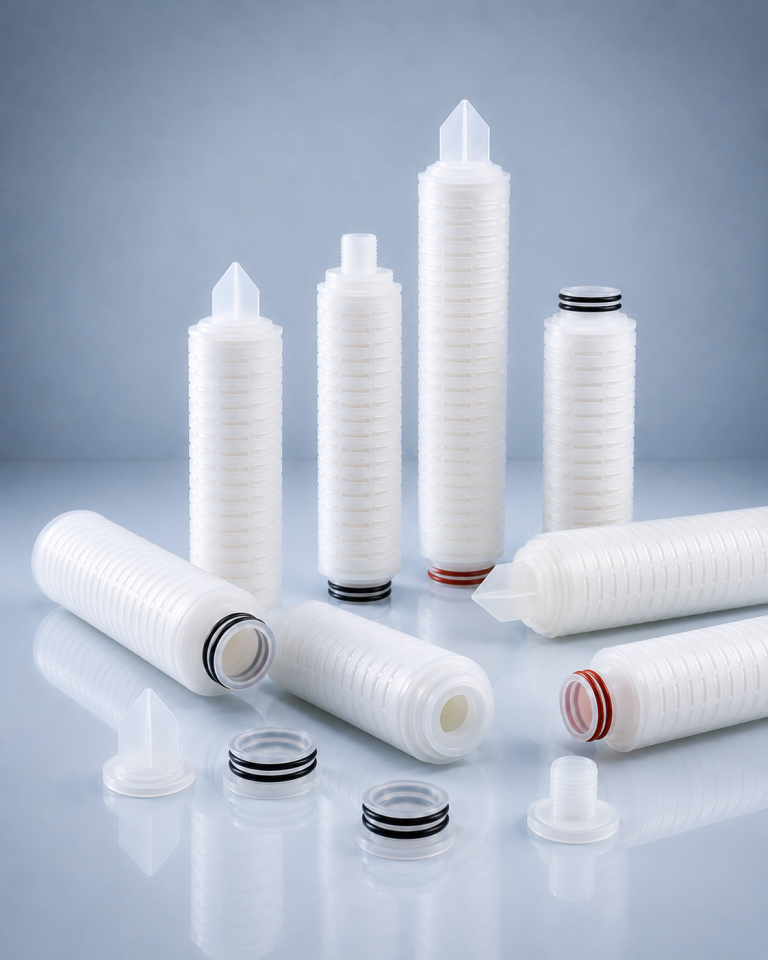
Glass fiber media is selected where the filtration system must handle higher solids loading, protect finer downstream filters and maintain stable flow over a longer operating cycle.
The multilayer fiber structure captures contaminants through the media depth and accommodates a larger particle load before change-out.
The pleated geometry increases usable surface area, supporting higher flow and lower face velocity in a compact cartridge.
Glass fiber cartridges reduce the contaminant load reaching final membrane filters, helping extend downstream service life.
Open fiber pathways support efficient liquid flow while retaining suspended particles.
Fine and coarse grades support polishing, general process filtration and high-flow pre-filtration.
PP or stainless steel cores and reinforced cages can be selected for demanding operating conditions.
Glass fiber combines depth filtration with pleated surface area, making it especially useful for pre-filtration and liquids with a higher concentration of suspended solids.
Particles are retained throughout the thickness of the glass fiber media rather than only on the outer surface.
Glass fiber cartridges are frequently installed upstream of PES, PTFE or other membrane cartridges to reduce premature blocking.
The media can be configured for fine polishing or larger-particle pre-filtration according to process requirements.
Glass fiber filtration media is supported by non-woven layers, an outer cage and a center core. End caps are thermally bonded to reduce bypass and eliminate adhesive from the primary connection.
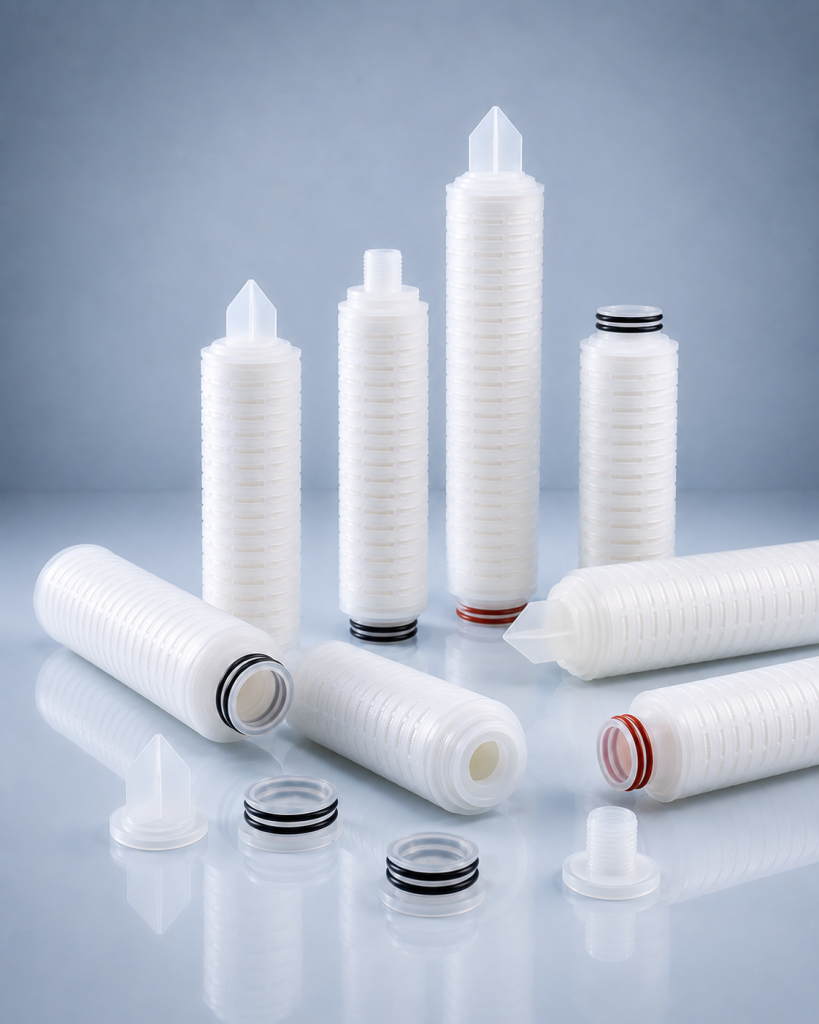
Glass fiber captures contaminants throughout the media depth for high dirt holding capacity.
Reinforced cores and compatible end-cap materials can be selected for elevated-temperature service.
Media grade, support layers, core, cage and seals can be configured for the working liquid.
Select the micron grade according to the target particle size, contaminant loading, downstream filter sensitivity and acceptable pressure drop.
For fine particle removal, polishing and protection before high-efficiency membrane cartridges.
Suitable for industrial water, chemicals, oils, coatings and process-liquid clarification.
Designed for larger particle removal, low resistance and protection of downstream equipment.
Confirm length, outside diameter, inside diameter and interface dimensions before ordering replacement cartridges.
Available from 10 to 70 inches. Lengths from 20 to 40 inches can be manufactured in one piece.
Reference outside diameters include 60, 64, 68, 84 and 131 mm.
The reference inside diameter is 28 mm. Custom ID options are available for special housings.
Each card includes a reserved image position for the corresponding glass fiber cartridge end cap photo.
Flat end configuration for standard open or closed cartridge designs.
Double O-ring 222 adapter for secure insertion and reliable sealing.
Extended 222 adapter for housings requiring a taller connection profile.
Bayonet-style 226 adapter for fast locking in compatible housings.
215 interface for selected industrial and OEM filter housings.
Threaded adapter for screw-in cartridge installation.
Triangle fin design for cartridge positioning and stabilization.
Semi-winged fin for alignment in compatible cartridge housings.
Flat peak cover for selected closed-end support configurations.
The following table presents common configurable values for this cartridge series. Final operating limits should be confirmed against the selected media, core, cage, gasket and end-cap construction.
| Category | Specification Item | Available Data |
|---|---|---|
| Product Size | Filtration Accuracy | 0.5 µm, 1 µm, 3 µm, 5 µm, 10 µm, 20 µm, 40 µm, 50 µm, 70 µm, 100 µm |
| Length | 10–70 inches; 20–40 inches can be manufactured in one piece | |
| Diameter | OD 60 mm, 64 mm, 68 mm, 84 mm, 131 mm; ID 28 mm | |
| End Cap Type | Port / Interface Options | 215, 222, High 222, 226, Triangle Tip, Semi-Winged Tip, Flat Peak Cover, Flat and custom interfaces |
| Operating Conditions | Normal Operating Temperature | Typical PP-supported construction: ≤80°C |
| Higher-Temperature Option | Custom reinforced or stainless-steel-supported construction available; confirm final limit before use | |
| Maximum Differential Pressure | Typical reference at 25°C: up to 0.5 MPa, subject to final construction | |
| Note | Sanitization / Sterilization | Hot water or steam-compatible versions require suitable core, lining, end-cap and gasket materials. |
Finer glass fiber grades produce higher pressure drop, while coarse grades provide lower resistance and higher flow for pre-filtration.
This chart is an illustrative selection guide. Actual pressure drop depends on cartridge length, pleat area, media density, liquid viscosity, temperature, contaminant loading, housing and operating flow.
Glass fiber pleated cartridges are commonly used as pre-filters or high-capacity process filters before finer downstream filtration.
Removal of suspended solids from process water, cooling water and utility water.
Pre-filtration before PES, PTFE or other final membrane cartridges.
Filtration of compatible process chemicals with elevated contaminant loading.
Particle removal from compatible oils, lubricants and hydraulic fluids.
Clarification of compatible coatings, resins, inks and surface-treatment liquids.
Process-water and compatible liquid pre-filtration where selected materials are suitable.
Reduction of particulate load before finer process or membrane filters.
Pre-filtration and particle reduction in compatible production liquids.
INCE filtration supports custom micron rating, media density, length, diameter, end cap, gasket, core, cage and packaging.
Provide particle size, solids concentration, liquid viscosity and target service life.
Choose 0.5–100 µm according to required retention, flow and pressure-drop limits.
Confirm length, OD, ID, end cap photo, gasket, core and cage requirements.
Support sample approval, OEM labels, bulk production and export packaging.
Send your micron rating, dimensions, end cap photo, contaminant loading and operating conditions.
Common questions before selecting glass fiber pleated cartridges.
Available grades include 0.5, 1, 3, 5, 10, 20, 40, 50, 70 and 100 µm.
Glass fiber provides high dirt holding capacity and reduces the contaminant load reaching finer downstream membranes.
Yes. Its depth structure is well suited to liquids with higher suspended-solids loading, provided chemical and temperature compatibility are confirmed.
Yes. Flat, 215, 222, High 222, 226, Threaded, Triangle Tip, Semi-Winged Tip, Flat Peak Cover and custom interfaces are available, with PP or stainless steel support options.
Please provide micron rating, length, OD, ID, end cap, gasket, liquid type, viscosity, particle load, temperature, pressure, flow rate and quantity.
Send the model, size, material, micron rating and operating requirements. The current product page is included automatically with your inquiry.
A glass-fiber or glass-microfiber inquiry should identify the supplied media grade and the rest of the element construction. Request the retention description, support and assembly information needed to compare it with the PP or membrane alternative. Different media architectures should be assessed against the same filtrate target.
Use a representative trial where solids loading controls the interval between changes. Record the initial pressure difference and its development, as well as the amount processed. A favorable initial flow does not establish the contaminant capacity or the useful operating interval in another liquid.
A request for more dirt capacity needs an operating record. Describe the retained material, the pressure trend and the amount of acceptable liquid processed before changeout. If possible, include samples or observations from the periods that create the greatest loading. The medium can then be assessed against a defined problem rather than a general wish for longer service.
Keep changes in viscosity and production rate visible. A filter that appears to last longer at a lower flow or warmer temperature has not necessarily demonstrated greater useful capacity. Compare the candidates at consistent conditions or explain the difference. This makes it easier to decide whether a glass-fiber construction merits a further trial.
Ask for the actual supplied medium, its retention description and the materials of supports, cage, core and seals. If the project has a particular cleanliness or product-contact requirement, state it and request the corresponding evidence for the element. The use of glass fibers in a medium does not establish every property of the finished cartridge.
Where the supplier proposes another architecture, compare its interfaces and dimensions with the installed housing. A favorable media assessment is not a fit approval. Confirm the seating, retention and service clearance before running the candidate, and keep the approved construction connected to its part reference.
Evaluate the filtrate using the process acceptance method, not only the visible deposit on a removed element. A large deposit shows that material was retained, but it does not by itself establish that the desired downstream result was achieved. Record the accepted volume and the reason the run ended so quality and capacity can be assessed together.
Include removal and disposal in the operating comparison. Wet elements, retained product and changeout time can alter the commercial result even when two candidates reach a similar interval. Use measured values where available and identify assumptions where they are not. The review should make the basis understandable without presenting an estimated saving as a guaranteed outcome.
The inquiry needs to distinguish the requested configuration from an established performance claim.
An inquiry headed “glass fiber pleated filter cartridge” should identify the actual media grade and supporting materials. Ask the supplier to state what is offered and what still needs confirmation; the description alone is not approval.
An inquiry headed “glass microfiber filter cartridge supplier” should identify the actual media grade and supporting materials. Ask the supplier to state what is offered and what still needs confirmation; the description alone is not approval.
Use a drawing and an exposure record to close the interfaces and materials questions.
For “glass fiber pleated filter cartridge”, compare the production liquid, cleaning liquid and proposed seal before accepting an apparent match. Record any unresolved point on the drawing or materials review instead of leaving it as an installation assumption.
For “glass microfiber filter cartridge supplier”, compare the production liquid, cleaning liquid and proposed seal before accepting an apparent match. Record any unresolved point on the drawing or materials review instead of leaving it as an installation assumption.
Agree what the trial must demonstrate before treating a sample as an approved production element.
Evaluate “glass fiber pleated filter cartridge” using retention and compatibility evidence for the offered element. Keep the operating conditions and end-of-run trigger with the result so another reviewer can understand what the evidence actually establishes.
Evaluate “glass microfiber filter cartridge supplier” using retention and compatibility evidence for the offered element. Keep the operating conditions and end-of-run trigger with the result so another reviewer can understand what the evidence actually establishes.
Keep the technical scope attached to the quantity, packing and delivery request.
When requesting “glass fiber pleated filter cartridge”, ask for the specific construction and documents included. Compare offers against the same requirements and list exceptions explicitly, including any item excluded from the quoted scope.
When requesting “glass microfiber filter cartridge supplier”, ask for the specific construction and documents included. Compare offers against the same requirements and list exceptions explicitly, including any item excluded from the quoted scope.
Retain the accepted reference and identify changes that need another review.
Before approving “glass fiber pleated filter cartridge”, retain the approved materials list and exposure conditions. A later change should be checked against that record rather than accepted because the description or outside appearance seems similar.
Before approving “glass microfiber filter cartridge supplier”, retain the approved materials list and exposure conditions. A later change should be checked against that record rather than accepted because the description or outside appearance seems similar.
A clean element test answers only part of the selection question. Once contaminants accumulate, resistance and sometimes filtrate quality change. Record the amount of accepted product processed before the agreed changeout trigger is reached. State whether that trigger is a pressure difference, a quality limit, a batch change or another defined event. This makes the operating interval interpretable instead of reducing the result to a claim that the filter lasted several days.
Keep the comparison at the actual liquid conditions. A warmer liquid or a lower flow can make one run appear easier than another. Record the temperature and viscosity basis where relevant, and identify differences in the feed. If conditions cannot be matched, explain the limitation rather than treating the results as a direct ranking of two products.
The element needs the intended support, seating and seal arrangement. Inspect the contact surfaces and use the supplied assembly procedure. Do not assume that a cartridge is correctly installed just because the closure can be fastened. Keep the outlet and clean-side surfaces protected while the housing is open, and make the installed element reference part of the service record.
If particles remain downstream, investigate more than the media label. Consider bypass, a damaged or misplaced seal, installation contamination and changes in the upstream liquid. Preserve the removed element and useful observations for the review. Replacing the cartridge with a finer grade can be an expensive distraction if the real problem is an interface or operating error.
Give suppliers the same drawing revision and process brief. Request the proposed material construction, end connection, seal, retention description and any documents needed by the project. Ask which items are included and which remain to be confirmed. Price, availability, MOQ and delivery are commercial terms for the actual offered configuration; none should be assumed from a general product description.
Keep the approved element and the accepted conditions together after purchase. A change in formulation, cleaning chemistry, operating temperature or housing arrangement may require another review. Having the original basis makes that decision easier and gives maintenance buyers a reliable reference for repeat orders. It also prevents a series of apparently minor substitutions from changing the assembly without anyone reviewing the complete result.
Put a date and drawing revision on the inquiry so technical replies can be tied to the same requirements. State the units beside each flow, temperature, dimension and pressure value. Identify whether a pressure figure refers to the vessel, the line or the difference across the element. Keep a list of agreed deviations with the final offer. These details make later receiving checks and repeat orders easier, especially when several configurations have similar names or several people take part in purchasing.
A change in medium can arrive with changes elsewhere in the element. Ask the supplier to identify supports, core, cage, end caps and seals rather than describing the proposal only by its membrane or fiber. Compare the full construction with the existing element and the intended liquid. Where a requirement applies to the complete flow path, evidence about one material does not close the entire review.
Keep production and cleaning exposures separate in the inquiry. State the actual liquid composition, concentration and temperature, together with relevant contact times or excursions. If information is incomplete, identify what is needed to finish the assessment. The useful result is a review tied to stated conditions, not a broad claim that a polymer or fiber is compatible with every process bearing the same industry label.
Define why the proposed material is being considered. It may concern retention, useful operating interval, product interaction or a documented exposure question. Select the observations that can resolve that issue. Keep the housing interface and other test conditions consistent where possible, so a difference in seating or operating temperature is not mistaken for an advantage of the medium.
A trial should record the element identification, the liquid used and the conditions throughout the run. State the amount of acceptable product processed and the reason testing stopped. If cleanliness or product interaction is part of the requirement, use the project acceptance method for that question. A clear-looking sample or a low initial pressure difference does not demonstrate every property a buyer may need.
Ask which construction, grade and conditions the supplied information covers. A document for one element should not automatically be extended to another construction that shares the same material abbreviation. Likewise, an operating value needs its associated conditions. Keep restrictions and missing information attached to the proposed part so they are not lost when a figure is copied into a quotation comparison.
Where the project requires traceability or product-contact evidence, identify the scope explicitly. Confirm how the delivered element will be connected to the applicable records. Avoid substituting a general company document for the information needed to approve the particular product. The buyer and supplier should be able to explain which requirement each record answers.
Consider the state of the assembly when it is opened and the way the element will be removed. Protect clean-side surfaces and follow the supplied installation procedure. If the liquid is valuable or the process changes products, record retained volume and the cleaning work associated with the candidate. These practical differences may influence the preferred construction even when initial filtration results are similar.
After approval, keep the material construction, interface and accepted duty together. Revisit that basis if the formulation, cleaning cycle or element construction changes. This is especially useful for repeat orders: the same medium name can otherwise conceal a different support or seal that raises a question the original review never considered.
Agree how the delivered elements will be identified and compared with the approved reference. The receiving team needs the relevant drawing or sample, the order configuration and the records specified for the project. Decide which checks can be completed on arrival and which require an operating observation. This avoids treating a matching carton description as the only acceptance evidence.
If identification, packaging or a supplied feature does not match the accepted record, keep the discrepancy visible and obtain clarification before using the affected elements. Record the supplier response and the final disposition. A receiving observation should be tied to the actual shipment so it can support a later service review without implying that an unexplained difference is either harmless or proof of a performance failure.
If one trial shows a better interval but another shows a less acceptable filtrate, preserve both results. Compare the liquid, operating conditions, installed element and sampling method before drawing a conclusion. Identify whether the difference can be explained by the test record or whether another targeted check is needed. Combining incompatible results into one average can conceal the question the selection was meant to answer.
Agree what evidence will close the remaining issue and who will assess it. Keep the next test focused on that issue instead of repeating the same demonstration without changing what is observed. The result can then support a specific purchase decision, or establish that the current information is insufficient, without turning an attractive isolated measurement into a general performance claim.
For the equipment around the element, see the filter housing resource center. To discuss a defined configuration, send the liquid duty and drawing to sales@incefiltration.com.
 WhatsApp