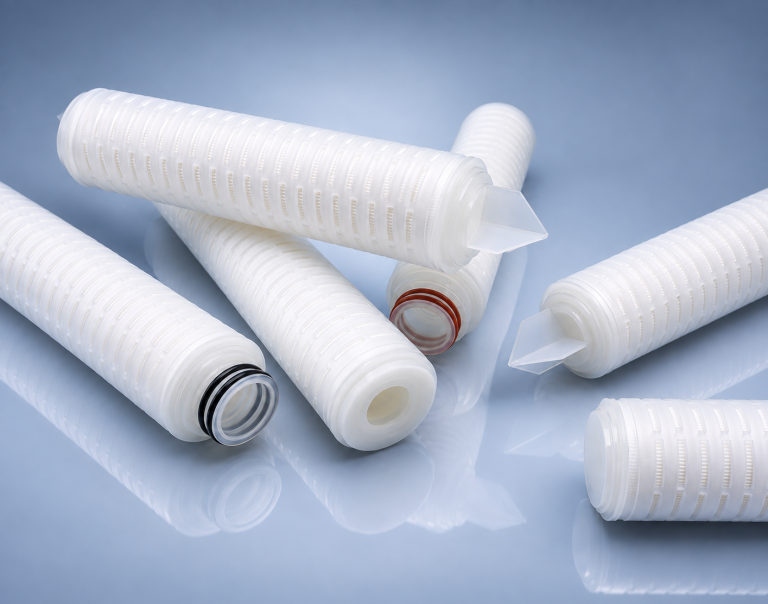
PP family image for illustration. The image does not identify an independently verified 3 µm SKU; confirm the ordered construction.
Selection summary
A 3 micron pleated filter cartridge is an intermediate particle-control grade between 1 and 5 micron. INCE PP and glass fiber families list 3 µm, allowing comparison of material construction and documented loading behavior for compatible liquids.
When to evaluate 3 µm filtration
A step between fine and general prefiltration
Consider 3 µm where tested 5 µm performance does not meet the process specification but a 1 µm final stage is not required. This is a selection hypothesis to verify with particle data, rather than a guarantee that 3 µm provides a fixed percentage improvement.
Check the complete filtration train
For a two-stage installation, check whether the upstream 3 µm stage meaningfully reduces the loading on a finer element. Sampling before and after each stage helps distinguish particle removal from pressure losses caused by a poorly sized housing.
Material options and exact-grade availability
This is a cross-material selection guide. The linked family pages are the catalog references, not substitutes for a confirmed grade-specific data sheet. Listed family information does not establish that every combination of dimensions, seals and rating is available.
Exact 3 µm grade listed on the detailed family page
Confirm the multilayer media, support construction and approved operating conditions.
For the existing polypropylene-specific product guide, see 3 micron PP pleated filter cartridge. That page addresses the PP construction; this page compares material and process-selection choices.
3 versus 5 micron
3 µm states the finer particle target. Compare the actual fraction removed at the process-critical sizes, not only the headline label. The flow-rate difference cannot be calculated from 3 and 5 alone.
Nearby selection guides: 1 µm · 5 µm. Compare equivalent efficiency definitions and cartridge dimensions before changing grade.
Specify the cartridge before ordering
Required rating
3 µm; state nominal/absolute definition and required retention efficiency.
Availability
Listed material families above; confirm the exact orderable combination.
Dimensions and interface
Confirm actual length, OD, ID, end-cap drawing and gasket arrangement against the existing housing.
Fluid and hydraulics
Provide fluid composition, concentration, viscosity at temperature, flow and allowable clean differential pressure.
Operating limits
Obtain configuration-specific temperature, pressure and change-out limits. Limits cannot be inferred from the micron number.
Documents
Request a grade-specific data sheet, retention method and any product-contact or validation records required for the application.
Trial and acceptance plan for 3 µm
Request a PP-versus-glass-fiber comparison for the same nominal length, diameter and flow. Include feed solids, liquid viscosity and required downstream quality so that the proposed construction can be assessed on equal terms.
Define the required downstream particle or process-quality result before the trial.
Install the confirmed cartridge and seals; check for bypass and record clean differential pressure at the design flow.
Track throughput, particle results and differential-pressure growth under representative feed conditions.
Approve a change-out criterion below the cartridge and housing limits. Replace earlier if process quality or flow requires it.
No grade-specific flow rate, retention percentage, service life, certification or microbial-validation result is asserted by this guide. Those values must come from documentation for the ordered configuration.
Questions about 3 micron pleated cartridges
What does a 3 micron pleated filter cartridge mean?
A 3 micron pleated filter cartridge is an intermediate particle-control grade between 1 and 5 micron. INCE PP and glass fiber families list 3 µm, allowing comparison of material construction and documented loading behavior for compatible liquids.
3 versus 5 micron: which should I choose?
3 µm states the finer particle target. Compare the actual fraction removed at the process-critical sizes, not only the headline label. The flow-rate difference cannot be calculated from 3 and 5 alone.
Is the 3 micron rating nominal or absolute?
The number alone does not say. Request the retention efficiency, challenge conditions and test method for the exact grade. Do not assume a universal efficiency percentage from the word nominal or absolute.
Will this cartridge fit my existing housing?
Match the actual overall length, outside and inside diameters, end-cap interface and seal arrangement against the housing drawing. A matching micron rating or nominal length does not establish fit.
Does this rating prove sterile filtration or dissolved-contaminant removal?
No. Particle-rating information alone does not establish sterilizing performance or removal of dissolved salts and chemicals. Microbial claims need product-specific evidence and process validation; dissolved contaminants require an appropriate treatment process.
How do I request a quotation?
Send the required rating and efficiency, liquid and concentration, flow, viscosity, temperature, pressure, particle load, cartridge dimensions, end-cap drawing, seals, quantity and required documentation. Ask INCE filtration to confirm the exact configuration before purchase.
Catalog references and related ratings
Prepared by INCE filtration from the linked material-family catalog information. Reviewed: 30 October 2026. Availability statements describe the published family lists at preparation time; a written quotation and data sheet establish the supplied configuration.

 WhatsApp