
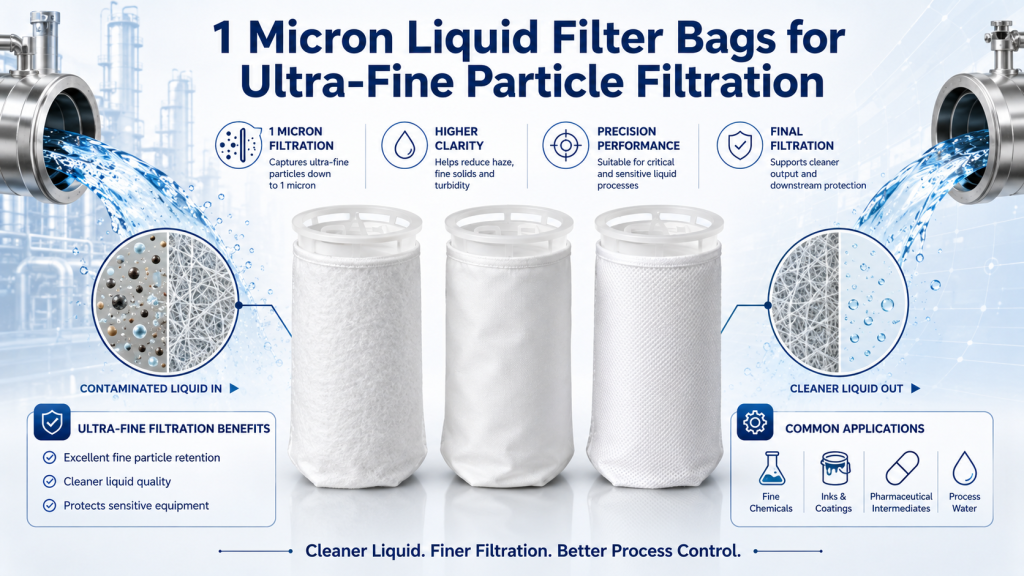
A 1 micron liquid filter bag is used when an industrial process requires substantially finer particle control than conventional 5, 10, 25 or 50 micron filtration can provide.
At this filtration level, the objective is often no longer simple sediment removal. Instead, 1 micron filtration is commonly used for liquid polishing, fine suspended-particle reduction and protection of sensitive downstream equipment.
However, selecting a 1 micron filter bag does not automatically guarantee absolute removal of every particle larger than 1 µm.
Actual filtration performance depends on the media construction, filtration efficiency, contaminant loading, flow rate and operating conditions.
INCE filtration manufactures 1 micron liquid filter bags in multiple filtration media and customized configurations for industrial water, chemicals, coatings, oils and process-liquid filtration. For applications specifically using felt media, see our 1 Micron Needle Felt Filter Bags guide.
What Does 1 Micron Mean in Liquid Filtration?
One micron, or micrometer (µm), equals:
0.001 mm
Therefore:
1 micron = 0.001 millimeter
A 1 micron filtration grade is considerably finer than common industrial bag filtration levels.
For comparison:
| Filter Rating | Relative Filtration |
|---|---|
| 1 micron | Ultra-fine |
| 5 micron | Fine |
| 10 micron | Fine process filtration |
| 25 micron | Fine to medium |
| 50 micron | Medium |
| 100 micron | Coarse |
A 1 micron filter bag may be used to reduce extremely small suspended contaminants that pass through coarser filtration stages.
Possible contaminants include:
- Fine sediment
- Small precipitated solids
- Fine metal particles
- Process debris
- Fine agglomerates
- Rust fines
- Suspended manufacturing contamination
The exact retention performance depends on the filter media and rating method.
When Should You Use a 1 Micron Liquid Filter Bag?
A 1 micron bag should normally be selected because the process genuinely requires very fine particle control.
Typical situations include:
- 5 micron filtration does not provide sufficient liquid clarity
- Fine contaminants affect downstream equipment
- A final polishing stage is required
- Small suspended solids affect product quality
- Sensitive nozzles, pumps or instruments require additional protection
- Liquid must be cleaned before a more critical downstream filtration stage
In many systems, a 1 micron bag works best after larger particles have already been removed.
This is an important distinction.
A 1 micron filter bag should not automatically be used as the first filtration stage simply because it provides a finer rating.
1 Micron vs. 5 Micron Filter Bags
The practical difference between 1 and 5 micron filtration can be significant.
| Feature | 1 Micron | 5 Micron |
| Filtration level | Ultra-fine | Fine |
| Particle control | Finer | Less fine |
| Flow resistance | Generally higher | Generally lower |
| Plugging risk | Higher | Lower |
| Pre-filtration value | Very high | High |
| Typical role | Final polishing | Fine/intermediate filtration |
Choose 1 micron when:
- 5 micron particles or smaller contaminants are causing problems
- Fine polishing is required
- Downstream equipment requires cleaner liquid
- The process can tolerate higher resistance
Choose 5 micron when:
- It already meets the required outlet quality
- Solids loading is relatively high
- Longer service life is more important than ultra-fine filtration
- 1 micron filtration provides no meaningful process benefit
The best filtration grade is not necessarily the smallest available micron number.
It is the coarsest filter that consistently meets the required cleanliness level.
Why 1 Micron Filtration Usually Needs Pre-Filtration
This is one of the most important design considerations.
Suppose a process liquid contains:
- Large particles above 100 µm
- Medium particles around 25–100 µm
- Fine particles around 5–25 µm
- Small amounts of contamination near 1 µm
If the entire liquid is sent directly through a 1 micron bag, that bag must capture almost the complete solids load.
This can cause:
- Rapid filter loading
- Higher differential pressure
- Reduced flow
- Frequent bag replacement
- Increased labor
- Higher filtration cost
A staged arrangement may perform much better.
For example:
100 micron → 25 micron → 5 micron → 1 micron
or:
50 micron bag → 5 micron bag → 1 micron polishing stage
The exact configuration depends on particle-size distribution and required outlet quality.
The principle is simple:
Remove larger particles before asking a 1 micron filter to perform the final fine-filtration work.
Is a 1 Micron Filter Bag an Absolute Filter?
Not necessarily.
This is one of the most important technical points at very low micron ratings.
Many conventional felt bags are nominally rated.
A nominal 1 micron filter bag may reduce particles around the stated filtration range, but that does not automatically mean it removes 100% of particles larger than exactly 1 µm.
Actual filtration performance depends on:
- Media construction
- Fiber size
- Media thickness
- Graded-density structure
- Particle shape
- Flow rate
- Test method
For critical applications, buyers should ask:
- Is the rating nominal or absolute?
- What is the stated retention efficiency?
- What test method supports the rating?
- Is a standard felt bag suitable as the final filtration stage?
Global Filter, for example, distinguishes conventional felt bags from high-efficiency microfiber bags and lists high-efficiency media with defined efficiency levels up to 95%.
For highly critical particle control, a high-efficiency filter bag or cartridge may therefore be more appropriate than relying only on a standard nominal 1 micron felt bag.
Standard Felt vs. High-Efficiency Media at 1 Micron
At 1 micron, media construction becomes increasingly important.
Standard Needle Felt
Needle felt works as depth filtration.
Particles can be captured:
- At the surface
- Between fibers
- Inside the media thickness
Advantages include:
- Good dirt-holding capacity
- Economical replacement
- Broad industrial use
- Multiple material options
Standard felt is often suitable for general fine polishing where absolute particle cut-off is not required.
High-Efficiency Microfiber Media
High-efficiency filter bags may use finer fibers, multiple layers or graded-density structures.
These designs can provide:
- Better retention consistency
- Higher efficiency at small particle sizes
- Improved fine-particle control
- More defined filtration performance
Some high-performance commercial bag filters are even available in sub-micron, absolute-rated configurations for critical process applications.
Therefore, “1 micron” should always be evaluated together with efficiency, not treated as a complete specification by itself.
Polypropylene 1 Micron Filter Bags
Polypropylene is a common material for industrial 1 micron filtration.
PP felt offers:
- Good compatibility with many acids and alkalis
- Economical replacement
- Low moisture absorption
- Good general industrial performance
- Depth-filtration capability
Common applications include:
- Process water
- Chemical solutions
- Electroplating liquids
- Cleaning systems
- Compatible coatings
- Industrial recirculation systems
INCE filtration supplies 1 micron polypropylene filter bags as part of its fine-filtration range.
For full PP product specifications, dimensions and ring options, the dedicated INCE filtration 1 micron product page should be used rather than duplicating those specifications here.
Polyester 1 Micron Filter Bags
Polyester is another widely used media for very fine liquid filtration.
It may be preferred where the application requires:
- Greater abrasion resistance
- Higher mechanical strength
- Higher operating-temperature capability than standard PP
- Compatibility with selected oils or process liquids
PRM, for example, currently sells 1 micron polyester felt filter bags in standard industrial bag sizes, illustrating the widespread use of polyester at this filtration grade.
Typical applications include:
- Oils
- Coatings
- Industrial water
- Process chemicals
- Manufacturing fluids
Chemical compatibility should always be verified before selecting polyester.
PTFE 1 Micron Filter Bags
PTFE may be considered where:
- Aggressive chemicals are involved
- Higher temperatures are present
- PP or polyester compatibility is insufficient
- Process cleanliness requirements justify specialty media
PTFE is generally selected because of its chemical and thermal properties rather than because 1 micron filtration itself requires PTFE.
The correct choice depends on the liquid and operating conditions.
Applications of 1 Micron Liquid Filter Bags
Final Process Water Polishing
Coarse filtration may leave fine suspended particles in industrial water.
A 1 micron bag can be used as a polishing stage before:
- Final use
- Sensitive equipment
- Downstream cartridges
- Membrane systems
It is generally more effective when upstream solids have already been reduced.
Chemical Processing
Fine insoluble contamination can come from:
- Raw materials
- Precipitation
- Storage tanks
- Pipelines
- Reaction by-products
A 1 micron filtration stage can help reduce these contaminants before transfer, filling or downstream treatment.
Media compatibility must be verified against the actual chemical.
Paints and Coatings
Fine contaminants can affect:
- Surface finish
- Product appearance
- Spray equipment
- Application quality
A 1 micron filter bag may be considered for selected coatings requiring very fine polishing.
However, formulated products require special care.
A filter that is too fine may retain desirable pigment or formulation components.
The product particle distribution should therefore be evaluated before moving to 1 micron filtration.
Oils and Lubricants
Ultra-fine filtration may help reduce fine particles in compatible industrial oils.
However, viscosity can become a major limitation.
A 1 micron filter passing water and the same filter passing a viscous oil may behave very differently.
For oil filtration, evaluate:
- Viscosity
- Temperature
- Flow requirement
- Filtration area
- Allowable pressure drop
Increasing filtration area or using staged filtration may be necessary.
Electronics and Sensitive Manufacturing
Fine process liquids used in electronics and precision manufacturing may require tighter particle control than ordinary industrial processes.
A 1 micron bag can be used as a pre-polishing or intermediate filtration stage where appropriate.
For applications requiring tightly validated removal efficiency, a membrane or high-efficiency cartridge may still be required downstream.
1 Micron Filter Bags Before RO Systems
A 1 micron bag may form part of a larger RO pretreatment system, but it should not automatically be treated as the universal final protection stage for an RO membrane.
A typical system may use:
Coarse filtration → Bag filtration → Fine cartridge filtration → RO
The exact pretreatment design depends on:
- Feed-water quality
- Suspended solids
- SDI
- Membrane requirements
- System flow
- Cartridge design
Bag filtration can reduce the contaminant burden before more precise downstream elements.
How Flow Rate Changes at 1 Micron
As filtration becomes finer, flow resistance generally increases.
A 1 micron filter has smaller effective flow paths than a 10, 25 or 50 micron grade of similar construction.
At the same system flow, this can result in:
- Higher initial pressure drop
- Faster differential-pressure increase
- Shorter service life
- Greater pump demand
This does not mean 1 micron filtration is inefficient.
It means that the system must provide enough filtration area for the required flow.
For high-flow systems, designers may need:
- Larger filter housings
- Multiple bags
- Parallel housings
- Upstream coarse filtration
rather than forcing the entire flow through one small fine filter.
What Determines 1 Micron Filter Bag Life?
There is no universal replacement interval.
Service life depends on several variables.
Solids Loading
The more contamination present, the faster the bag fills.
Particle Distribution
If large amounts of particles are above 1 micron, the fine filter may load very quickly.
Filter Area
More media area generally means a lower solids load per unit area.
Liquid Viscosity
Higher viscosity creates greater resistance.
Flow Rate
Excessive flow can increase differential pressure.
Upstream Filtration
Proper pre-filtration can dramatically extend service life.
In industrial systems, operators should normally monitor differential pressure rather than changing 1 micron bags purely according to calendar time.
When Should You Not Use a 1 Micron Filter Bag?
A 1 micron bag is not appropriate for every fine-filtration problem.
Consider a coarser filter when:
- 5 or 10 micron already meets process requirements
- Solids loading is high
- Maximum flow is more important
- Ultra-fine particle removal provides no product benefit
Consider a different filtration technology when:
- Absolute or validated retention is required
- Sterile filtration is required
- Critical particles are significantly below 1 micron
- Membrane-level separation is necessary
- Tight beta-ratio performance is required
In these cases, a high-efficiency cartridge or membrane filter may be a more appropriate final stage.
How to Specify a 1 Micron Liquid Filter Bag
A complete specification should include more than “1 micron.”
Provide:
- Micron rating: 1 µm
- Required efficiency: nominal or defined high efficiency
- Filter media: PP, polyester, PTFE or other
- Bag dimensions
- Ring or collar design
- Seam construction
- Liquid being filtered
- Particle contamination
- Flow rate
- Viscosity
- Operating temperature
- Operating pressure
- Required quantity
This is especially important at 1 micron because media efficiency can have a significant impact on actual particle retention.
1 Micron Liquid Filter Bag FAQ
Is 1 micron finer than 5 micron?
Yes. A 1 micron filter grade is five times smaller in nominal particle-size scale than a 5 micron grade and is used for much finer filtration.
Does a 1 micron filter bag remove bacteria?
A conventional 1 micron bag should not be assumed to provide sterile or microbiological filtration. Bacteria vary in size, and reliable microbial removal requires an appropriately validated filtration system.
Does a 1 micron bag remove every particle larger than 1 micron?
Not necessarily. Standard felt bags are often nominally rated. Actual efficiency depends on the media and filter design.
Is 1 micron suitable for final liquid polishing?
Yes, in many industrial processes a 1 micron bag can be used as a polishing stage after larger particles have already been removed.
Should I use 1 micron or 5 micron?
Use 1 micron only when the process needs finer particle control than 5 micron provides. If 5 micron already produces acceptable cleanliness, it may offer longer life and lower pressure drop.
Can a 1 micron filter bag be used before RO?
Yes, it may be part of an RO pretreatment train, but the overall pretreatment design should follow feed-water quality and membrane requirements.
Which material is best for 1 micron filtration?
PP is common for economical general-purpose filtration, polyester can provide stronger mechanical and temperature performance, and PTFE is suited to more demanding chemical or thermal conditions.
Can INCE filtration manufacture custom 1 micron filter bags?
Yes. INCE filtration can provide multiple media, sizes, ring styles, seam constructions and OEM configurations for 1 micron industrial filtration.
Ultra-Fine Particle Filtration with 1 Micron Filter Bags
A 1 micron liquid filter bag is most effective when it is used for a clearly defined fine-filtration objective.
The correct system should balance:
1 micron retention + filtration efficiency + media compatibility + flow + viscosity + contaminant load + pre-filtration
For many industrial processes, 1 micron filtration works best as a final bag-filtration or polishing stage, not as the first filter exposed to heavily contaminated liquid.
If absolute or tightly controlled particle removal is required, the system may need a high-efficiency bag or downstream cartridge rather than relying only on conventional nominal felt media.
INCE filtration manufactures 1 micron liquid filter bags in PP, polyester, PTFE and customized constructions for fine industrial liquid filtration.
For detailed product specifications, standard sizes and ring configurations, refer to the dedicated INCE filtration 1 Micron Filter Bags product page.
For application selection, provide INCE filtration with your:
Liquid type
Target contaminant
Required retention level
Current filtration stage
Flow rate
Temperature
Viscosity
Existing bag dimensions
INCE filtration can help determine whether a 1 micron filter bag is suitable or whether a different filtration stage would provide better overall performance.
Contact INCE filtration for 1 micron filter bag selection, replacement matching, OEM manufacturing or a custom quotation.
 WhatsApp