
A 100 micron liquid filter bag is commonly used as a protective filtration stage in industrial process systems where the main objective is to remove larger suspended solids before they reach pumps, nozzles, heat exchangers, finer filters or downstream equipment.
At 100 µm, the filtration goal is usually not fine liquid polishing.
Instead, the filter is used to control debris that can interfere with equipment operation, increase maintenance or overload finer filtration stages.
This makes 100 micron filtration particularly useful for:
- Process-water protection
- Coarse solids removal
- Cooling-water filtration
- Equipment protection
- Batch transfer filtration
- Industrial liquid screening
- Pre-filtration before finer bags or cartridges
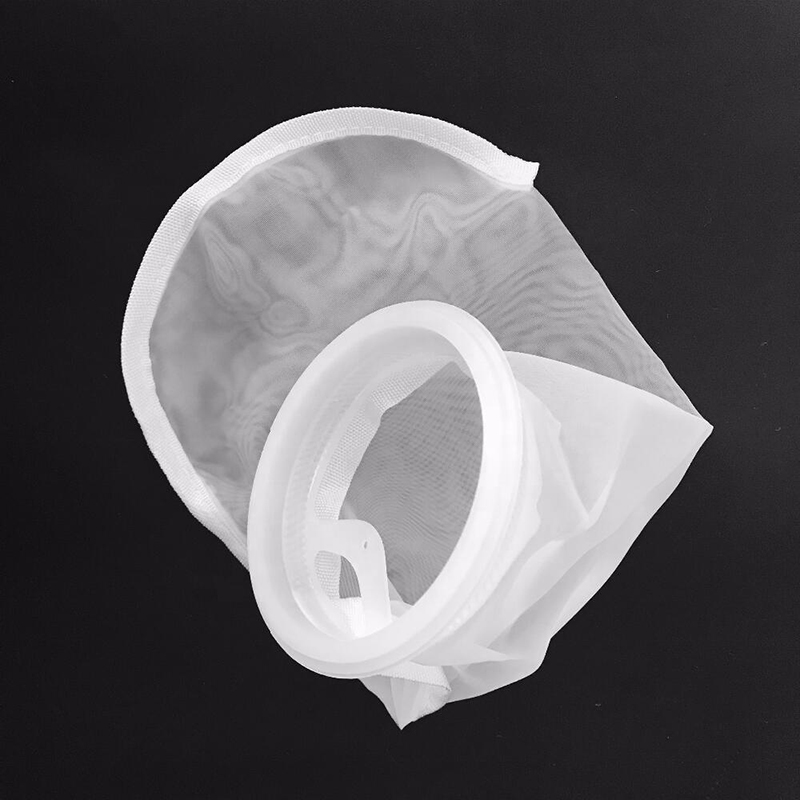
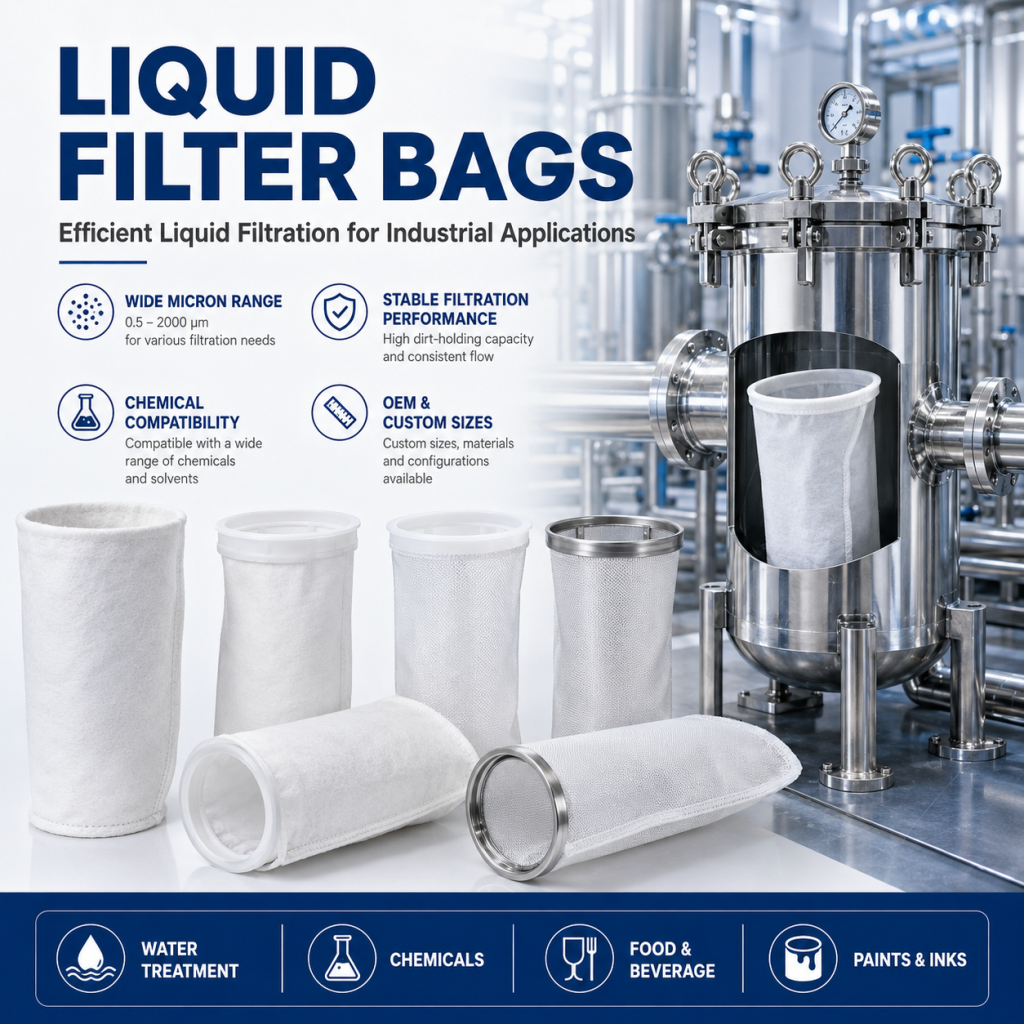
INCE filtration manufactures 100 micron filter bags in multiple filtration media, including polypropylene, polyester, nylon and PTFE, for industrial liquid filtration systems.
What Does 100 Micron Filtration Actually Do?
One micron equals 0.001 millimeter.
Therefore:
100 micron = 0.100 mm
This places 100 µm firmly in the coarse-to-medium industrial filtration range.
Typical contaminants targeted at this level may include:
- Rust flakes
- Pipe scale
- Tank debris
- Metal chips
- Paint skins
- Resin agglomerates
- Fibers
- Coarse sediment
- Process residues
- Larger suspended solids
The purpose is generally to remove particles large enough to create a mechanical or process problem.
A 100 micron bag should therefore be selected based on what the downstream process can tolerate, rather than simply choosing it because it offers high flow.
Why 100 Micron Is Often Used for Pre-Filtration
Fine filters are expensive when they are forced to capture large amounts of coarse debris.
Suppose a process ultimately requires 10 micron filtration but the incoming liquid contains substantial particles above 100 µm.
Sending everything directly to a 10 micron filter means the fine media must capture both:
- Large contaminants
- Fine contaminants
That uses filter capacity inefficiently.
A more practical arrangement can be:
100 micron pre-filter → 10 or 25 micron final filtration
The 100 micron stage removes larger solids first.
The downstream filter can then focus on smaller particles.
This can help improve:
- Fine-filter service life
- Process stability
- Filter-change frequency
- Consumable cost
- Downstream equipment protection
This upstream-protection role is also how INCE filtration currently positions its main 100 micron range.
75 vs. 100 vs. 200 Micron Filtration
The best grade depends on the size of contamination the process can safely tolerate.
| Requirement | 75 Micron | 100 Micron | 200 Micron |
|---|---|---|---|
| Medium particle control | Strong | Good | Limited |
| Coarse solids removal | Good | Very suitable | Excellent |
| Upstream protection | Strong | Balanced | Basic |
| Heavy debris loading | Moderate | Good | Very good |
| Fine downstream filter protection | Strong | Very suitable | Moderate |
| General process screening | Good | Very suitable | Coarser |
Choose 75 micron when:
Smaller medium-sized contaminants still need to be controlled.
Choose 100 micron when:
You want a practical balance between solids removal, equipment protection and process throughput.
Choose 200 micron when:
The process mainly contains large debris and maximum coarse-solids handling is more important than tighter particle control.
A Better Way to Select 100 Micron: Start with the Equipment
For many industrial applications, the most useful selection question is:
What size particle can damage or block the downstream equipment?
For example, consider:
- Spray nozzles
- Pump passages
- Heat-exchanger channels
- Control valves
- Fine cartridge filters
If particles near or above 100 µm can interfere with these components, a 100 micron upstream filter may provide useful protection.
This equipment-based approach is often more meaningful than selecting a filter solely according to liquid appearance.
Protecting Pumps
Pumps can be exposed to:
- Hard particles
- Rust flakes
- Metal debris
- Tank contamination
Depending on pump design, these solids can contribute to:
- Wear
- Seal damage
- Reduced performance
- Maintenance problems
A 100 micron bag upstream can remove larger debris before it reaches the pump.
This does not replace all pump-protection measures, but it can reduce unnecessary solids loading.
Protecting Spray Nozzles
Spray systems are sensitive to particle blockage.
The correct filter rating depends on nozzle-orifice size and the process liquid.
A 100 micron filter can be useful where:
- Larger debris causes intermittent blockage
- Fine suspended solids are acceptable
- Maintaining flow is important
If nozzle openings are very small, a finer downstream stage may still be required.
Protecting Heat Exchangers
Cooling and process liquids can carry solids that gradually accumulate inside heat-exchanger passages.
Common contamination includes:
- Scale
- Rust
- Sediment
- Process debris
A 100 micron filter installed upstream can reduce larger solids before they enter the exchanger.
This can be particularly useful in:
- Cooling-water loops
- Industrial recirculation systems
- Utility-water circuits
The correct micron grade depends on channel size and contamination type.
100 Micron Nylon Mesh for Surface Screening
Nylon monofilament mesh is highly relevant at 100 micron.
INCE filtration already manufactures a dedicated 100 micron nylon liquid filter bag range using nylon material, a defined 100 µm opening and stitching-sewn construction, with multiple industrial sizes and ring-top options.
Nylon mesh primarily works through surface filtration.
Particles larger than the mesh openings are retained near the media surface.
This can be useful for:
- Liquid straining
- Coarse screening
- Paint and coating filtration
- Food-process straining
- Industrial water
- Reusable filtration applications
The relatively defined mesh opening makes nylon particularly useful where physical particle screening is the main objective.
100 Micron Felt for Depth Loading
Felt behaves differently.
Rather than relying only on a defined surface opening, felt creates a three-dimensional network of fibers.
Particles can become trapped:
- At the surface
- Between fibers
- Deeper inside the media
This depth-filtration behavior may be useful when the process contains a broad range of particle sizes.
At 100 micron, felt can be considered when:
- Dirt-holding capacity is important
- Particle sizes are irregular
- Contamination is not uniform
- Disposable filtration is preferred
The choice between mesh and felt therefore depends on the contaminant structure, not simply the micron number.
Mesh vs. Felt at 100 Micron
| Feature | Nylon Mesh | Felt |
|---|---|---|
| Filtration mechanism | Surface screening | Depth filtration |
| Opening behavior | More defined | Nominal media behavior |
| Particle loading | Mainly on surface | Throughout media depth |
| Cleaning potential | Often better | Usually treated as disposable |
| Broad particle distribution | Moderate | Good |
| Uniform coarse particles | Very suitable | Suitable |
| Main strength | Screening | Dirt holding |
For relatively uniform larger particles, mesh can be very effective.
For mixed or irregular contamination, felt may provide better depth loading.
Process Water Pre-Filtration
Industrial process water may contain:
- Sediment
- Rust
- Scale
- Tank contamination
- Pipeline debris
A 100 micron bag can be installed early in the treatment process to reduce this coarse solids load.
Typical downstream equipment might include:
- Pumps
- Sand or multimedia filters
- Fine cartridges
- Heat exchangers
- Membrane pretreatment systems
The 100 micron stage is not intended to produce final purified water.
Its job is to remove larger contamination before finer treatment becomes more expensive or sensitive.
Cooling-Water Systems
Cooling-water systems often involve large continuous circulation volumes.
Fine filtration may not always be necessary.
The process may simply need to prevent:
- Larger solids accumulation
- Heat-exchanger fouling
- Pump contamination
- Pipe debris recirculation
A 100 micron filtration stage can provide a practical coarse-solids barrier while maintaining process throughput.
If finer suspended solids later become a problem, an additional downstream stage can be added.
Paints and Coatings
Paint and coating processes often generate or collect:
- Skins
- Agglomerates
- Dried particles
- Mixing-tank debris
- Foreign contamination
A 100 micron bag can act as a screening stage before:
- Transfer
- Packaging
- Filling
- Downstream filtration
This grade is often useful when the objective is to remove larger defects rather than produce fine polishing.
For formulations containing large pigments or functional particles, using too fine a filter can create product problems.
Resin and Adhesive Processing
Viscous resins and adhesives can contain:
- Cured fragments
- Gel particles
- Tank skins
- Foreign debris
Fine filtration can create excessive resistance in these fluids.
A 100 micron filter can provide coarse defect removal without imposing the same restriction as much finer media.
For high-viscosity applications, important factors include:
- Process temperature
- Flow requirement
- Filter area
- Pump capability
Micron rating should therefore be selected together with fluid rheology.
Metalworking and Parts Cleaning
Metalworking fluids can accumulate larger contamination such as:
- Chips
- Grinding debris
- Rust
- Dirt
- Cleaning residues
A 100 micron filter bag can be used as an upstream solids-removal stage before the fluid reaches more sensitive filtration or recirculation equipment.
Where fine metal particles also need control, the system can use a second stage.
For example:
100 micron bag → 20 micron bag
or:
100 micron screening → fine cartridge
Batch Transfer Filtration
Not every process needs continuous filtration.
During batch transfer, liquids can pick up contamination from:
- Mixing tanks
- Pipelines
- Raw-material handling
- Storage vessels
A 100 micron filter bag can be temporarily installed during transfer to intercept larger debris before the product reaches another tank or filling process.
This can be a simple and economical quality-control step.
Why Particle Shape Matters at 100 Micron
Industrial particles are not always round.
They may be:
- Flat
- Fibrous
- Long
- Flexible
- Irregular
- Soft
A long fiber may pass through an opening differently from a rigid spherical particle of similar nominal size.
This means the micron rating should be treated as a filtration reference, not a perfect prediction of every contaminant.
For difficult applications, examining captured solids or performing a filtration trial can produce better results than selecting solely from a micron chart.
When 100 Micron Is Too Fine
A coarser grade such as 150 or 200 micron may be more appropriate when:
- Only very large debris needs removal
- Solids concentration is extremely high
- Finer particle control adds no process value
- Filter loading is unnecessarily frequent
In that situation, 100 micron may be doing more filtration than the process actually requires.
When 100 Micron Is Too Coarse
Consider 75, 50 or 25 micron filtration when:
- Medium particles still damage equipment
- Product defects remain
- Downstream filters load too quickly
- Nozzles still block
- Liquid cleanliness is insufficient
If very fine particle control is required, 10 micron or finer filtration may eventually be needed.
The correct grade should therefore be evaluated according to the failure mode the process is trying to prevent.
How to Tell If Your 100 Micron Stage Is Working
The effectiveness of coarse filtration can be measured through process results.
Monitor:
- Amount of captured solids
- Downstream filter life
- Pump maintenance
- Nozzle blockage
- Heat-exchanger cleaning frequency
- Product contamination
- Process interruptions
A successful 100 micron stage should reduce problems downstream without causing unnecessary filter changes upstream.
100 Micron Filtration as Part of a Multi-Stage System
A staged filtration system does not need every possible micron level.
The goal is to make each stage perform a specific job.
Examples include:
100 micron → 25 micron
for general two-stage filtration.
200 micron → 100 micron → 20 micron
for heavily contaminated process liquids.
100 micron mesh → 10 micron cartridge
where larger solids need screening before finer final filtration.
The ideal sequence depends on the actual particle-size distribution.
Adding unnecessary stages can increase equipment cost without providing meaningful process benefits.
How to Specify a 100 Micron Pre-Filter
For application selection, provide:
- Liquid type
- Main contaminant
- Approximate contaminant size
- Required downstream cleanliness
- Equipment being protected
- Flow rate
- Liquid viscosity
- Operating temperature
- Existing housing dimensions
- Preferred filter media
- Whether cleaning or disposal is preferred
- Required quantity
For replacement products, also provide the existing bag dimensions and ring or collar type.
100 Micron Process Filtration FAQ
What is a 100 micron filter bag used for?
It is commonly used for coarse solids removal, process pre-filtration and protection of downstream equipment such as pumps, nozzles, heat exchangers and finer filters.
Is 100 micron considered fine filtration?
No. In most industrial liquid-filtration systems, 100 micron is considered a coarse or pre-filtration grade.
Is 100 micron finer than 200 micron?
Yes. A 100 micron filter provides tighter particle control than a 200 micron filter.
Is 100 micron coarser than 75 micron?
Yes. A 75 micron filter removes somewhat smaller particles.
Is nylon mesh good for 100 micron filtration?
Yes. Nylon monofilament is widely used at this rating for surface screening and liquid straining. INCE filtration has a dedicated 100 micron nylon mesh range.
Should I use felt or mesh?
Choose mesh for more defined surface screening and felt where depth loading and broader particle capture are more important.
Can 100 micron filtration protect a fine cartridge?
Yes. Removing larger solids upstream can reduce the contaminant load reaching finer downstream cartridges.
Can INCE filtration supply 100 micron filter bags?
Yes. INCE filtration supplies 100 micron bags in PP, polyester, nylon, PTFE and customized media for industrial filtration applications.
Using 100 Micron Filtration as an Upstream Protection Stage
A 100 micron liquid filter bag is most valuable when it performs a clearly defined upstream job.
Rather than trying to polish the liquid, it removes larger contamination before that contamination creates problems elsewhere in the process.
Typical roles include:
- Protecting pumps
- Protecting spray nozzles
- Reducing heat-exchanger debris
- Removing tank contamination
- Screening process liquids
- Extending downstream filter life
- Supporting batch transfer
The most important decision at 100 micron is often not the micron number itself, but whether the process needs mesh surface screening or felt depth filtration.
INCE filtration already manufactures 100 micron liquid filter bags in multiple media and has dedicated nylon mesh configurations for industrial screening applications.
For exact dimensions, ring options and model specifications, refer to the existing INCE filtration 100 Micron Filter Bags and 100 Micron Nylon Liquid Filter Bags product pages rather than duplicating those specifications here.
For process selection, provide INCE filtration with your:
Liquid type
Contaminant description
Equipment being protected
Current filtration stage
Flow requirement
Viscosity
Existing housing information
INCE filtration can help determine whether 100 micron filtration provides the right upstream protection or whether a finer or coarser stage would be more appropriate.
Contact INCE filtration for process pre-filtration selection, replacement filter bags, OEM supply or customized filtration solutions.
 WhatsApp