
A 20 micron liquid filter bag is a practical choice for industrial fluid filtration when 25 or 50 micron filtration is too coarse, but 5 or 10 micron filtration creates more resistance or shorter service life than the process requires.
This makes 20 µm a useful intermediate filtration grade for removing fine suspended solids from water, coolants, cleaning fluids, chemicals, coatings and other compatible process liquids.
However, micron rating alone does not determine filtration performance.
A successful 20 micron filtration system must also consider:
- Filter media
- Nominal or absolute efficiency
- Particle distribution
- Solids concentration
- Liquid viscosity
- Required flow rate
- Differential pressure
- Filter housing size
INCE filtration manufactures industrial liquid filter bags in multiple media and micron ratings, including dedicated 20 micron polypropylene configurations for fine process filtration.
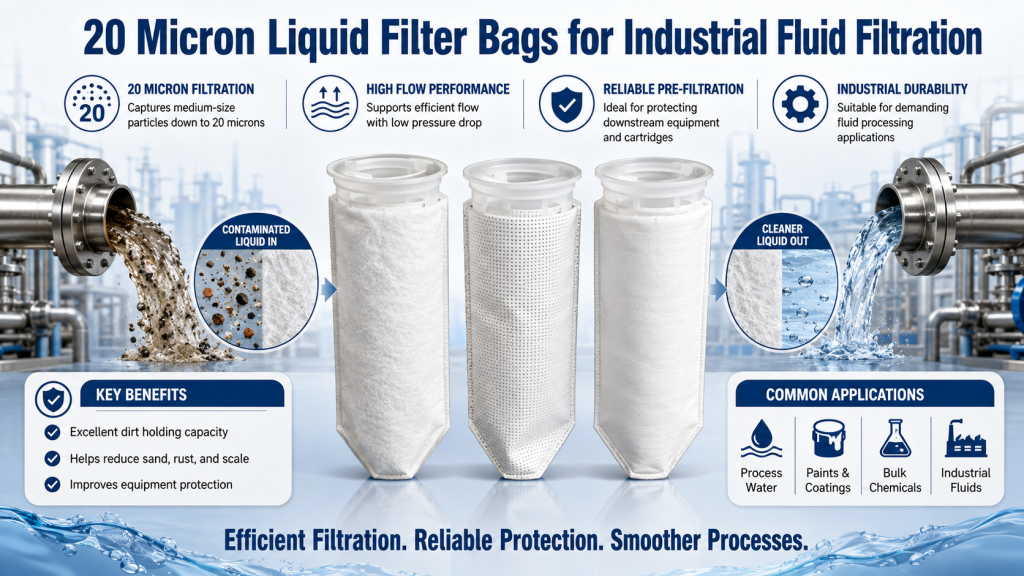
What Does 20 Micron Mean in Liquid Filtration?
One micron, or micrometer (µm), equals 0.001 millimeter.
Therefore:
20 micron = 0.020 mm
A 20 micron liquid filter bag is designed for removing relatively fine suspended contamination from industrial liquids.
Typical contaminants may include:
- Fine sediment
- Rust particles
- Metal fines
- Process debris
- Small agglomerates
- Precipitated solids
- Tank contamination
- Fine manufacturing residues
For comparison:
| Micron Rating | Relative Filtration |
|---|---|
| 5 micron | Fine |
| 10 micron | Fine process filtration |
| 20 micron | Fine-to-medium |
| 25 micron | Fine-to-medium |
| 50 micron | General filtration |
| 100 micron | Coarse / pre-filtration |
Twenty micron filtration is therefore positioned between conventional fine polishing and general process filtration.
Why Choose 20 Micron Instead of 10 or 25 Micron?
The value of 20 micron filtration is that it provides a useful compromise.
Compared with 10 micron
A 20 micron filter is coarser.
This can provide:
- Lower filtration resistance
- Longer service life
- Better performance with higher solids loading
- Fewer filter changes
when 10 micron retention is unnecessary.
Compared with 25 micron
A 20 micron filter provides slightly finer particle control.
It can be useful when 25 micron filtration allows small contaminants to pass but moving directly to 10 micron would be more restrictive than necessary.
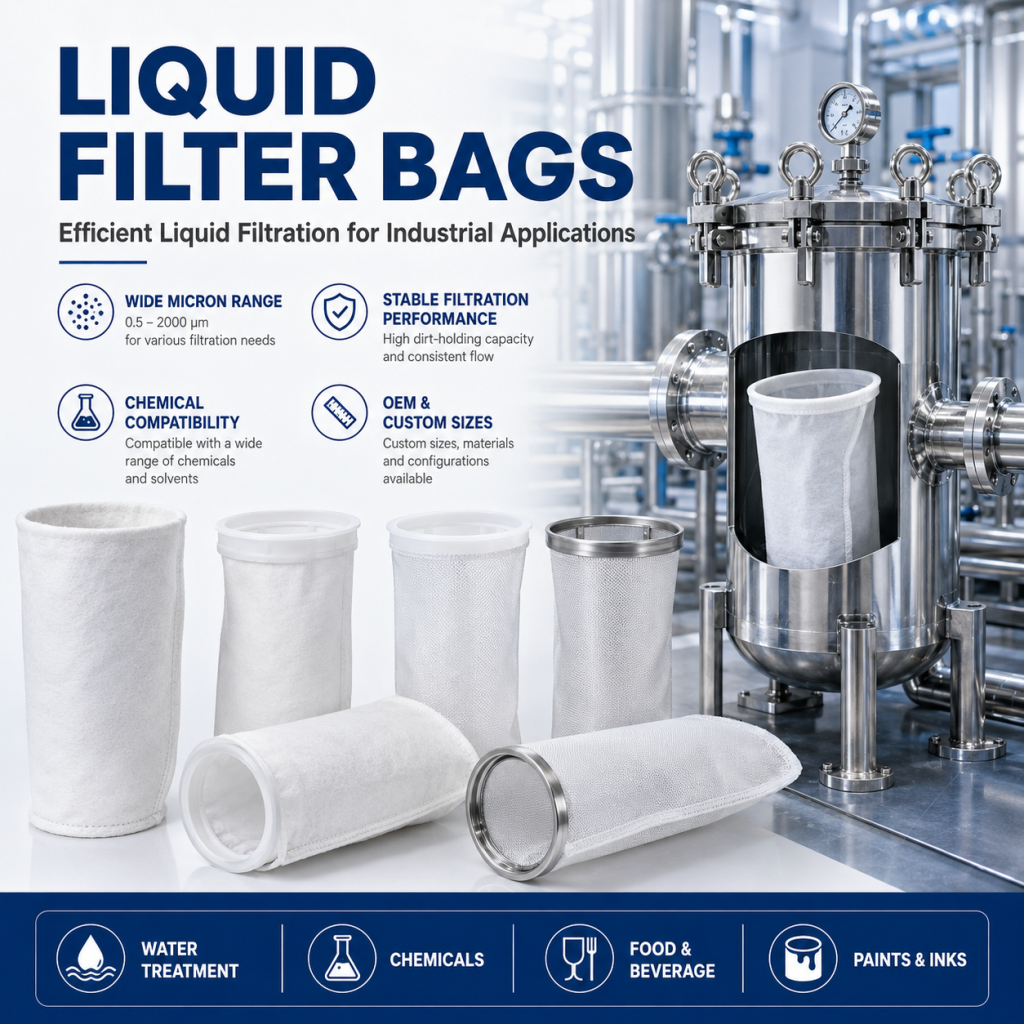
10 vs. 20 vs. 25 Micron Filter Bags
| Feature | 10 Micron | 20 Micron | 25 Micron |
| Filtration level | Fine | Fine-to-medium | Fine-to-medium |
| Relative resistance | Higher | Moderate | Slightly lower |
| Fine particle removal | Stronger | Balanced | Slightly coarser |
| Solids tolerance | Moderate | Good | Good |
| Typical role | Fine filtration | Industrial process filtration | General fine filtration |
Choose 10 micron when fine contamination genuinely affects the process.
Choose 20 micron when you need finer control than 25 micron but want to maintain practical flow and bag life.
Choose 25 micron when slightly coarser filtration already meets the process requirement.
The best rating is the coarsest filter that reliably produces the required result.
Where Are 20 Micron Filter Bags Used?
Twenty micron filtration has practical applications across industrial systems.
Industrial Process Water
Process water often contains:
- Rust
- Pipe scale
- Sediment
- Suspended solids
- Process debris
A 20 micron bag can be used where 50 or 100 micron filtration leaves too much fine contamination.
Possible applications include:
- Plant process water
- Cooling-water side streams
- Equipment wash water
- Recycled water
- Utility water
Parts Washer and Cleaning Fluid Filtration
Industrial parts washers continuously accumulate:
- Metal particles
- Dirt
- Abrasive contamination
- Process residues
Twenty micron bags are used in real parts-washing equipment as replacement filters for maintaining cleaner washing solutions. For example, Jenfab currently offers a 20 micron polypropylene felt filter bag specifically for aqueous parts washers.
A 20 micron grade can provide a useful balance between removing fine contaminants and maintaining circulation flow.
Coolant and Metalworking Fluid Filtration
Machining coolants can collect:
- Metal fines
- Grinding debris
- Dirt
- Abrasive particles
Twenty micron filtration may help maintain fluid cleanliness and reduce contaminants reaching:
- Pumps
- Nozzles
- Heat exchangers
- Machine components
Master Fluid Solutions also lists a disposable 20 micron filtration option for coolant and cleaner handling equipment, demonstrating this micron grade’s practical use in metalworking fluids.
For heavily contaminated coolant, coarse upstream filtration may still be necessary.
Chemical Processing
A 20 micron liquid filter bag can be used to remove suspended solids from compatible chemical streams.
Contamination may come from:
- Raw materials
- Reactions
- Storage tanks
- Transfer piping
- Precipitation
- Packaging processes
Material compatibility must always be confirmed.
Polypropylene is widely used with many compatible chemical solutions, while polyester or specialty media may be more suitable in other conditions.
Paints, Coatings and Inks
Coatings can contain:
- Agglomerates
- Skins
- Foreign particles
- Process debris
Twenty micron filtration can be a useful intermediate grade where 25 or 50 micron filtration is too coarse but 5 or 10 micron filtration risks excessive pressure drop or unwanted retention.
Important factors include:
- Pigment size
- Product viscosity
- Required finish
- Flow rate
- Application equipment
A micron grade should not be selected without considering the actual formulation.
Industrial Clarification Systems
Twenty micron filter bags are also used in industrial clarification equipment.
For example, BWT documentation specifies 20 micron bags in clarifier systems designed to remove suspended contamination while monitoring filter head loss.
This illustrates an important operating principle:
Filter bag replacement should often be based on differential pressure or head loss rather than a fixed calendar schedule.
Polypropylene 20 Micron Filter Bags
Polypropylene is one of the most common materials for 20 micron industrial liquid filtration.
PP felt provides depth filtration through a three-dimensional fiber structure.
Typical benefits include:
- Good compatibility with many industrial chemicals
- Good dirt-holding capability
- Low moisture absorption
- Economical replacement
- Broad process use
INCE filtration already has a dedicated 20 Micron PP Liquid Filter Bags range, including multiple actual sizes, ring-top options and sewn or welded constructions.
For complete PP dimensions and model numbers, the dedicated product page should be used rather than repeating those specifications in this article.
Polyester 20 Micron Filter Bags
Polyester may be considered where the process requires:
- Greater mechanical strength
- Good abrasion resistance
- Higher temperature capability than standard PP
- Compatibility with oils and selected process liquids
Typical applications include:
- Industrial oils
- Coatings
- Process water
- Automotive fluids
- Manufacturing liquids
The correct material depends on chemical and thermal conditions rather than micron rating alone.
Felt vs. Mesh at 20 Micron
Filter media structure also matters.
Felt Filter Bags
Needle felt works mainly through depth filtration.
Particles can be retained:
- On the surface
- Between fibers
- Within the thickness of the media
This usually provides useful dirt-holding capacity for industrial fluid filtration.
Mesh Filter Bags
Mesh primarily provides surface filtration through defined openings.
Twenty micron woven mesh can exist in specialized constructions, but standard industrial liquid bag filtration at this level is commonly associated with felt or other fine media.
The correct choice depends on whether the process needs depth loading or a more defined surface-screening mechanism.
Nominal vs. Absolute 20 Micron Filtration
A 20 micron rating does not necessarily mean every particle above 20 µm will be removed.
Many standard industrial felt bags are nominally rated.
Actual retention depends on:
- Media design
- Fiber distribution
- Flow rate
- Particle shape
- Solids loading
- Test method
For critical filtration, ask:
- Is the rating nominal or absolute?
- What retention efficiency is specified?
- Is test data available?
- Does the process require a high-efficiency final stage?
If tightly defined particle removal is required, a high-efficiency filter bag or cartridge may be more appropriate.
Why Solids Loading Matters
A 20 micron filter bag can perform well with moderate contamination, but high solids concentration can still shorten its service life.
If the liquid contains substantial quantities of particles above 50 or 100 micron, those particles consume filter capacity unnecessarily.
A staged arrangement may be better.
For example:
100 micron → 50 micron → 20 micron
or:
50 micron bag → 20 micron bag → fine cartridge
This allows the 20 micron bag to focus on the smaller particles it was selected to remove.
20 Micron Filtration Before Fine Cartridges
A 20 micron bag can also serve as pre-filtration before more expensive cartridges.
For example:
20 micron filter bag → 5 micron cartridge → final polishing
Potential benefits include:
- Reduced cartridge loading
- Longer cartridge life
- Lower consumable cost
- More stable differential pressure
- Easier handling of larger solids
This approach is particularly useful where a cartridge system alone is experiencing frequent plugging.
How Viscosity Affects 20 Micron Filtration
Water passes through filter media much more easily than oil, resin or thick coating.
As viscosity increases:
- Pressure drop increases
- Flow decreases
- Bag loading becomes more noticeable
- More filter area may be required
Therefore, a 20 micron filter used with a viscous industrial fluid may require a larger housing or multiple bags.
Important information includes:
- Fluid viscosity
- Operating temperature
- Required flow
- Pump capacity
- Allowable differential pressure
How to Extend 20 Micron Filter Bag Life
Several strategies can improve service life.
Remove Coarse Solids First
Use 50 or 100 micron pre-filtration when large particles are present.
Avoid Oversizing Flow
Excessive flow increases loading and pressure drop.
Increase Filtration Area
A larger bag or multi-bag housing reduces the contaminant load per unit of media.
Monitor Differential Pressure
A rapidly increasing pressure differential is a better indication of loading than time alone.
Select the Correct Media
Choose PP, polyester or another media according to liquid compatibility and operating temperature.
When Should You Not Use a 20 Micron Filter Bag?
Twenty micron filtration is not always the right solution.
Choose a coarser grade when:
- 50 micron already achieves the required result
- Solids loading is very high
- Maximum flow is the priority
Choose a finer grade when:
- 20 micron allows problematic contamination through
- Final liquid clarity is insufficient
- Sensitive downstream components need stronger protection
Consider a high-efficiency cartridge when:
- Defined removal efficiency is required
- Very fine polishing is necessary
- Absolute filtration performance is important
How to Specify a 20 Micron Liquid Filter Bag
A complete inquiry should include:
- Micron rating: 20 µm
- Filter material
- Required efficiency
- Bag diameter
- Bag length
- Ring or collar design
- Sewn or welded construction
- Fluid being filtered
- Target contaminant
- Flow rate
- Viscosity
- Operating temperature
- Operating pressure
- Required quantity
Providing the industrial fluid type is particularly important because the same 20 micron bag may behave very differently in water, coolant and oil.
20 Micron Liquid Filter Bag FAQ
What does a 20 micron filter bag remove?
It is used for removing relatively fine suspended solids such as sediment, rust, metal fines, process debris and small agglomerates. Actual retention depends on filter efficiency and media design.
Is 20 micron finer than 25 micron?
Yes. A 20 micron rating is slightly finer than 25 micron.
Is 20 micron coarser than 10 micron?
Yes. A 10 micron filter provides finer filtration but can also create greater resistance and load more rapidly.
What is a 20 micron filter bag used for?
Typical applications include process water, parts-washing fluids, machining coolants, chemicals, coatings and general industrial fluid filtration.
Is 20 micron good for coolant filtration?
It can be. Twenty micron filtration is used in metalworking and cleaning-fluid systems where fine debris needs to be reduced without moving to very fine filtration.
Is a 20 micron filter absolute?
Not automatically. Many felt bags are nominally rated. Ask for actual filtration efficiency when critical retention is required.
Can a 20 micron filter bag be used before a cartridge filter?
Yes. It can reduce solids loading before finer downstream cartridges and potentially extend cartridge service life.
Which material should I choose?
Polypropylene is widely used for compatible water and chemical applications, while polyester may provide advantages in abrasion resistance, strength or temperature capability.
Industrial Fluid Filtration at 20 Micron
A 20 micron liquid filter bag is most useful when an industrial process needs a balance between fine particle control, practical flow and reasonable service life.
It fits particularly well between 10 and 25 micron filtration.
The correct system should balance:
20 micron retention + media compatibility + fluid viscosity + solids loading + flow + pressure drop
For liquids with substantial coarse contamination, upstream filtration can reduce unnecessary loading.
For applications requiring finer or tightly controlled particle removal, a downstream cartridge or higher-efficiency filtration stage may still be required.
INCE filtration supplies industrial liquid filtration products across multiple micron grades and manufactures a dedicated range of 20 micron polypropylene liquid filter bags for compatible industrial applications.
For complete PP sizes, model codes, rings and seam configurations, refer to the dedicated INCE filtration 20 Micron PP Liquid Filter Bags product page.
For application selection, send INCE filtration your:
Fluid type
Target contamination
Current micron rating
Flow rate
Viscosity
Temperature
Existing bag dimensions
Required quantity
INCE filtration can help determine whether 20 micron filtration is appropriate and recommend a suitable filtration configuration.
Contact INCE filtration for industrial fluid filtration selection, OEM production or custom filter bag requirements.
 WhatsApp