
Choosing the correct liquid filter bag micron rating is not simply a matter of selecting the smallest micron number available. A finer filter bag may capture smaller particles, but it can also create higher pressure drop, fill with contaminants faster, reduce flow, and increase filter replacement costs.
For most industrial filtration systems, the correct micron rating is the one that removes the unwanted particles while maintaining an acceptable balance between filtration efficiency, flow rate, pressure drop, filter life, and operating cost.
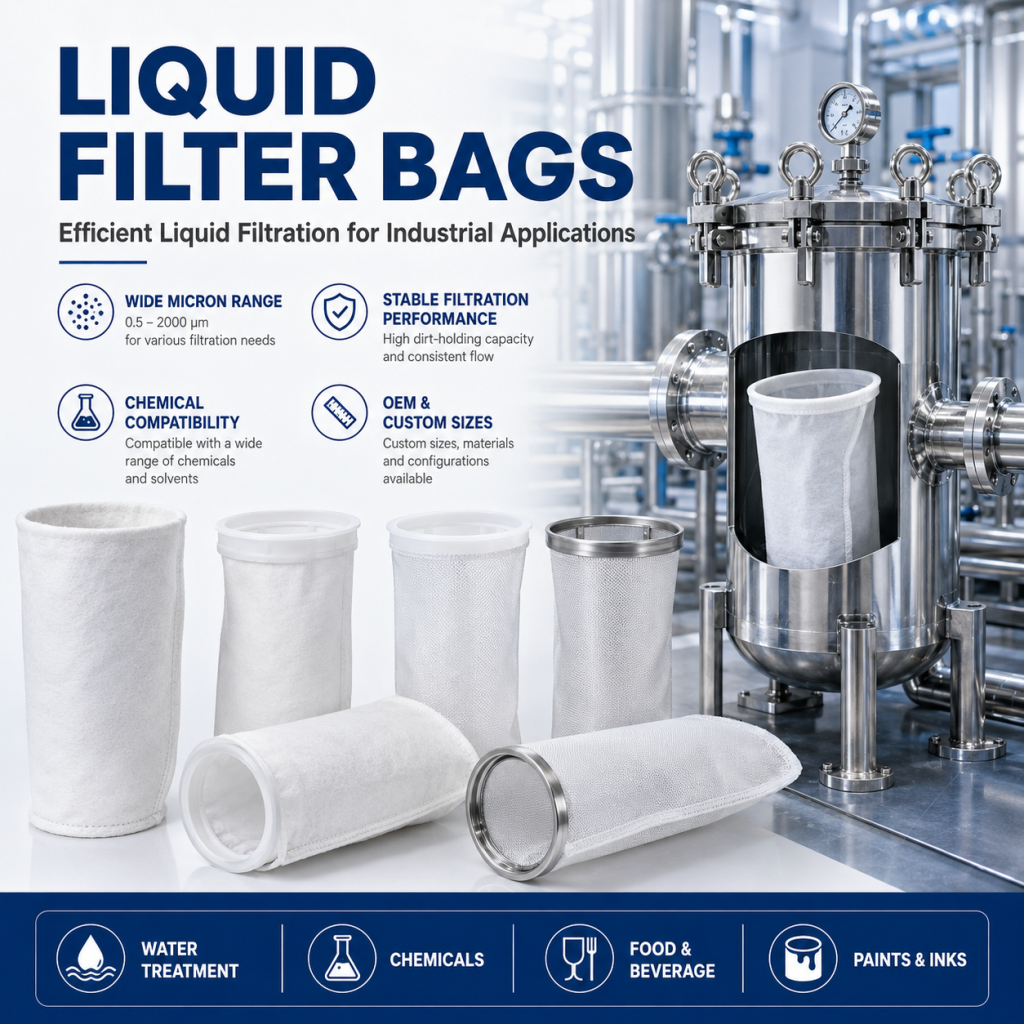
As an industrial filtration manufacturer, INCE filtration supplies liquid filter bags in a wide range of micron ratings, materials, sizes, and constructions for water treatment, chemicals, coatings, oils, food processing, metalworking, electronics, and general process filtration.
This guide explains how to select the right micron rating for your application and why micron size should always be considered together with filter media, particle characteristics, process conditions, and filtration efficiency.
Quick Answer: What Micron Filter Bag Should You Choose?
As a practical starting point:
| Micron Rating | Filtration Level | Typical Purpose |
|---|---|---|
| 1–5 micron | Very fine | Final polishing and fine suspended solids |
| 10 micron | Fine | Fine sediment and process contamination |
| 25 micron | Fine to medium | General industrial process filtration |
| 50 micron | Medium | Process water, coatings, oils and general solids removal |
| 75–100 micron | Medium to coarse | Pre-filtration and equipment protection |
| 150–200 micron | Coarse | Large suspended solids and high-flow filtration |
| 250–500 micron | Very coarse | Screening, large particles and upstream protection |
| 500–1500 micron | Screening | Large debris and particle separation |
This table should be treated as a starting point rather than a universal specification. The best filter bag micron rating depends on the actual particle distribution, required filtrate quality, filter media construction and process conditions.
What Does Micron Rating Mean in a Liquid Filter Bag?
A micron, also called a micrometer or µm, is one thousandth of a millimeter:
1 micron = 0.001 mm
The micron rating of a filter bag is a reference to the particle size the filtration media is designed to retain.
For example, a 10 micron liquid filter bag is intended for significantly finer particle removal than a 100 micron filter bag.
In general:
Smaller micron number = finer filtration
Larger micron number = coarser filtration and potentially higher flow
However, this does not mean every 10 micron filter bag removes exactly the same percentage of 10 micron particles.
The construction of the media is equally important.
Needle felt, monofilament mesh, multifilament mesh and high-efficiency multilayer media can behave very differently even when they carry a similar micron designation.
This is one of the most important points to understand before comparing filter bags from different manufacturers.
Nominal vs. Absolute Micron Rating: What Is the Difference?
One of the most common mistakes in liquid filtration is comparing filter bags only by their micron number without checking how that rating is defined.
Nominal Micron Rating
A nominal-rated filter bag is designed to remove a substantial percentage of particles at or around its specified micron size, but it does not necessarily retain every particle at that size.
Traditional felt filter bags are commonly associated with nominal filtration.
They are widely used because they provide:
- High dirt-holding capacity
- Good flow characteristics
- Economical filtration
- Effective general process filtration
- Broad industrial applicability
Nominal-rated filter bags are often suitable when the goal is to reduce general suspended contamination rather than achieve a tightly controlled particle cut-off.
Absolute Micron Rating
An absolute-rated filter is designed to provide a much more defined retention efficiency at the stated particle size.
Absolute or high-efficiency filtration becomes important when downstream product quality or equipment protection requires more consistent particle removal.
However, buyers should always check the manufacturer’s stated efficiency because the term “absolute” should be connected to an actual tested retention level rather than treated as a micron number alone.
Why This Matters
A nominal 10 micron filter and a high-efficiency 10 micron filter may produce very different results in the same process.
Therefore, when requesting a quotation, do not ask only:
“Can you supply a 10 micron filter bag?”
A better question is:
“What retention efficiency does this 10 micron filter bag provide, and what type of media is used?”
How to Choose the Correct Liquid Filter Bag Micron Rating
A reliable selection process should consider at least seven factors.
1. Identify the Smallest Particle You Need to Remove
Start with the contamination itself.
Ask:
- What particles are present?
- What particle sizes cause quality problems?
- Are the particles hard or deformable?
- Is the contamination evenly distributed?
- Are there occasional large particles?
- Is the target particle size known from laboratory analysis?
If the process must remove particles of approximately 25 micron and above, for example, a filtration grade around this level may be considered.
But selecting a significantly finer bag without a process reason can create unnecessary resistance and shorten bag life.
When Particle Size Is Unknown
In many factories, the precise particle distribution is not available.
In that situation, useful information can include:
- Existing filter specification
- Visible contamination
- Sediment samples
- Downstream quality problems
- Previous filter performance
- Required product clarity
- Differential pressure history
A small filtration trial using several micron grades can also provide much better information than selecting a micron rating by guesswork.
2. Define the Required Filtrate Quality
Next, decide what you are trying to achieve.
There is a major difference between:
- Removing visible debris
- Protecting a pump
- Protecting spray nozzles
- Reducing suspended solids
- Improving liquid clarity
- Removing fine process contamination
- Preparing liquid for a finer downstream filter
- Final product polishing
For basic pre-filtration, a 100 or 200 micron filter bag may be sufficient.
For general process filtration, 25 or 50 micron bags are common starting points.
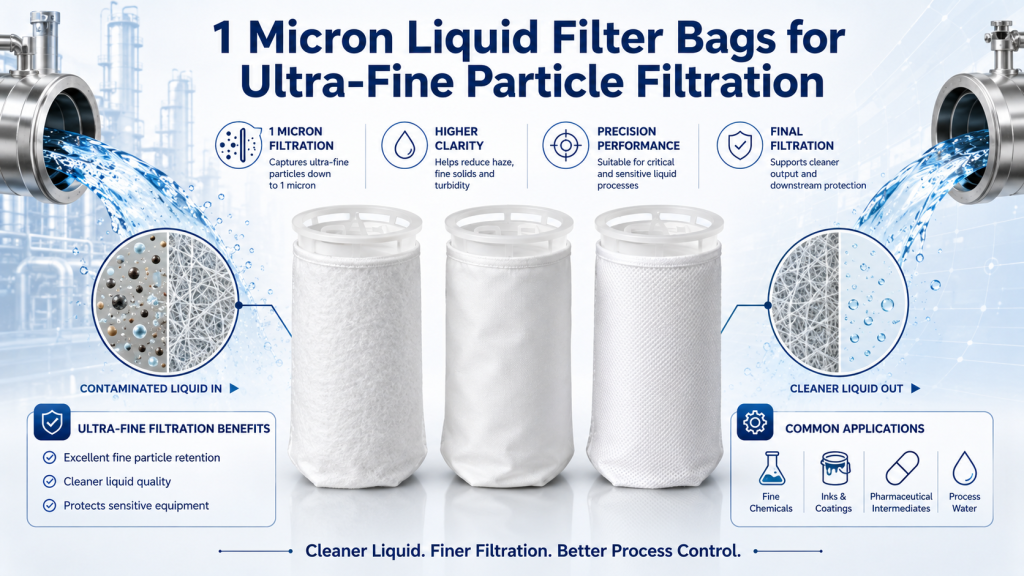
For finer liquid polishing, 1, 5 or 10 micron filtration may be considered.
The correct choice should always be linked to the required outlet quality rather than simply choosing the lowest micron number.
3. Consider the Particle Loading
Micron rating influences how quickly the filter bag becomes loaded.
Imagine a process containing:
- Large quantities of 100–300 micron particles
- Moderate quantities of 20–50 micron particles
- Small quantities of particles below 10 micron
Installing a 1 micron filter bag directly may technically provide finer filtration, but the bag could load rapidly because it is being asked to capture almost the entire contaminant distribution.
A staged system may perform better.
For example:
Stage 1: 100 micron
↓
Stage 2: 25 micron
↓
Stage 3: 5 micron
This approach allows the coarse filter to remove larger contamination before the liquid reaches the fine filtration stage.
Why Multi-Stage Filtration Can Reduce Cost
A coarse pre-filter can:
- Extend final filter life
- Reduce premature plugging
- Stabilize flow
- Reduce change-out frequency
- Protect higher-cost downstream filters
- Improve overall filtration consistency
This is especially useful where the liquid contains a broad particle-size distribution or a high concentration of solids.
4. Balance Micron Rating and Flow Rate
Finer filtration generally produces more flow resistance than coarse filtration when other design factors are similar.
This means that choosing a micron rating that is unnecessarily fine can result in:
- Increased differential pressure
- Reduced flow
- Faster filter loading
- More frequent bag replacement
- Increased operating cost
The filter bag should therefore be selected as part of the complete hydraulic system.
Important information includes:
- Required flow rate
- Liquid viscosity
- Operating temperature
- Inlet pressure
- Allowable pressure drop
- Filter housing size
- Number of filter bags
High-flow installations may require a larger bag filter housing, multiple filter bags, or a staged filtration arrangement rather than simply changing micron rating.
5. Consider Liquid Viscosity
Viscosity has a major effect on filtration performance.
Water flows through filtration media much more easily than thick resin, paint, adhesive, syrup or high-viscosity oil.
When filtering viscous liquids, an excessively fine micron rating can produce unacceptable pressure loss.
Applications involving high-viscosity fluids therefore require the micron rating to be evaluated together with:
- Process temperature
- Flow requirement
- Pump capacity
- Filtration area
- Filter media permeability
Sometimes moving from 10 micron to 25 micron, increasing filtration area, or adding coarse pre-filtration can provide better overall process performance.
6. Match the Filter Media to the Liquid
Micron rating tells only part of the story.
The filter bag material must also be chemically and thermally compatible with the process liquid.
INCE filtration manufactures and supplies filter bags using media including polypropylene, polyester, nylon and PTFE, with standard and customized constructions available for industrial filtration applications.
Polypropylene Filter Bags
Polypropylene felt is widely used for general industrial liquid filtration.
Typical advantages include:
- Good chemical compatibility with many process liquids
- Economical filtration
- Good solids-holding capacity
- Broad micron availability
PP filter bags are commonly used for water treatment, chemicals, plating solutions, coatings and general industrial liquids.
Polyester Filter Bags
Polyester provides good mechanical strength and abrasion resistance and is suitable for many applications requiring greater temperature capability than standard polypropylene media.
Common applications include:
- Coatings
- Oils
- Automotive processes
- Process water
- Industrial chemicals
Nylon Mesh Filter Bags
Nylon monofilament mesh is particularly useful where a more defined opening and surface filtration are required.
Typical applications include:
- Coarse particle removal
- Paint filtration
- Food processing
- Process screening
- Reusable filtration applications
PTFE Filter Bags
PTFE is considered where aggressive chemicals or elevated temperatures make conventional filter media unsuitable.
Because PTFE is a premium filtration material, it should normally be selected according to actual chemical and thermal requirements rather than micron rating alone.
7. Decide Between Felt and Mesh Filter Bags
Filter construction affects particle retention as much as the micron number.
Felt Filter Bags
Needle felt works mainly as a depth filtration medium.
Particles can be captured throughout the three-dimensional fiber structure rather than only at the surface.
Advantages include:
- High dirt-holding capacity
- Good general filtration efficiency
- Wide micron availability
- Cost-effective industrial filtration
Felt is frequently selected for finer and medium-range filtration.
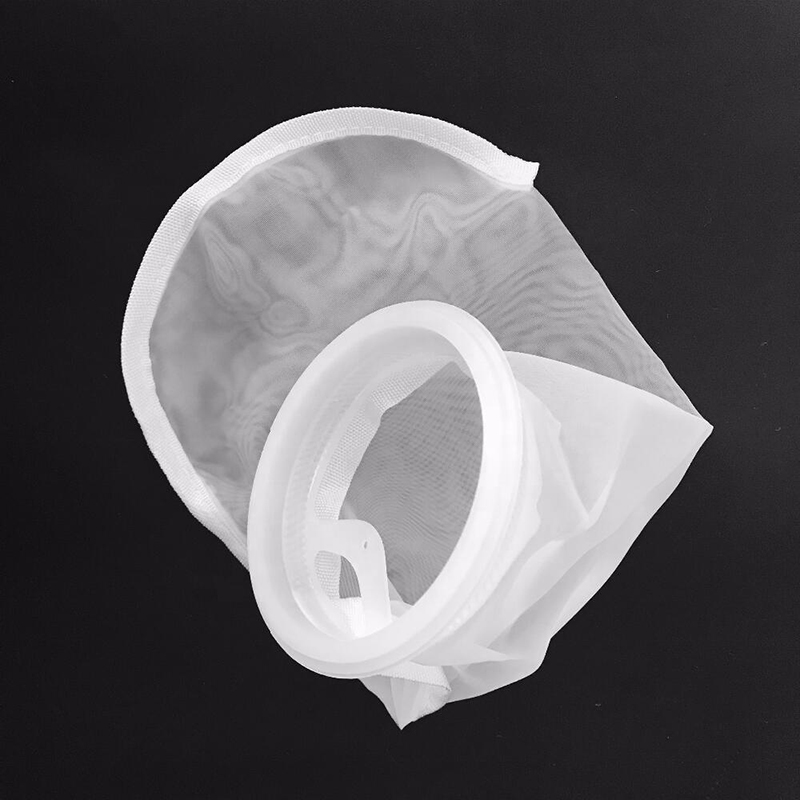
Mesh Filter Bags
Monofilament mesh behaves primarily as a surface filtration medium.
Particles larger than the defined openings are retained on the surface of the mesh.
Advantages can include:
- Defined openings
- High flow
- Lower resistance
- Easier solids release
- Potential cleanability in suitable applications
Mesh media is frequently used for coarse filtration, screening and applications requiring a relatively defined particle cut-off.
Recommended Micron Ratings by Application
The following values can be used as preliminary selection guidance.
| Application | Typical Starting Range |
| General process water | 10–100 micron |
| Cooling water | 25–100 micron |
| Paint and coatings | 10–100 micron |
| Metalworking fluids | 10–100 micron |
| Lubricating oil | 5–50 micron |
| Chemical processing | 1–100 micron |
| Food processing | 5–200 micron |
| Pre-filtration | 50–500 micron |
| Fine liquid polishing | 1–10 micron |
| Large solids screening | 200–1500 micron |
These are not universal engineering specifications. Actual selection depends on contamination, process quality requirements, flow, viscosity, temperature and filter media.
Is a Lower Micron Rating Always Better?
No.
This is one of the most important filter bag selection principles.
A 1 micron filter bag is not automatically “better” than a 50 micron filter bag.
It is simply designed for a different filtration objective.
If the application only needs to remove 80–100 micron particles, using a 1 micron bag may:
- Increase pressure drop
- Reduce process flow
- Increase filter consumption
- Increase maintenance
- Raise filtration cost without improving the required product quality
The most economical filtration system therefore uses the coarsest micron rating that consistently achieves the required filtration result.
Example 1: Process Water Filtration
Suppose industrial process water contains visible sediment and particles mainly above approximately 50 micron.
The customer does not require ultra-fine polishing but wants to protect pumps and downstream equipment.
A 50 or 100 micron filter bag may be a better starting point than a 1 or 5 micron bag.
If downstream equipment later requires finer filtration, a second filtration stage can be added.
Example 2: Paint and Coating Filtration
Coatings may contain agglomerates, foreign particles or process contamination that can affect surface finish or block spray equipment.
The correct filter rating depends heavily on:
- Coating viscosity
- Pigment particle distribution
- Application equipment
- Required finish
- Acceptable pressure drop
A filter that is too coarse may allow problematic contamination through, while a filter that is too fine may remove desirable product components or create excessive pressure.
This is why coating filtration should be selected according to both contaminant size and formulation characteristics.
Example 3: Protecting a Fine Cartridge Filter
Consider a system using an expensive fine cartridge as the final filtration stage.
Sending heavily contaminated liquid directly to that cartridge can result in rapid replacement.
A bag filter installed upstream at perhaps 50 or 100 micron can remove larger contamination first.
The system might therefore use:
100 micron bag filter → 20 micron bag filter → final cartridge
The exact sequence depends on the process, but the principle is simple:
Use inexpensive coarse filtration to reduce the solids load before expensive fine filtration whenever practical.
Common Mistakes When Selecting a Filter Bag Micron Rating
Mistake 1: Automatically Selecting the Smallest Micron
Finer does not always mean better.
Select filtration according to the process requirement.
Mistake 2: Ignoring Nominal vs. Absolute Efficiency
Two filters with the same micron number may perform differently.
Always consider retention efficiency and media construction.
Mistake 3: Ignoring Liquid Viscosity
A filter that performs well in water may create excessive pressure drop in a high-viscosity liquid.
Mistake 4: Ignoring Particle Loading
High solids loading can rapidly plug a fine filter bag.
Consider pre-filtration.
Mistake 5: Choosing Micron Rating Without Checking Material Compatibility
Correct micron size does not compensate for an incompatible filter media.
Chemical compatibility and temperature must be reviewed separately.
Mistake 6: Looking Only at Filter Bag Price
The cheapest bag is not necessarily the lowest-cost filtration solution.
Total operating cost includes:
- Bag consumption
- Labor
- Downtime
- Product losses
- Disposal
- Pressure loss
- Energy consumption
Filter life and process stability can be more important than unit price.
Information to Provide When Selecting a Liquid Filter Bag
When contacting INCE filtration for filter bag selection, providing the following information will make the recommendation more accurate:
- Liquid being filtered
- Target contaminant
- Approximate particle size
- Required micron rating, if already known
- Required flow rate
- Operating temperature
- Operating pressure
- Liquid viscosity
- Current filter bag material
- Filter bag dimensions
- Ring or collar type
- Current filtration problem
- Required quantity
If you already use another manufacturer’s filter bag, providing the existing model number, dimensions, photographs, drawings or specifications can also help identify a compatible replacement.
Frequently Asked Questions About Liquid Filter Bag Micron Ratings
What micron filter bag is best for general industrial filtration?
For many general industrial applications, 25, 50 or 100 micron filter bags are useful starting points. The final selection should depend on the target particle size and required filtrate quality.
Is 1 micron finer than 10 micron?
Yes. A 1 micron filtration grade is finer than a 10 micron grade.
However, actual particle retention also depends on whether the filter is nominal or high-efficiency rated and on the construction of the filter media.
What is a 100 micron filter bag used for?
A 100 micron filter bag is commonly used for coarse process filtration, suspended solids removal, equipment protection and pre-filtration before finer filtration stages.
Should I use a 5 micron or 10 micron filter bag?
Choose according to the smallest particle that must be controlled and the acceptable pressure drop.
A 5 micron bag provides finer filtration, while a 10 micron bag may provide longer life and lower resistance where 5 micron removal is unnecessary.
Can a filter bag remove particles smaller than its micron rating?
Depending on the structure of the filter media, some smaller particles may also be captured within depth media. However, filter selection should not assume guaranteed removal below the stated performance rating.
What micron filter bag should be used before an RO system?
There is no single universal bag-filter rating for every RO system. The required pre-filtration depends on feed-water quality and the downstream membrane and cartridge filtration design. Bag filtration is frequently used as an upstream solids-removal stage rather than the final RO protection element.
Does changing from 100 micron to 10 micron reduce flow?
It can. Finer filtration media normally creates greater resistance and may load more rapidly when the liquid contains significant suspended solids.
Flow performance should therefore be evaluated together with filtration area, viscosity and contaminant concentration.
Can INCE filtration manufacture custom micron filter bags?
Yes. INCE filtration supplies industrial liquid filter bags in multiple materials, micron ratings, standard bag sizes and custom configurations. Custom dimensions, ring styles, seam constructions and OEM requirements can be developed according to the filtration system.
Choosing the Right Filter Bag Is About the Complete Process
The correct liquid filter bag micron rating is not necessarily the lowest micron available.
Successful filtration requires matching:
Particle size + filtration efficiency + filter media + liquid compatibility + flow rate + viscosity + solids loading + operating conditions
For coarse pre-filtration, larger micron ratings can provide high flow and economical solids removal.
For general industrial filtration, medium micron ratings can provide an effective balance between contaminant removal and service life.
For final polishing or critical particle control, finer or high-efficiency filtration may be required.
When the contamination range is broad, multi-stage filtration can often provide better performance and lower operating cost than relying on a single very fine filter.
Need Help Selecting a Liquid Filter Bag Micron Rating?
INCE filtration is an industrial filtration manufacturer and supplier providing liquid filter bags, filter cartridges, filter housings and filter mesh for industrial filtration systems.
Our filter bags are available in polypropylene, polyester, nylon, PTFE and application-specific constructions, with standard and customized micron ratings, sizes, rings and seam designs.
If you are uncertain whether your application requires 1 micron, 5 micron, 10 micron, 25 micron, 50 micron, 100 micron or a coarser filter bag, send us your process information.
Tell INCE filtration:
What liquid are you filtering?
What particles do you need to remove?
What flow rate and temperature are involved?
What filter housing or bag size are you currently using?
Our team can help evaluate a suitable filter bag specification for your filtration process.
Contact INCE filtration for a filter bag recommendation, OEM solution or factory quotation.
 WhatsApp