
A 2 micron liquid filter bag is used when an industrial process requires finer particle control than conventional 5 or 10 micron filtration, but does not necessarily require an ultra-fine 1 micron filtration stage.
This makes 2 µm filtration a specialized option for precision liquid filtration, process polishing and fine suspended-particle reduction.
However, selecting a 2 micron filter bag should not be based on micron size alone.
At this filtration level, actual performance depends heavily on:
- Filter media construction
- Filtration efficiency
- Solids concentration
- Liquid viscosity
- Flow rate
- Filter area
- Upstream filtration
A 2 micron rating can provide an effective middle ground between 1 and 5 micron filtration, but only when it matches the actual particle-removal requirement.
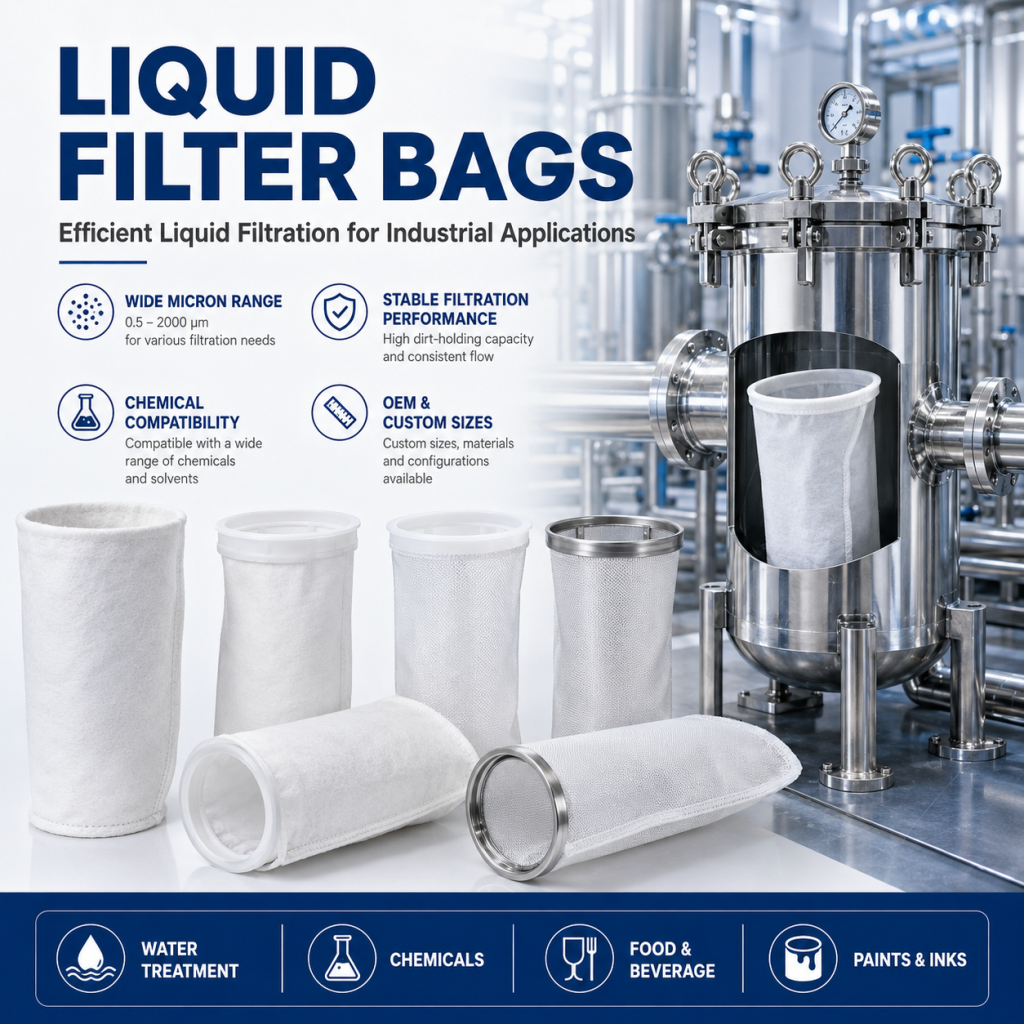
INCE filtration supplies industrial liquid filtration products in multiple fine micron grades and can evaluate application-specific filter bag requirements according to liquid type, filtration target and operating conditions.
What Does 2 Micron Mean in Liquid Filtration?
A micron, or micrometer (µm), equals 0.001 millimeter.
Therefore:
2 micron = 0.002 mm
For comparison:
| Micron Rating | Relative Filtration Level |
|---|---|
| 1 micron | Ultra-fine |
| 2 micron | Precision fine filtration |
| 5 micron | Fine |
| 10 micron | Fine process filtration |
| 25 micron | Fine to medium |
| 50 micron | General filtration |
A 2 micron liquid filter bag is intended for applications where very small suspended particles need to be reduced before final processing or downstream treatment.
Typical contaminants may include:
- Fine sediment
- Small precipitated solids
- Fine metal particles
- Process residues
- Small agglomerates
- Rust fines
- Fine suspended manufacturing debris
The exact particle-removal performance still depends on whether the filter is nominally or more tightly efficiency-rated.
Why Choose 2 Micron Instead of 1 or 5 Micron?
Two micron filtration occupies a useful position between common 1 and 5 micron grades.
Compared with 5 micron
A 2 micron filter can provide finer particle control where 5 micron filtration does not produce sufficient liquid cleanliness.
Compared with 1 micron
A 2 micron filter may offer a practical compromise when 1 micron filtration creates unnecessary pressure drop, short service life or excessive replacement frequency.
This makes 2 micron filtration worth considering when:
- 5 micron filtration is slightly too coarse
- 1 micron filtration is unnecessarily restrictive
- Final liquid clarity needs improvement
- Downstream equipment requires tighter particle control
- A precision polishing stage is needed
The correct choice should be based on actual process results rather than selecting the smallest possible micron number.
1 vs. 2 vs. 5 Micron Liquid Filter Bags
| Feature | 1 Micron | 2 Micron | 5 Micron |
| Filtration level | Ultra-fine | Precision fine | Fine |
| Relative pressure drop | Highest | Medium-high | Lower |
| Plugging tendency | Highest | Moderate-high | Lower |
| Typical role | Final polishing | Precision polishing | Fine/intermediate filtration |
| Pre-filtration importance | Very high | High | High |
| Best when | Maximum fine-particle reduction is needed | 5 µm is insufficient but 1 µm is excessive | General fine filtration is sufficient |
A 2 micron bag can therefore be useful when the process requires more precision than 5 micron filtration without moving directly to 1 micron.
Is a 2 Micron Filter Bag an Absolute Filter?
Not necessarily.
This distinction is very important.
A filter labeled “2 micron” may be nominally rated, meaning it is designed to reduce particles around that size but may not capture every particle larger than exactly 2 µm.
Filtration performance depends on:
- Fiber structure
- Media thickness
- Density gradient
- Particle shape
- Flow velocity
- Manufacturing consistency
- Test method
For critical industrial applications, buyers should ask:
- Is the 2 micron rating nominal or absolute?
- What retention efficiency is specified?
- Is there test data for the media?
- Is a bag filter suitable as the final filtration stage?
If a process requires a tightly defined particle-removal efficiency, a high-efficiency bag or cartridge may be more suitable than conventional felt.
Why 2 Micron Filtration Often Needs Pre-Filtration
A 2 micron bag can load rapidly if it receives a large amount of coarse contamination.
Consider a liquid containing:
- Particles above 100 µm
- Significant solids between 25 and 100 µm
- Fine solids between 5 and 25 µm
- A smaller fraction around 2 µm
Using a 2 micron bag as the only filtration stage forces it to capture nearly everything.
This can cause:
- Rapid differential-pressure increase
- Reduced flow
- Frequent bag changes
- Higher labor cost
- Greater consumable use
A staged system may perform better.
For example:
50 micron → 10 micron → 2 micron
or:
25 micron bag → 5 micron bag → 2 micron polishing stage
The exact arrangement depends on the solids concentration and required outlet quality.
Polypropylene Media for Fine Filtration
Polypropylene is widely used for industrial depth filtration because it provides:
- Good compatibility with many acids and alkalis
- Low moisture absorption
- Economical replacement
- Good dirt-holding capability
- Broad use in industrial water and chemicals
PP felt uses a three-dimensional fiber structure, allowing contamination to be retained throughout the depth of the media.
For a specialized 2 micron application, however, the actual availability and efficiency of the media should be confirmed rather than assuming every PP felt construction can reliably provide the same 2 µm performance.
Polyester Media for 2 Micron Filtration
Polyester may be considered where the process requires:
- Good abrasion resistance
- Greater mechanical strength
- Higher temperature capability than standard PP
- Compatibility with oils or selected industrial liquids
Polyester depth media is commonly used for fine filtration in:
- Industrial oils
- Paints and coatings
- Process water
- Manufacturing fluids
- Chemical processing
At 2 micron, material compatibility and filtration efficiency should both be checked before selection.
When Would PTFE Be Considered?
PTFE is typically selected for demanding chemical or thermal conditions.
A specialty fine-filtration bag may use PTFE when:
- The liquid is chemically aggressive
- PP and polyester are not compatible
- Elevated temperatures are involved
- Process conditions justify premium filtration media
PTFE should not be selected simply because the micron rating is low.
Material and filtration accuracy are separate design decisions.
Applications for 2 Micron Liquid Filter Bags
Precision Process Water Filtration
Industrial water that has already passed through coarse filters may still contain fine suspended particles.
A 2 micron filtration stage can help reduce residual contamination before:
- Sensitive equipment
- Final process use
- Fine cartridge filtration
- Membrane systems
This is most effective when larger solids have already been removed upstream.
Chemical Processing
Fine insoluble contaminants can enter chemical liquids from:
- Raw materials
- Reaction processes
- Tank storage
- Pipelines
- Precipitation
A 2 micron liquid filter bag may be used for polishing compatible chemical streams before filling, transfer or downstream processing.
The filter material must be compatible with the actual chemical and operating temperature.
Paints and Coatings
Coatings can contain very fine:
- Agglomerates
- Skins
- Process debris
- Foreign particles
A 2 micron filtration grade may be considered for selected high-quality coating applications.
However, formulated products require caution.
A filter that is too fine may remove desirable pigments or functional particles.
The product formulation and particle-size distribution should therefore be understood before using a 2 micron bag.
Fine Oil Filtration
Some industrial oils require fine suspended-particle control.
A 2 micron bag may be considered for compatible low- or moderate-viscosity oils where fine contamination needs to be reduced.
However, viscosity has a major effect on pressure drop.
Higher-viscosity liquids may require:
- More filtration area
- Lower flow per bag
- Parallel housings
- Higher operating temperature
- Upstream pre-filtration
The filtration system should be sized accordingly.
Metalworking Fluids
Fine metal particles and abrasive contamination can accumulate in circulating process liquids.
A 2 micron polishing stage can be useful where small particles affect:
- Surface finish
- Tool performance
- Equipment wear
- Process consistency
For heavily contaminated systems, coarse filters should remove the bulk solids first.
Electronics and Precision Manufacturing
Processes involving sensitive equipment or fine manufacturing tolerances may require cleaner liquids than general industrial filtration can provide.
A 2 micron filter bag may function as an intermediate or polishing stage before more tightly controlled downstream filtration.
Where validated critical filtration is required, cartridge or membrane filtration may still be necessary.
2 Micron Filter Bags Before Cartridge Filters
A 2 micron bag can also be used to protect more expensive final cartridges.
For example:
25 micron bag → 5 micron bag → 2 micron bag → high-efficiency cartridge
This approach can reduce the contaminant load reaching the final element.
Potential benefits include:
- Longer cartridge life
- More stable differential pressure
- Fewer expensive cartridge changes
- Lower total filtration cost
Whether this many stages are needed depends on the actual process.
In some cases, a simpler two-stage system is sufficient.
Pressure Drop at 2 Micron
Fine filtration increases resistance.
As effective pore size becomes smaller, the liquid requires more pressure to move through the media.
This effect becomes more significant when:
- Flow rate is high
- Liquid viscosity is high
- Solids loading is high
- Filter area is small
A system that operates easily with a 25 micron filter may experience a noticeably higher differential pressure after switching to 2 micron.
Therefore, do not change micron rating without evaluating:
flow + viscosity + filtration area + allowable pressure drop
How to Extend 2 Micron Filter Bag Life
The most effective way to improve service life is often to reduce the amount of contamination reaching the fine filter.
Consider:
Coarse Pre-Filtration
Use 25, 50 or 100 micron filtration where large solids are present.
Intermediate Filtration
A 5 or 10 micron stage can reduce the load before 2 micron polishing.
Increase Filter Area
Using a larger bag or multi-bag housing distributes solids over more media.
Reduce Excessive Flow
High flow velocity can accelerate differential-pressure increase.
Monitor Differential Pressure
Replace bags according to actual pressure performance rather than calendar time alone.
When Should You Not Use a 2 Micron Filter Bag?
A 2 micron filter is not necessary in every process.
Use a coarser grade when:
- 5 micron already meets the required cleanliness
- Solids loading is high
- Maximum flow is the priority
- Fine particle reduction provides no process benefit
Consider 1 micron or higher-efficiency filtration when:
- 2 micron does not achieve the required result
- Very fine polishing is needed
- Defined retention efficiency is critical
Consider a cartridge or membrane when:
- Absolute particle control is required
- Sterile filtration is required
- Sub-micron removal is necessary
- A validated retention specification is required
How to Specify a 2 Micron Liquid Filter Bag
A complete inquiry should include:
- Required micron rating: 2 µm
- Required filtration efficiency
- Liquid type
- Target contaminant
- Filter media preference
- Bag diameter
- Bag length
- Ring or collar type
- Flow rate
- Viscosity
- Operating temperature
- Operating pressure
- Required quantity
Because 2 micron is a more specialized filtration grade than common 1, 5 or 10 micron catalog ratings, confirm the actual media specification and retention performance before placing a production order.
2 Micron Liquid Filter Bag FAQ
What does a 2 micron filter bag remove?
It is used for very fine suspended-particle reduction around the 2 µm filtration range. Actual retention depends on the media construction and efficiency rating.
Is 2 micron finer than 5 micron?
Yes. A 2 micron filter is finer than a 5 micron filter and can reduce smaller suspended particles.
Is 2 micron coarser than 1 micron?
Yes. A 1 micron filtration grade is finer and generally creates greater filtration resistance under comparable conditions.
When should I choose 2 micron instead of 1 micron?
Two micron filtration can be useful when 5 micron is insufficient but the additional resistance and loading associated with 1 micron filtration are unnecessary.
Is a 2 micron filter bag absolute?
Not automatically. Many industrial felt filter bags are nominally rated. Ask for the actual retention efficiency if critical particle control is required.
Can a 2 micron bag be used for water filtration?
Yes, for suitable fine or polishing stages after larger suspended solids have been removed.
Can it be used before RO?
It may form part of an RO pretreatment train, but the correct sequence depends on feed-water quality and the downstream cartridge and membrane specifications.
Which filter bag material is best at 2 micron?
The material depends on fluid chemistry, temperature, viscosity and required efficiency. PP and polyester may be considered for many industrial liquids, while specialty media can be used for more demanding conditions.
Precision Liquid Filtration at 2 Micron
A 2 micron liquid filter bag can provide a useful filtration step between conventional 5 micron fine filtration and ultra-fine 1 micron polishing.
It is most appropriate when the process requires:
finer retention than 5 µm + practical flow + controlled pressure drop + good upstream solids removal
The key is not simply selecting “2 micron.”
A successful filtration system must also match:
Filtration efficiency + media + liquid chemistry + solids loading + flow + viscosity + filter area
For heavily contaminated liquids, 2 micron filtration should usually be protected by coarser upstream stages.
For applications requiring absolute or validated removal performance, a high-efficiency cartridge or other final filtration technology may be more appropriate.
INCE filtration supplies industrial liquid filtration solutions across multiple fine micron grades and can evaluate specialized filtration requirements according to the actual process conditions.
If you require a 2 micron filtration solution, send INCE filtration your:
Liquid type
Target particle size
Required filtration efficiency
Current filter grade
Flow rate
Temperature
Viscosity
Existing bag dimensions
INCE filtration can help evaluate whether 2 micron filtration is technically appropriate and whether a standard or customized filtration solution should be used.
Contact INCE filtration for precision liquid filtration selection, OEM development or a custom filtration quotation.
 WhatsApp