
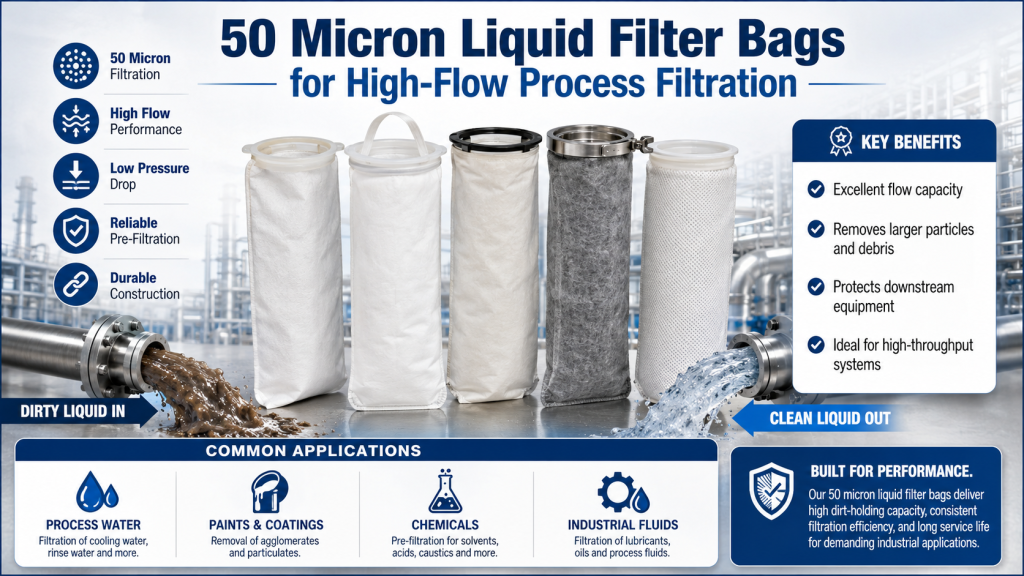
A 50 micron liquid filter bag is widely used in industrial processes that need dependable particle removal without creating the higher resistance associated with finer filtration grades.
Compared with 10 or 25 micron filter bags, a 50 micron bag generally allows higher process flow and can tolerate heavier solids loading when the filter media, housing and operating conditions are properly selected.
This makes 50 µm filtration particularly useful for high-flow process water, cooling systems, chemicals, coatings, metalworking fluids and industrial pre-filtration.
However, “50 micron” alone does not determine how much liquid a filter bag can handle. High-flow performance also depends on filtration area, media type, liquid viscosity, solids concentration and allowable differential pressure.
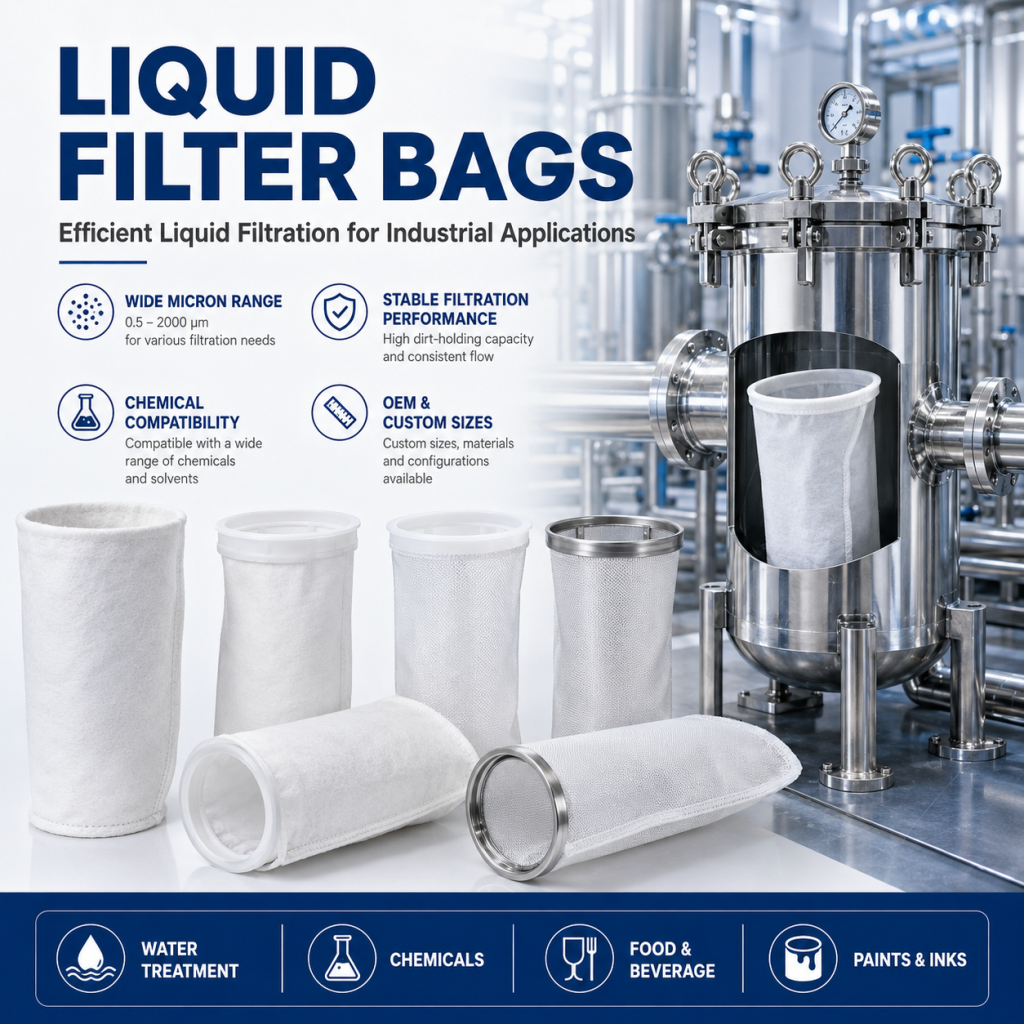
INCE filtration manufactures 50 micron filter bags in polypropylene, polyester, nylon, PTFE and customized media for industrial liquid filtration systems.
Why Is 50 Micron Suitable for High-Flow Filtration?
As filter media becomes finer, liquid generally encounters greater resistance.
A 5 or 10 micron filter must force the liquid through much finer filtration pathways than a 50 micron filter of comparable construction.
A 50 micron bag therefore offers an effective balance between:
- Particle removal
- Flow capacity
- Dirt-holding capability
- Differential pressure
- Filter service life
This is especially useful when the objective is to remove medium-sized process contaminants rather than perform final fine polishing.
Typical high-flow applications include:
- Process-water circulation
- Cooling-water filtration
- Equipment protection
- Industrial washing systems
- Chemical transfer
- Coating production
- Metalworking-fluid circulation
- Pre-filtration before finer cartridges
What Does 50 Micron Mean?
One micron (µm) equals 0.001 millimeter.
Therefore:
50 micron = 0.050 mm
A 50 micron filter bag is used to reduce medium-sized suspended particles in industrial liquids.
These can include:
- Sediment
- Rust
- Pipe scale
- Metal particles
- Process debris
- Paint skins
- Agglomerates
- Tank contamination
- Larger suspended solids
The actual particle-retention efficiency depends on the media construction and whether the filter is nominally or more tightly rated.
A 50 micron designation should therefore not automatically be interpreted as 100% removal of every particle larger than exactly 50 µm.
25 vs. 50 vs. 100 Micron Filter Bags
The choice between nearby micron grades has a direct effect on both particle retention and system flow.
| Feature | 25 Micron | 50 Micron | 100 Micron |
|---|---|---|---|
| Filtration level | Finer | General / medium | Coarser |
| Relative flow potential | Lower | High | Higher |
| Pressure resistance | Higher | Moderate | Lower |
| Solids handling | Moderate | Good | Very good |
| Typical role | Fine process filtration | High-flow process filtration | Coarse pre-filtration |
| Equipment protection | Fine contaminants | General contaminants | Larger particles |
Choose 25 micron when:
Smaller particles need to be controlled and the system can tolerate additional resistance.
Choose 50 micron when:
You need a practical balance between particle removal, flow and service life.
Choose 100 micron when:
Removing larger debris and maximizing throughput are more important than finer filtration.
In most industrial systems, the most economical choice is the coarsest micron rating that consistently meets the process requirement.
Flow Rate Depends on More Than Micron Rating
One common mistake is assuming that all 50 micron filter bags provide the same flow.
They do not.
Actual flow capability depends on several factors.
Filtration Area
A larger bag provides more media area for the liquid to pass through.
For this reason, a long industrial filter bag generally supports greater total system flow than a much smaller bag of the same media.
Liquid Viscosity
Water passes through filtration media much more easily than:
- Oil
- Paint
- Resin
- Thick chemicals
- High-viscosity process liquids
The same 50 micron bag can therefore show very different pressure-drop behavior depending on the fluid.
Solids Concentration
As particles accumulate in the filter media, flow resistance increases.
A heavily contaminated liquid can load a 50 micron bag rapidly even if initial flow is excellent.
Filter Media
Felt, mesh and specialty media do not have identical permeability even when they share the same nominal micron rating.
Number of Bags
High-throughput systems may require a multi-bag housing instead of forcing the entire process flow through one element.
Filter Area Is Critical in High-Flow Systems
Increasing filtration area can often improve system performance more effectively than simply selecting a coarser micron rating.
For example, if a 50 micron bag reaches high differential pressure too quickly, the problem may not be the micron specification.
The system may simply have insufficient filtration area.
Possible solutions include:
- Using a longer filter bag
- Installing a larger bag filter housing
- Moving from single-bag to multi-bag filtration
- Installing parallel housings
- Adding upstream coarse filtration
This allows the same target micron rating to operate at a lower flow per unit area.
Single-Bag vs. Multi-Bag Filtration
Single-Bag Housing
A single-bag system is practical for:
- Low-to-medium process flow
- Compact installations
- Batch filtration
- Smaller production lines
It has lower equipment complexity and is easy to maintain.
Multi-Bag Housing
For larger industrial flow rates, several bags can be installed in one housing.
This provides:
- Greater filtration area
- Lower loading per bag
- Higher total flow
- Longer operating cycles
- Reduced pressure rise
For very high-flow processes, increasing the number of filter bags can be more effective than selecting an excessively coarse micron rating.
Polypropylene 50 Micron Filter Bags
Polypropylene felt is widely used for high-flow industrial liquid filtration.
Its advantages include:
- Good compatibility with many acids and alkalis
- Economical replacement
- Good depth-loading characteristics
- Low moisture absorption
- Broad industrial applicability
Typical uses include:
- Process water
- Chemical solutions
- Electroplating liquids
- Cleaning fluids
- Coatings
- General manufacturing liquids
INCE filtration already manufactures a dedicated 50 micron PP liquid filter bag range with real industrial sizes, sewn and welded constructions, and multiple ring-top options.
For exact PP sizes and model codes, the dedicated product page should be used rather than reproducing those specifications here.
Polyester 50 Micron Filter Bags
Polyester felt is useful where applications require:
- Good mechanical strength
- Abrasion resistance
- Higher temperature capability than standard PP
- Compatibility with oils and selected process liquids
Typical applications include:
- Industrial oils
- Coatings
- Process water
- Automotive fluids
- Metalworking systems
INCE filtration also has a dedicated 50 micron polyester range designed for balanced filtration, higher process flow and manageable pressure drop.
Nylon 50 Micron Filter Bags
Nylon provides a different filtration mechanism.
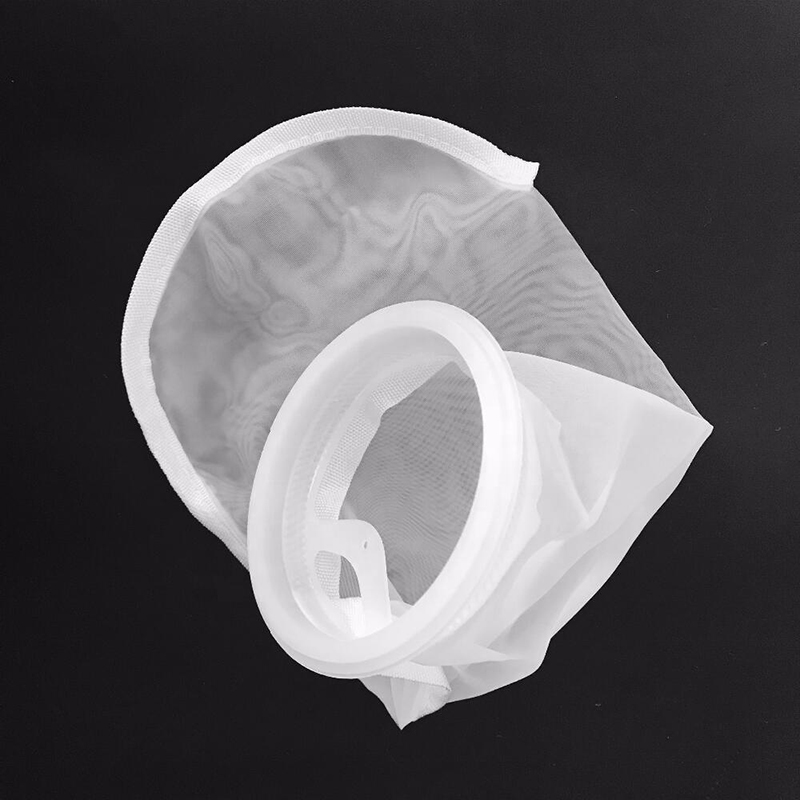
Many nylon filter bags use woven monofilament mesh rather than needle felt.
This means the media primarily performs surface filtration.
Potential advantages include:
- Defined mesh openings
- High liquid permeability
- Lower resistance
- Easier release of captured particles
- Suitability for selected reusable applications
A 50 micron nylon mesh filter bag can therefore be useful where particle screening and high throughput are more important than depth-loading capacity.
INCE filtration currently manufactures 50 micron nylon filter bags in several actual sizes and ring configurations.
Felt vs. Mesh for High-Flow Filtration
Choosing between felt and mesh can significantly change system behavior.
50 Micron Felt
Felt provides depth filtration.
Particles can be captured throughout the thickness of the media.
This can provide:
- Greater dirt-holding capacity
- Better handling of mixed particle sizes
- Good general industrial filtration
50 Micron Mesh
Mesh provides primarily surface filtration.
Particles larger than the openings are retained near the media surface.
This can provide:
- High permeability
- Defined openings
- Lower resistance
- Easier cleaning in suitable applications
For high-flow systems with relatively uniform particles, mesh may be attractive.
For liquids containing a broad contaminant distribution, felt may provide better depth loading.
High-Flow Process Water Filtration
Process water is one of the most common applications for 50 micron bags.
Industrial water can contain:
- Sediment
- Rust
- Pipe scale
- Tank debris
- Suspended solids
A 50 micron bag can reduce this contamination while maintaining practical process flow.
It may be used before:
- Heat exchangers
- Pumps
- Spray systems
- Finer cartridges
- Process equipment
- Water reuse systems
Where finer water quality is eventually required, the 50 micron bag can function as an upstream protection stage.
Cooling-Water Filtration
Cooling systems often circulate large volumes of water continuously.
This makes flow capacity particularly important.
A filter that is unnecessarily fine can:
- Increase pump load
- Reduce circulation
- Plug frequently
- Require excessive maintenance
A 50 micron filtration stage can help reduce larger suspended contamination while supporting continuous circulation.
The final micron selection should depend on the equipment being protected and actual contaminant distribution.
Paints and Coatings
Coatings often contain unwanted:
- Skins
- Agglomerates
- Foreign particles
- Tank debris
A 50 micron liquid filter bag can remove these contaminants while allowing relatively high process flow.
For viscous coatings, filtration area becomes especially important.
A larger housing or multiple bags may be needed to prevent excessive pressure drop.
The selected micron rating should also be large enough to avoid removing desirable pigments or functional formulation components.
Metalworking Fluids
Coolants and washing fluids can accumulate:
- Metal chips
- Grinding particles
- Dirt
- Abrasive contamination
A 50 micron filter bag can provide useful general solids removal in circulating systems.
Where very fine metal fines must also be controlled, a second downstream stage may be added.
For example:
50 micron bag → 10 micron cartridge
This prevents the fine cartridge from carrying the full solids load.
Chemical Processing
High-flow chemical transfer and circulation systems can also use 50 micron filtration for:
- Raw-material cleanup
- Tank contamination removal
- Precipitated solids
- Pipeline debris
- General process clarification
Material compatibility is critical.
PP, polyester, nylon and PTFE each have different chemical and temperature limitations.
The micron rating and material should therefore be selected separately.
Why Differential Pressure Matters
A filter bag gradually fills with contamination during operation.
As solids accumulate, resistance increases.
The difference between inlet and outlet pressure is called differential pressure.
Monitoring this value provides useful information about filter loading.
A rapidly rising differential pressure may indicate:
- High solids concentration
- Insufficient filtration area
- Excessive flow
- Liquid viscosity changes
- A micron rating that is too fine
For high-flow installations, differential-pressure monitoring is more useful than replacing filter bags solely according to a fixed calendar schedule.
50 Micron Filter Bags as Pre-Filters
A 50 micron bag is especially effective as an upstream protection stage.
For example:
100 micron → 50 micron → 10 micron
or:
50 micron bag → 5 micron cartridge → final process
The 50 micron stage removes larger contamination before it reaches the more expensive fine filter.
Potential benefits include:
- Longer downstream filter life
- More stable flow
- Lower consumable cost
- Reduced maintenance
- Better process consistency
Not every system requires multiple stages, but staged filtration becomes increasingly useful as solids loading increases.
Nominal vs. Absolute 50 Micron Filtration
Many conventional felt filter bags are nominally rated.
This means the 50 micron number describes a filtration grade, but it does not necessarily guarantee complete removal of all particles larger than exactly 50 µm.
If critical particle retention is required, ask:
- Is the media nominal or absolute rated?
- What retention efficiency is specified?
- How was filtration performance tested?
- Is a bag filter sufficient as the final filtration stage?
For many general high-flow applications, nominal felt filtration is appropriate.
For tightly controlled particle removal, a higher-efficiency element may be required.
When Should You Not Use a 50 Micron Filter Bag?
Choose a finer filter when:
- Smaller particles are affecting product quality
- 50 micron filtration does not provide sufficient clarity
- Sensitive downstream equipment needs stronger protection
A 10 or 25 micron bag may then be more appropriate.
Choose a coarser filter when:
- The main contaminants are large
- Solids concentration is extremely high
- Maximum process throughput is the priority
A 100, 150 or 200 micron filter may provide longer service life.
The system should be optimized around the process requirement rather than simply choosing the smallest micron available.
How to Improve High-Flow Filter Bag Performance
For better performance at 50 micron:
Increase Filtration Area
Use a larger bag or multi-bag housing for higher process flow.
Remove Large Debris First
Install a coarse upstream stage when solids loading is high.
Match the Media to the Liquid
Consider chemical compatibility, temperature and viscosity.
Avoid Excessive Flow per Bag
Too much flow through one element can increase differential pressure.
Monitor Pressure Drop
Use actual operating condition rather than time alone to determine bag loading.
Check Housing Sealing
A poorly fitted ring or collar can allow bypass regardless of micron rating.
How to Specify a 50 Micron Filter Bag for a High-Flow System
Provide the following information:
- Micron rating: 50 µm
- Liquid being filtered
- Target contaminant
- Required flow rate
- Liquid viscosity
- Operating temperature
- Operating pressure
- Preferred filter media
- Existing bag dimensions
- Ring or collar type
- Single-bag or multi-bag housing
- Required quantity
For large-flow projects, required system flow is especially important.
The manufacturer can then evaluate whether one bag provides sufficient filtration area or whether a multi-bag configuration is more appropriate.
50 Micron High-Flow Filtration FAQ
Is 50 micron good for high-flow filtration?
Yes. Fifty micron is commonly selected where general particle removal and high process flow must be balanced. Actual flow capacity still depends on bag size, filter media, viscosity and housing design.
Is 50 micron finer than 100 micron?
Yes. A 50 micron filter provides finer particle retention than a 100 micron filter.
Is 50 micron coarser than 25 micron?
Yes. A 25 micron filter provides finer filtration, but a 50 micron bag can generally provide lower resistance and better solids handling.
Does a 50 micron filter bag have a higher flow rate?
Compared with a finer bag of similar construction and size, it can generally support lower resistance and greater flow potential. Actual system flow must still be calculated from the complete filtration setup.
Is felt or mesh better for high flow?
Mesh can provide high permeability and surface screening, while felt provides depth filtration and generally better dirt-holding capacity. The best choice depends on the contaminant.
Can a 50 micron bag be installed before cartridge filters?
Yes. This is a common way to remove larger solids before finer and more expensive downstream filtration stages.
What material is best for a 50 micron filter bag?
PP is common for compatible water and chemicals, polyester offers good strength and abrasion resistance, nylon mesh is useful for surface screening, and PTFE is considered for demanding chemical or temperature conditions.
Can INCE filtration supply custom 50 micron filter bags?
Yes. INCE filtration supplies multiple media, industrial sizes, ring and collar configurations, seam constructions and OEM options for 50 micron filtration.
Designing High-Flow Filtration Around 50 Micron Bags
A 50 micron liquid filter bag is a practical choice for industrial processes that need meaningful solids removal while maintaining high liquid throughput.
The most effective system is not determined by micron rating alone.
High-flow performance depends on:
50 micron retention + filtration area + liquid viscosity + solids concentration + media permeability + allowable differential pressure
For moderate-flow systems, a single industrial bag may be sufficient.
For large process streams, multi-bag housings or parallel filtration systems can provide more area while maintaining the required 50 micron filtration level.
For heavily contaminated liquids, upstream coarse filtration can reduce loading and extend service life.
INCE filtration manufactures 50 micron filter bags in PP, polyester, nylon, PTFE and customized filtration media for industrial process applications.
For detailed dimensions, ring configurations and product models, use the dedicated INCE filtration 50 Micron Filter Bags and individual material product pages.
For high-flow system selection, provide INCE filtration with your:
Liquid type
Required system flow
Target contamination
Viscosity
Operating temperature
Current filtration arrangement
Bag housing size
INCE filtration can help evaluate the appropriate media, filtration area and bag configuration for the process.
Contact INCE filtration for high-flow liquid filtration selection, OEM filter bags or custom industrial filtration solutions.
 WhatsApp