
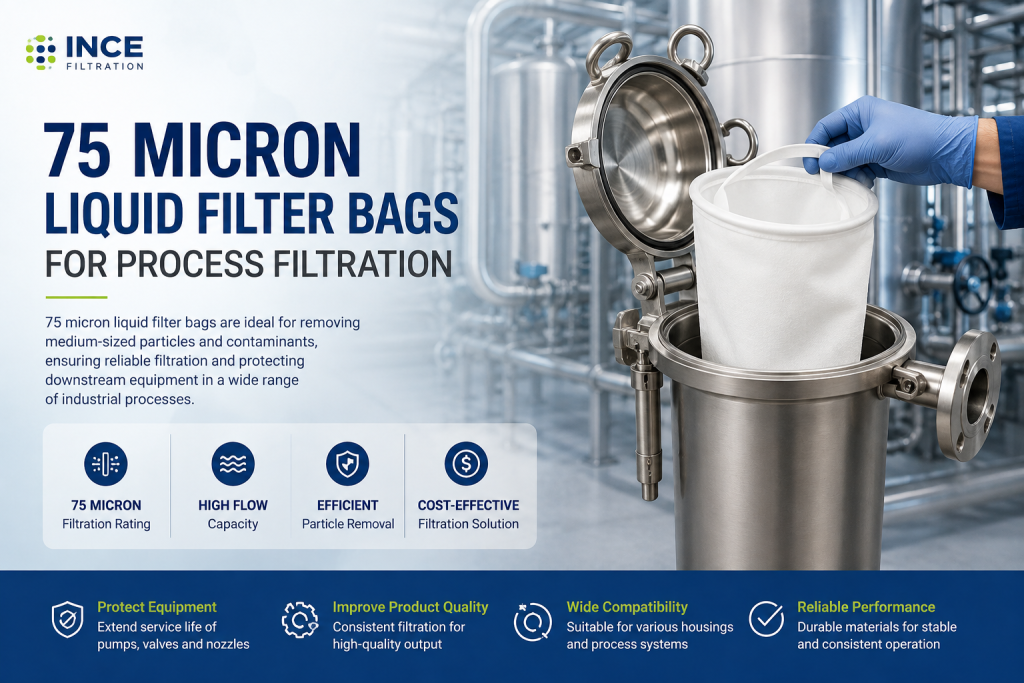
A 75 micron liquid filter bag is often selected when an industrial process needs reliable removal of visible and medium-sized contaminants without moving into fine filtration.
It sits between commonly used 50 and 100 micron grades and can be especially useful for process stabilization, equipment protection, liquid straining and intermediate filtration.
Rather than using 75 micron simply as another point on a micron chart, it is more useful to think of it as a filtration grade for processes where:
- 100 micron allows too much contamination through
- 50 micron creates more restriction than the application requires
- Medium-sized debris must be removed consistently
- High solids loading makes very fine filtration impractical
- Downstream pumps, nozzles or finer filters need protection
INCE filtration supplies industrial liquid filter bags in multiple filtration media, including dedicated 75 micron nylon mesh configurations for process screening and filtration.
Where 75 Micron Fits in an Industrial Filtration Process
Seventy-five micron filtration is generally used for medium particle control rather than fine polishing.
Typical process contaminants may include:
- Tank debris
- Rust flakes
- Larger metal particles
- Paint skins
- Resin agglomerates
- Fiber fragments
- Pipeline contamination
- Coarse suspended solids
- Food-processing residues
- Manufacturing debris
At 75 µm, the purpose is often not to produce visually crystal-clear liquid.
Instead, the filter helps keep the process stable by preventing larger unwanted particles from moving further downstream.
This makes 75 micron useful in continuous manufacturing systems where excessive fine filtration would add unnecessary maintenance.
Why Choose 75 Micron Instead of 50 or 100 Micron?
The difference between these three ratings may appear small, but it can matter in real process conditions.
50 Micron
Better when smaller suspended particles must be removed.
It is the finer option but may load more quickly when the liquid contains a large concentration of solids.
75 Micron
Useful when the process requires a middle position between contamination control and throughput.
It is especially practical for:
- Intermediate filtration
- Equipment protection
- Product straining
- Moderate solids loading
100 Micron
Better for coarse pre-filtration where larger debris is the primary concern.
It generally places less restriction on the process but allows more medium-sized contamination downstream.
50 vs. 75 vs. 100 Micron: Practical Selection
| Process Requirement | 50 Micron | 75 Micron | 100 Micron |
|---|---|---|---|
| Fine suspended solids | Better | Moderate | Limited |
| Medium particle control | Excellent | Very suitable | Good |
| Coarse debris removal | Good | Very good | Excellent |
| High solids loading | Moderate | Good | Very good |
| Equipment protection | Strong | Balanced | Basic |
| Intermediate screening | Suitable | Ideal | Suitable |
| Final polishing | Limited | Not typical | Not typical |
The most useful question is not:
“Which micron is better?”
It is:
“What is the largest particle that can safely remain in the process?”
If particles around 80–100 µm are causing problems but finer contaminants are acceptable, 75 micron can be a very logical selection.
75 Micron as a Process Stabilization Filter
One of the best uses of a 75 micron filter bag is maintaining process stability.
Many industrial systems do not require extremely fine liquid clarity.
They simply need to prevent contaminants from:
- Blocking spray nozzles
- Entering pumps
- Scratching surfaces
- Accumulating in tanks
- Damaging downstream equipment
- Entering final product filling systems
In these applications, using an unnecessarily fine filter may increase maintenance without improving the process result.
A 75 micron bag provides a useful mechanical barrier against medium-sized particles while allowing the process to continue with relatively low filtration burden.
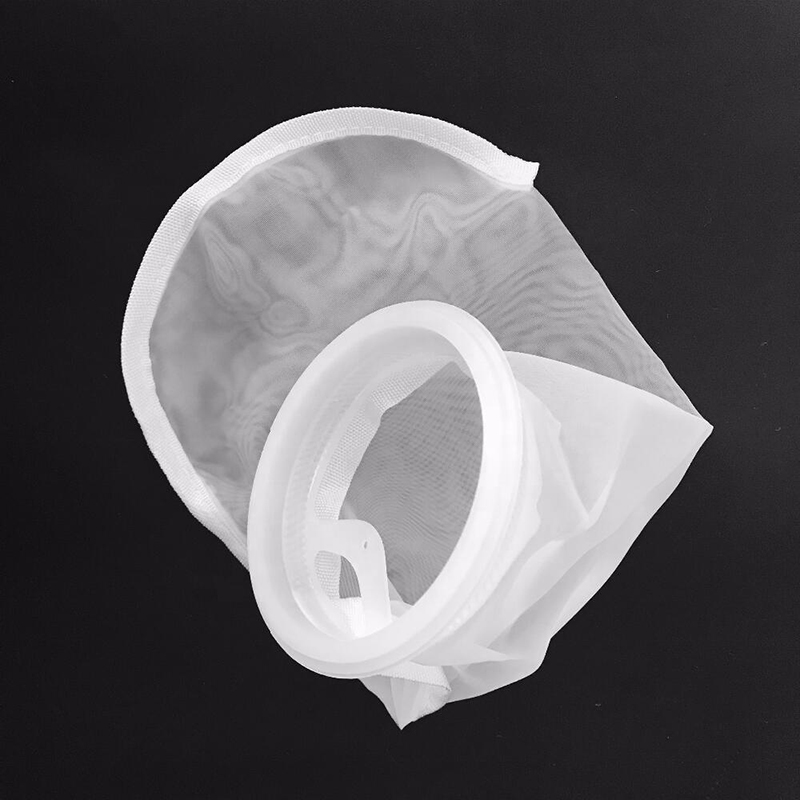
75 Micron Nylon Mesh Filter Bags
Nylon monofilament is one of the most relevant materials at the 75 micron level.
Unlike felt, nylon monofilament works mainly by surface screening.
The woven openings provide a relatively defined separation point, so particles larger than the mesh openings remain primarily on the media surface.
This type of construction is useful when:
- Particle size is relatively consistent
- High permeability is required
- Solids should remain on the surface
- Cleaning may be considered
- Fiber migration should be minimized
Current commercial 75 micron products from multiple suppliers are commonly based on nylon monofilament mesh, which reflects the strong fit between this micron range and surface-screening applications.
INCE filtration also manufactures a dedicated 75 micron nylon range with defined industrial dimensions and multiple ring-top configurations.
When Felt May Be Better Than Nylon Mesh
Nylon mesh is not automatically the best choice for every 75 micron application.
Felt can be preferable when the contaminant contains particles of many different sizes.
Felt
Felt captures particles throughout the thickness of the media.
This makes it suitable when:
- Contamination is irregular
- Smaller particles are mixed with larger solids
- Dirt-holding capacity is more important than a defined opening
- Depth loading is desired
Nylon Mesh
Mesh mainly retains particles at the surface.
This makes it suitable when:
- Defined screening is important
- The contaminant is relatively uniform
- High permeability is required
- Easy particle release is valuable
At 75 micron, deciding between depth filtration and surface screening can be more important than the micron number itself.
Application: Paints and Coatings
Paint and coating systems often contain unwanted:
- Skins
- Agglomerates
- Tank contamination
- Mixing debris
A 75 micron bag can be used before:
- Filling
- Transfer
- Spray application
- Downstream processing
This grade can be useful when the process needs to remove visible and medium-sized defects without filtering so finely that desirable pigments or formulation components are affected.
For coating applications, particle distribution and viscosity should be reviewed before changing micron rating.
Application: Industrial Water and Utility Systems
Industrial water does not always require fine polishing.
In many factories, the goal is simply to prevent larger contamination from reaching equipment.
A 75 micron filter bag can be used for:
- Utility water
- Equipment wash water
- Cooling-water side streams
- Recycled process water
- Tank circulation
Typical contaminants include rust, scale, sediment and debris.
Where finer cleanliness is required later, 75 micron filtration can serve as an upstream screening stage.
Application: Metalworking and Parts Cleaning
Metalworking and parts-washing systems can contain:
- Chips
- Abrasive particles
- Dirt
- Larger metal fragments
- Process residues
A 75 micron bag can help reduce these contaminants before the fluid returns to pumps or spray systems.
This can be especially useful where extremely fine filtration is unnecessary but uncontrolled debris would create equipment or quality problems.
Application: Food and Beverage Process Straining
Selected food-processing liquids may require removal of:
- Fibrous material
- Undissolved solids
- Larger ingredient particles
- Foreign matter
A 75 micron mesh bag can act as a process-straining stage where the objective is particle separation rather than fine clarification.
Material compatibility, food-contact requirements and cleanability must be confirmed for the specific application.
Application: Resins, Adhesives and Viscous Process Liquids
Viscous liquids can become difficult to process through very fine filters.
Resins and adhesives may contain:
- Gel particles
- Cured material
- Tank skins
- Foreign solids
A 75 micron screening stage can remove larger defects without creating the pressure loss associated with very fine filtration.
This is particularly important in processes where maintaining transfer speed is more important than removing fine suspended particles.
Protecting Pumps and Nozzles
One practical reason to use 75 micron filtration is equipment protection.
Instead of selecting the micron rating based on liquid appearance, start with the smallest opening inside the equipment being protected.
For example, if a spray system can tolerate fine suspended particles but is vulnerable to larger debris, a 75 micron filter may prevent:
- Nozzle blockage
- Pump damage
- Valve fouling
- Flow interruption
without over-filtering the entire liquid stream.
This is often a more economical filtration strategy.
Using 75 Micron as an Intermediate Stage
Seventy-five micron also works well between coarse screening and finer filtration.
A process could use:
200 micron screening → 75 micron filter bag → downstream process
or:
75 micron bag → 10 or 25 micron final filtration
In the second arrangement, the 75 micron bag removes the larger contaminant load before the finer filter.
This allows the downstream element to focus on smaller particles.
The benefit is not simply longer filter life.
It can also make filtration behavior more predictable because the downstream filter receives a more consistent particle distribution.
75 Micron for Batch Transfer Filtration
Batch processes often generate temporary contamination during:
- Mixing
- Tank cleaning
- Raw-material addition
- Product transfer
A 75 micron filter bag can be installed during transfer from one vessel to another to capture unwanted debris before the next production stage.
This is useful in processes where a permanent fine-filtration system would be unnecessary.
Typical examples include:
- Paint production
- Chemical blending
- Resin preparation
- Industrial cleaning fluids
- Selected food-processing liquids
Why Particle Shape Matters
Micron ratings describe size, but real particles are not always spherical.
Industrial contaminants may be:
- Flat
- Fibrous
- Needle-shaped
- Flexible
- Irregular
- Soft agglomerates
A long thin particle may behave differently from a round particle with the same nominal dimension.
This is particularly important when comparing mesh and felt.
Mesh relies more strongly on the geometry of its openings, while felt captures particles through a complex fiber structure.
For difficult applications, actual filtration testing can be more valuable than relying only on a micron number.
Nominal Rating vs. Defined Mesh Opening
This is another important distinction.
A felt bag may carry a nominal micron rating, which describes its approximate retention performance.
A monofilament mesh bag is more directly related to the physical opening of the woven mesh.
That does not mean every process result is perfectly predictable, because particle shape, pressure and deformation still matter.
However, for screening applications where a relatively defined opening is important, monofilament mesh is often easier to specify.
This is one reason 75 micron nylon mesh is common in industrial straining applications.
What Can Cause a 75 Micron Bag to Fail Prematurely?
A filter may perform poorly even when the micron rating is correct.
Common causes include:
Excessive Solids Loading
Too much contamination can cover the media quickly.
Incorrect Media
A chemically incompatible filter can weaken or deform.
Poor Housing Fit
An incorrect ring or collar can allow bypass.
High Viscosity
Thick liquids can create much greater resistance than water.
Wrong Filtration Mechanism
A mesh filter may not perform like felt when the contaminant contains a wide particle-size distribution.
Excessive Flow Velocity
Very high velocity can reduce effective filtration performance and increase mechanical stress.
When 75 Micron Is Too Fine
Consider 100, 150 or 200 micron filtration when:
- Only large debris must be removed
- Solids loading is very high
- The process does not benefit from medium particle control
- Maximum throughput is the priority
Using a 75 micron bag in such a process may simply increase replacement frequency.
When 75 Micron Is Too Coarse
Consider 50, 25 or 10 micron filtration when:
- Smaller particles affect surface quality
- Fine sediment is still reaching downstream equipment
- Product clarity is insufficient
- Sensitive equipment requires tighter protection
The correct micron rating should be tied directly to the downstream requirement.
How to Evaluate Whether 75 Micron Is Working
Instead of relying only on filter appearance, evaluate the process.
Useful indicators include:
- Downstream particle contamination
- Nozzle blockage frequency
- Pump and valve maintenance
- Product defects
- Filter-change frequency
- Pressure behavior
- Solids captured per bag
- Process interruptions
If equipment problems remain, the micron rating may be too coarse.
If bags load too quickly without improving process quality, the rating may be finer than necessary or the system may require upstream screening.
What Information Should Be Provided for Selection?
For a useful filtration recommendation, provide:
- Liquid being filtered
- Main contaminant
- Approximate particle size
- Whether particles are hard, soft or fibrous
- Required flow rate
- Liquid viscosity
- Operating temperature
- Current micron rating
- Existing bag dimensions
- Filter housing type
- Whether cleaning or disposal is preferred
- Required quantity
This information helps determine whether 75 micron should be used as a mesh screening stage, felt depth filter or part of a multi-stage filtration process.
75 Micron Liquid Filter Bag FAQ
What is a 75 micron filter bag used for?
It is commonly used for medium particle removal, industrial liquid straining, process stabilization and protection of downstream equipment.
Is 75 micron finer than 100 micron?
Yes. A 75 micron grade removes smaller particles than a 100 micron filter under comparable conditions.
Is 75 micron coarser than 50 micron?
Yes. It allows larger particles to pass than a 50 micron filter.
Why would I choose 75 micron instead of 50 micron?
Choose 75 micron when 50 micron filtration is finer than necessary and creates more loading or restriction without improving the process result.
Is nylon mesh suitable at 75 micron?
Yes. Nylon monofilament is widely used at this filtration grade because it provides a defined mesh opening and good liquid permeability.
Is felt available at similar micron ratings?
Yes, depending on the manufacturer and media range. Felt provides depth filtration rather than the surface-screening behavior of monofilament mesh.
Can 75 micron be used before a finer filter?
Yes. It can remove medium-sized solids before 10, 25 or 50 micron downstream filtration.
Can INCE filtration supply 75 micron filter bags?
Yes. INCE filtration has a dedicated 75 micron nylon liquid filter bag range with multiple actual dimensions and ring-top configurations.
Using 75 Micron Filtration to Keep a Process Stable
A 75 micron liquid filter bag is best viewed as a process-control tool rather than simply another micron option.
Its value comes from removing medium-sized contamination that can disrupt equipment or production while avoiding unnecessarily fine filtration.
It is particularly useful for:
- Process straining
- Equipment protection
- Batch transfer filtration
- Industrial water
- Coatings
- Cleaning liquids
- Metalworking fluids
- Intermediate filtration stages
The most important decision is whether the process requires surface screening or depth filtration.
For relatively defined particle separation, nylon monofilament mesh can be a strong option.
For broader contaminant distributions, felt media may provide better depth loading.
INCE filtration already manufactures a dedicated range of 75 micron nylon filter bags for industrial liquid filtration. For exact sizes, ring-top structures and product codes, use the dedicated 75 Micron Nylon Liquid Filter Bags product page rather than duplicating those specifications here.
For application selection, send INCE filtration your:
Liquid type
Particle description
Current filtration grade
Flow requirement
Viscosity
Housing size
Downstream equipment requirement
INCE filtration can help determine whether 75 micron filtration is appropriate and whether mesh, felt or another filtration configuration better matches the process.
Contact INCE filtration for 75 micron filter bag selection, OEM filtration supply or application-specific filtration solutions.
 WhatsApp