
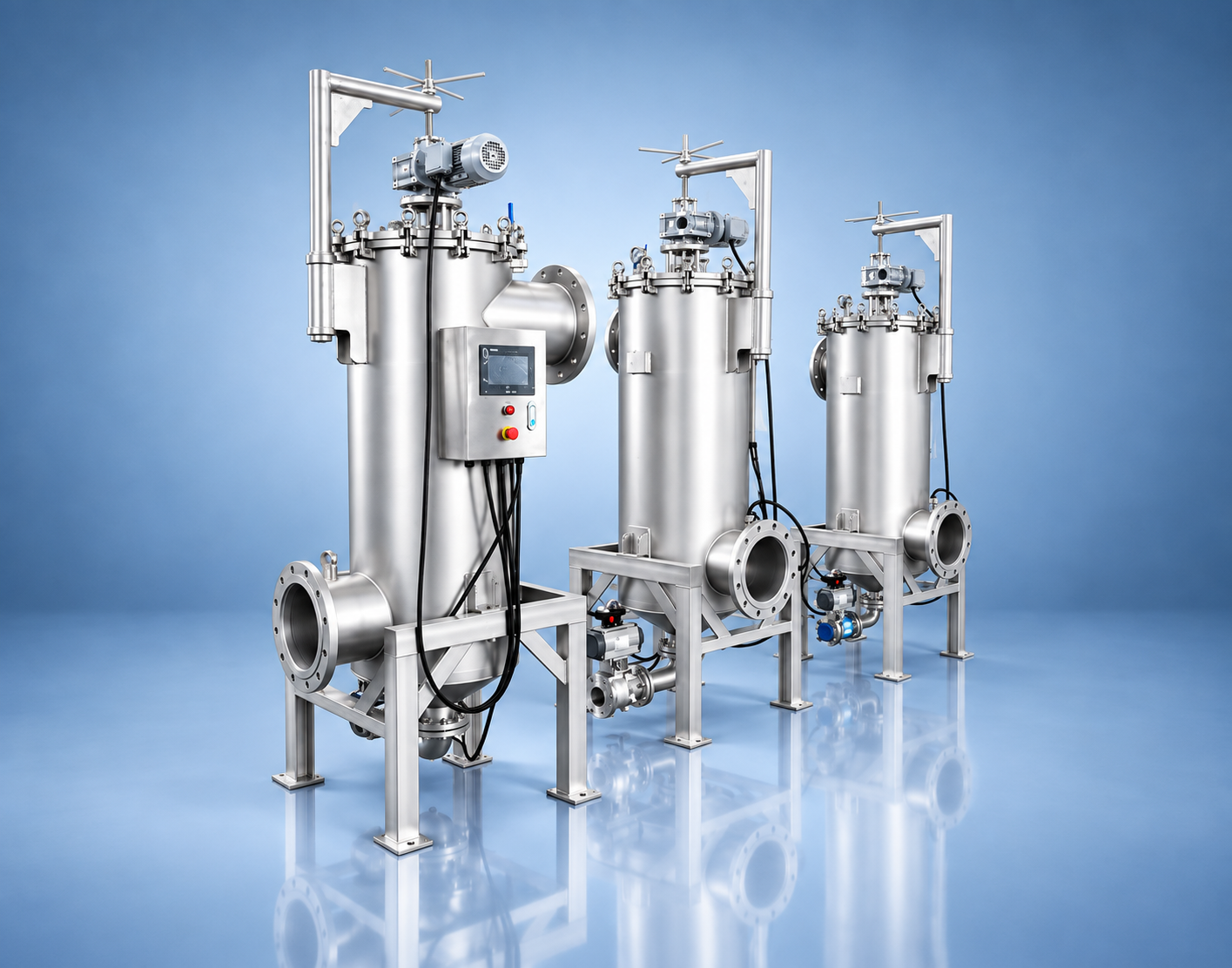
Choose an internal scraper when deposits form on the inside surface of the screen or suspended impurities tend to adhere there; choose an external scraper when larger particles accumulate on the outside surface and need regular removal. This is a starting rule, not a final design: solids, viscosity, stickiness, flow, pressure and drain logic must be reviewed. See the self-cleaning filter housing product page for the equipment family.
Trying to reduce manual filter cleaning? Request an internal/external scraper selection. Include the operating liquid, micron or opening target, flow, temperature, pressure, connection, quantity, destination country, and any drawing or incumbent model available.
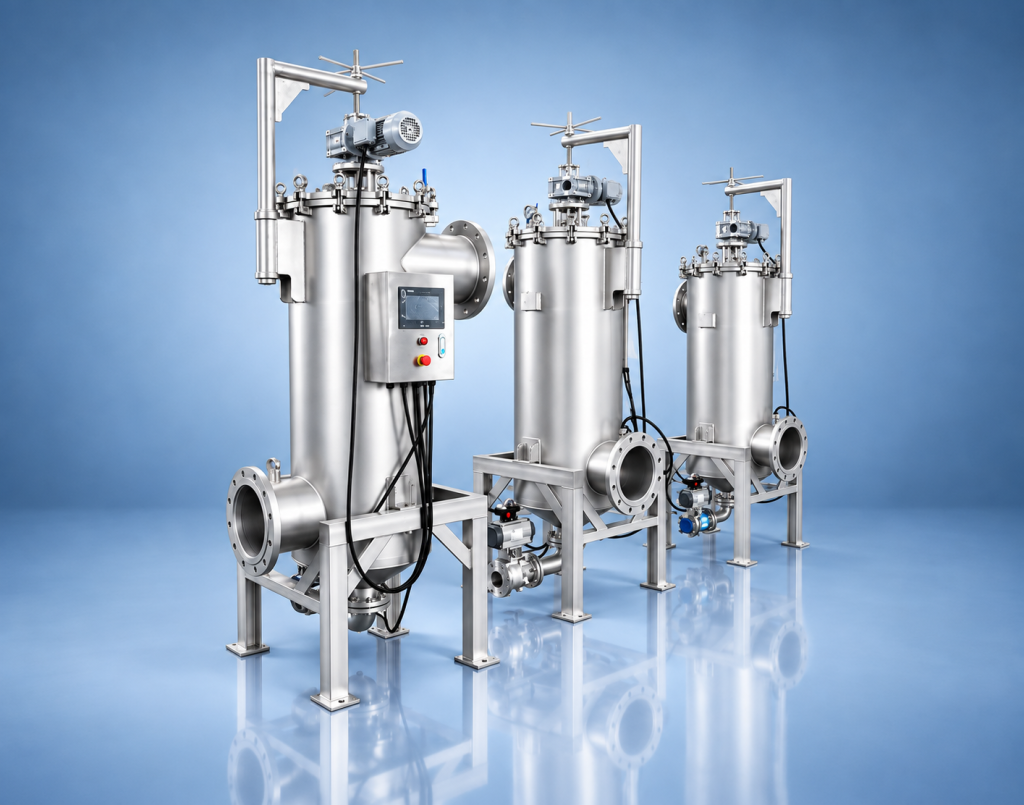
Internal versus external scraper: the buyer’s first decision
| Selection question | Internal scraper | External scraper |
|---|---|---|
| Where does the deposit form? | Inside surface of the screen | Outside surface of the screen |
| Published application cue | Adhering suspended impurities / inward deposits | Larger or regularly accumulating particles |
| What must be verified | Particle stickiness, hardness, shape, concentration and whether the scraper can remove the cake | Particle size/shape, loading, abrasion and whether discharge prevents re-deposition |
| Drain strategy | Time, differential pressure, manual or PLC trigger must match the process | Same; discharge frequency and valve sequence must be engineered |
| Purchase evidence | Section drawing, screen orientation, scraper material, motor/gearbox and control narrative | The same project documents are required |
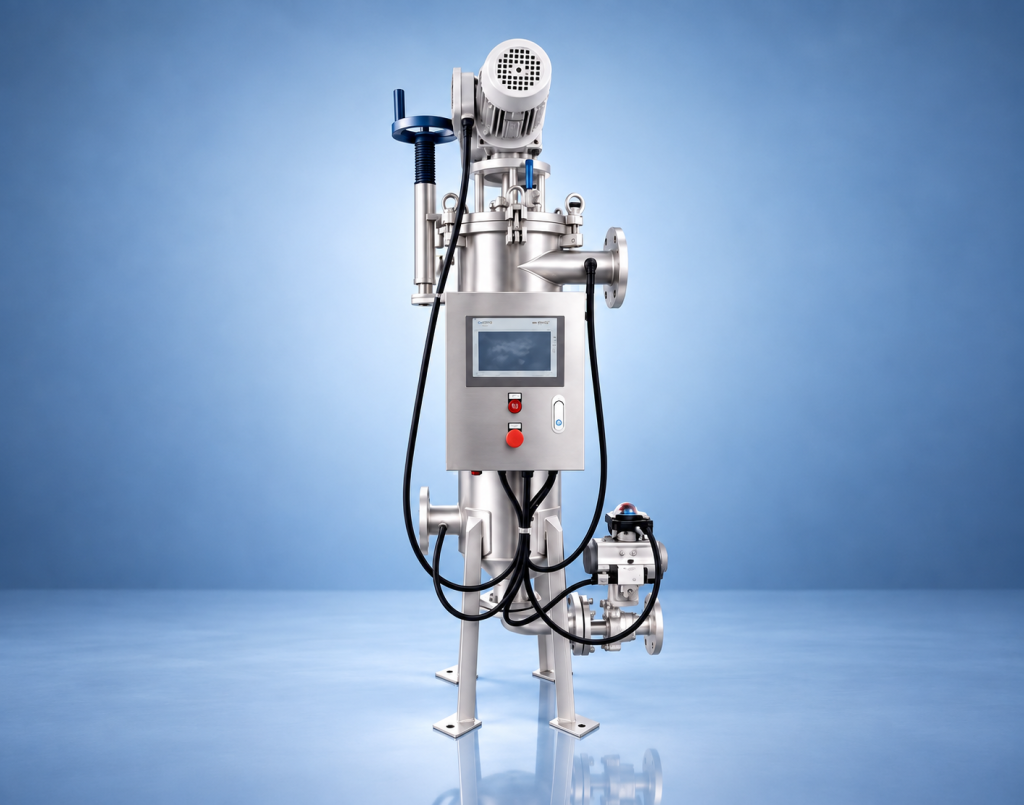
INCE lists reusable 304/316L V-slot metal screens, a PTFE scraper and FKM seal as reference configuration items. The product family publishes filtration down to a 20 µm reference, vessel sizes from 219 to 800 mm, operating-pressure reference around 0.8 MPa, DN40 drain reference and motor power around 0.37–0.55 kW. These figures describe the range; they do not prove suitability for an unreviewed process.
What process data decides the scraper arrangement?
- Liquid: composition, viscosity and density at minimum/normal/maximum temperature, corrosiveness and whether it crystallizes or cures.
- Solids: particle-size distribution, hardness, shape, concentration, stickiness, compressibility and whether particles can damage the screen.
- Hydraulics: required flow, inlet pressure, allowable pressure drop, operating cycle and downstream sensitivity.
- Filtration: target opening or test requirement, screen material, expected cake behavior and acceptable carryover.
- Discharge/control: drain destination, valve type, purge volume, time or differential-pressure trigger, PLC signals and motor voltage/frequency.
- Mechanical: connection standard/orientation, 304 or 316L, seal compatibility, space, support, cleaning method and applicable code.
Why the 20 µm and 0.8 MPa references need engineering confirmation
Finer openings increase resistance and may change cleaning behavior. Pressure, temperature, screen geometry and liquid viscosity affect the selection together. Ask the quotation to state the selected screen, clean and terminal differential pressure assumptions, design conditions and control sequence. Do not use a single web specification as a universal guarantee.
Before choosing internal or external scraper Send your solids and control data. Include the operating liquid, micron or opening target, flow, temperature, pressure, connection, quantity, destination country, and any drawing or incumbent model available.
Minimum quotation deliverables
- Model/configuration and internal or external scraper statement.
- Process/design conditions and materials of construction.
- Screen type, material, stated opening and filtration basis.
- Vessel/nozzle/drain drawing and service clearances.
- Motor, gearbox, voltage/frequency and control/interface description.
- Cleaning/discharge trigger and valve sequence.
- Seal materials, spare/wear parts and maintenance instructions.
- Inspection, documentation, packing and destination requirements.
A safer selection sequence
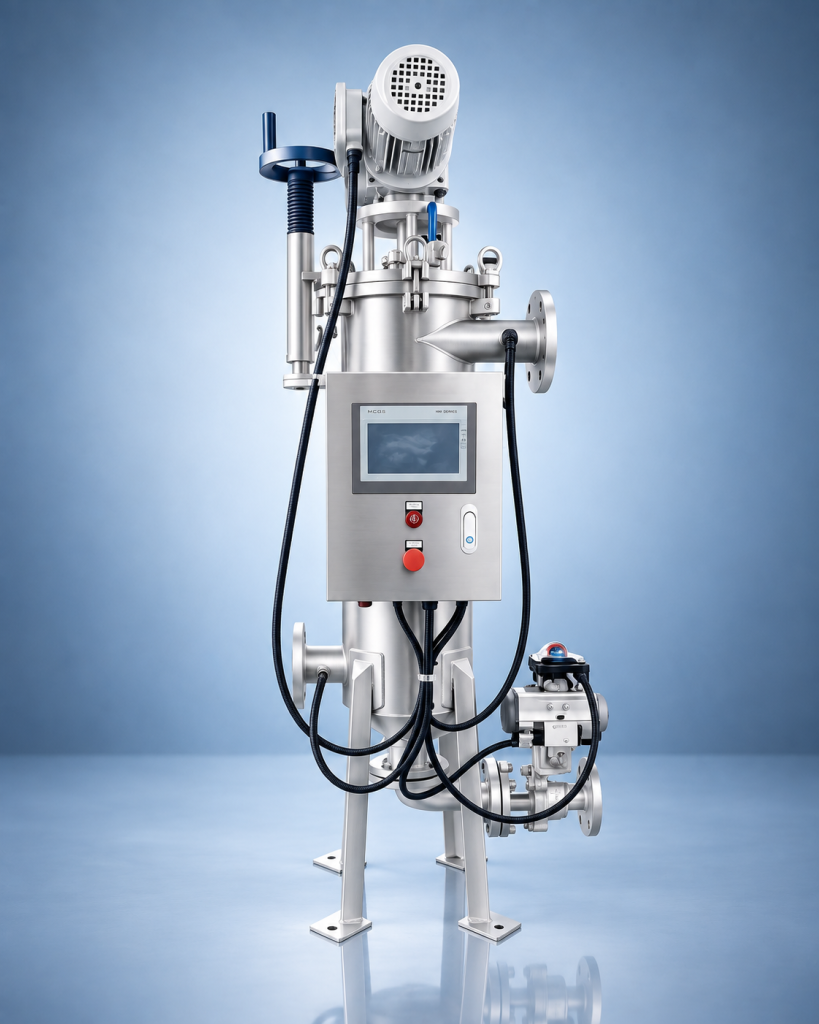
First establish where and how solids deposit. Next confirm the screen opening and process differential-pressure limits. Then define how the scraped solids leave the vessel. Finally, review motor, controls, materials and service access. A pilot or sample test may be appropriate when particles are highly sticky, deformable, abrasive or variable.
Frequently Asked Questions
Is an internal scraper always better for sticky solids?
Not automatically. The published cue supports inside-surface deposits and adhering impurities, but actual behavior depends on solids, screen geometry, viscosity and cleaning conditions. Provide a sample or test data when risk is high.
Can I select the unit only from flow rate?
No. Flow must be reviewed with viscosity, solids load, screen opening, pressure drop, vessel size and cleaning/discharge cycle.
What should I send for a control quotation?
Provide motor power supply, PLC or standalone preference, time/differential-pressure/manual triggers, alarm/interlock needs, drain valve sequence and site standards.
Have process data, a sample or an incumbent model Get an engineered scraper-filter quotation. Include the operating liquid, micron or opening target, flow, temperature, pressure, connection, quantity, destination country, and any drawing or incumbent model available.
 WhatsApp