
A filter bag efficiency test report should connect a particle size to a measured removal result under stated test conditions. A micron label, an “absolute” description or an efficiency percentage alone leaves important procurement questions unanswered. Ask which offered bag, assembly and test conditions the result actually represents.
This guide is about evaluating performance evidence. It does not assign an efficiency to INCE bags. Use the PP filter bags product page to request a proposed grade and supporting information; use the micron selection chart for the broader size-selection discussion.
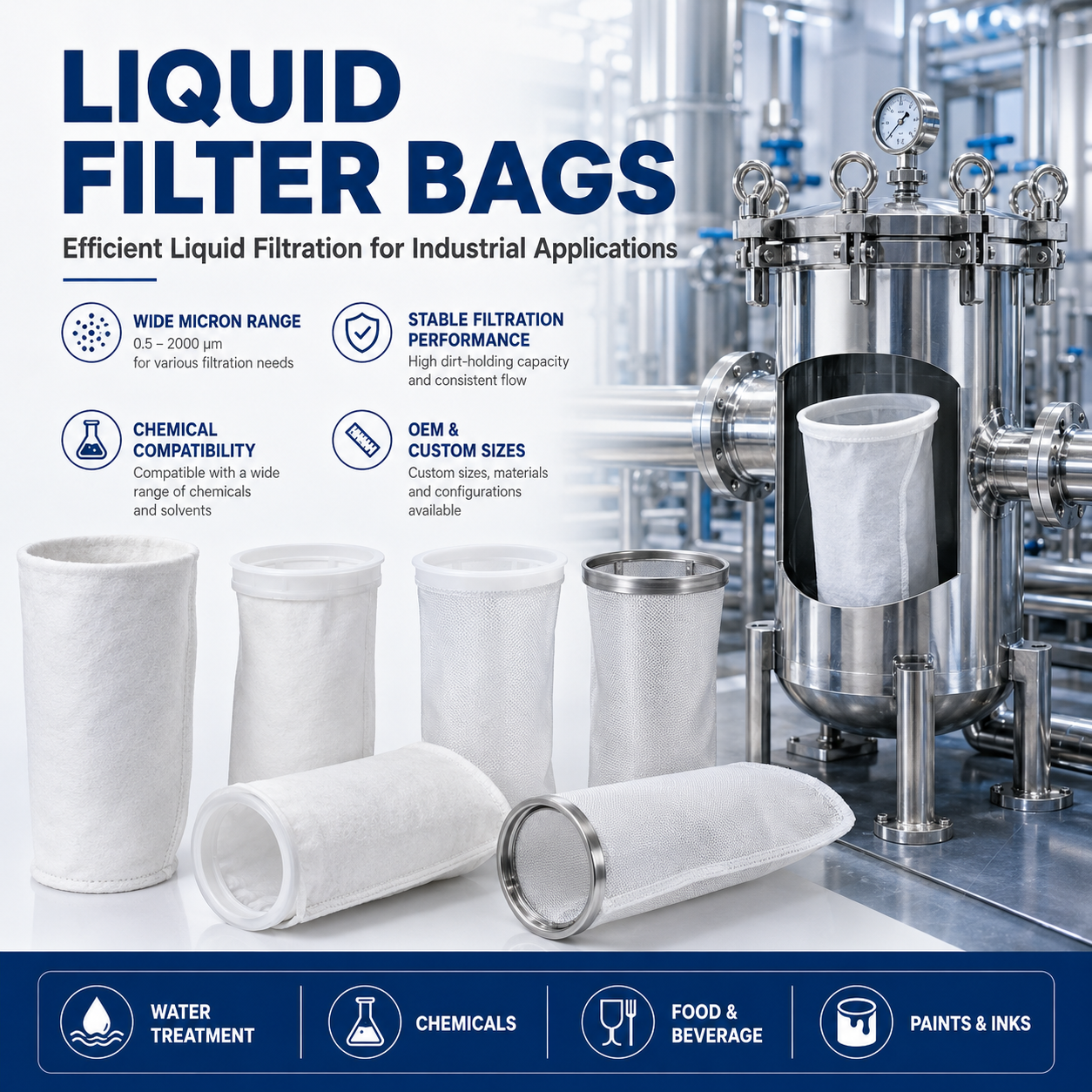
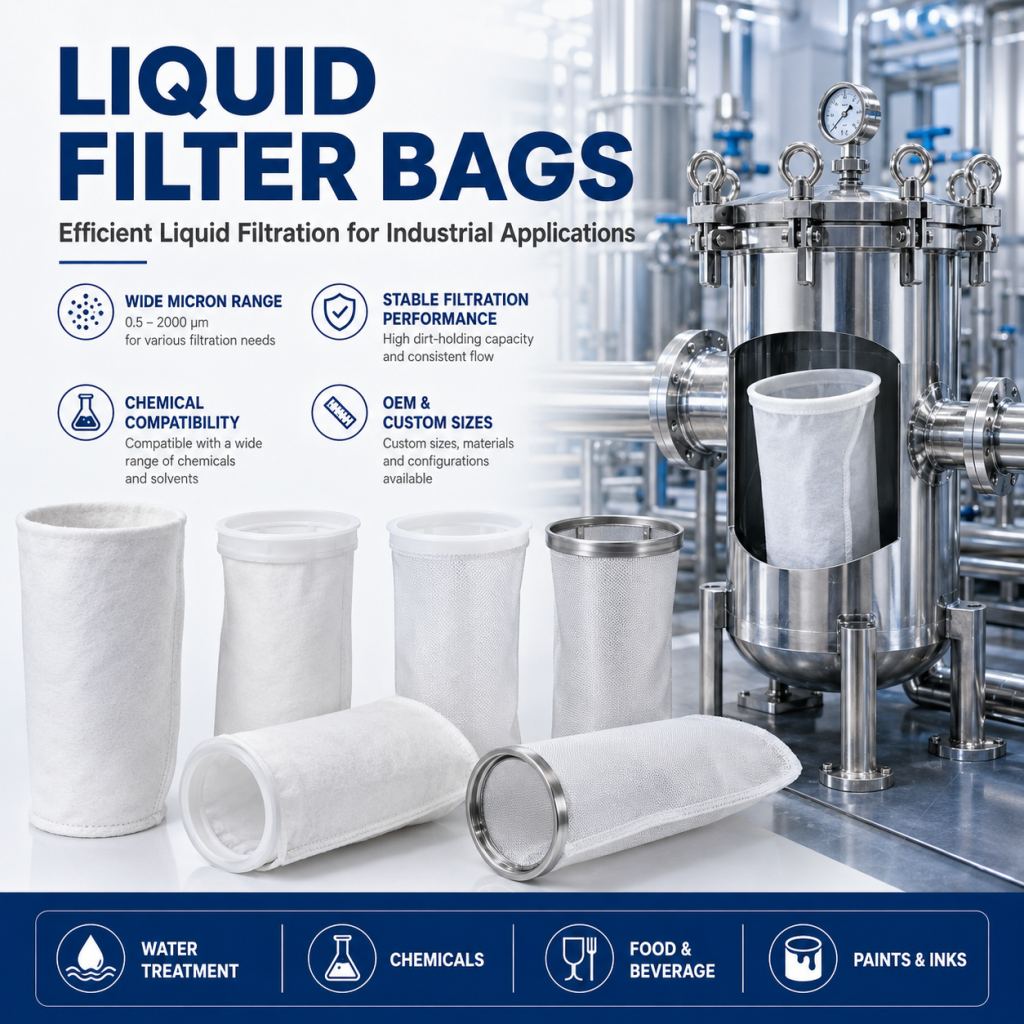
Representative liquid filter bags. A product photograph does not verify a beta ratio or particle-retention claim.
Read beta ratio with its particle-size threshold
For a stated particle-size threshold, beta compares upstream and downstream particle concentrations on a consistent basis. The corresponding removal efficiency is 100 × (1 − 1/β). Donaldson’s technical explanation makes the same central point: the size and the efficiency must be reported together.
| Illustrative beta value | Calculated efficiency | Interpretation at the stated size |
|---|---|---|
| 10 | 90% | One-tenth of the upstream concentration remains downstream |
| 100 | 99% | One-hundredth remains downstream |
| 1,000 | 99.9% | One-thousandth remains downstream |
These are mathematical examples, not INCE product ratings. They describe concentration ratios at a specified threshold, not the percentage of every possible contaminant removed from a process. A laboratory result is also not a warranty of identical field performance.
Ask what was tested
Request the exact sample identification, media construction, finished bag dimensions, seam, collar and housing arrangement. A small media coupon does not automatically represent a finished bag with seams and a bag-to-housing seal. An assembly test may evaluate a different scope from a media-only result.
Then request the test method and edition, challenge material, test liquid, particle-size measurement basis, flow and temperature, loading sequence and report date. Identify whether the stated result applies to the clean condition, a particular loading point or another reporting basis. Do not compare unlike conditions as though they were a controlled side-by-side trial.
Distinguish four kinds of evidence
| Evidence supplied | What to confirm | What it does not establish alone |
|---|---|---|
| Catalog micron label | Supplier’s rating definition and proposed grade | A specified removal percentage |
| Media test | Sample and method match the offered medium | Finished-bag sealing performance |
| Finished assembly report | Bag and housing configuration are identified | Performance in every process liquid |
| Application trial | Approved conditions and downstream acceptance criteria | Universal performance outside the tested duty |
In a comparative RFQ, send the same duty and evidence requirements to every supplier. If only a datasheet is available, record that limitation. Ask for clarification or a qualification sample rather than silently replacing missing evidence with a stronger marketing description.
Keep nominal ratings and woven openings in context
Do not assign one universal efficiency percentage to the word “nominal,” or interpret “absolute” as a test-free guarantee that no particle can pass. Require the supplier’s definition and the evidence relevant to your process requirement.
For a 75 or 250 micron requirement, clarify whether the number refers to a media rating, a woven opening or a result under an agreed method. For nylon mesh bags and stainless steel filter mesh, geometric information remains useful, but it is not automatically the same evidence as a finished assembly’s particle-retention report.
Turn the evidence into an acceptance decision
Define the critical downstream result with the responsible process team. Ask whether the available report addresses that result and whether a process trial remains necessary. Retain the agreed report identifier with the approved product revision so that a later substitution is reviewed rather than assumed equivalent.
Use the separate lot traceability and incoming inspection guide for receiving controls. Routine dimensional or visual inspection is a different task from establishing the efficiency of the proposed design.
Request a performance-evidence review
Send the required particle-size threshold and removal criterion, liquid, flow, temperature, current bag reference and order quantity. Ask INCE to identify available test evidence, its scope and any qualification work still required before a final specification is accepted.
Frequently asked questions
Does a beta value without a particle size define the bag?
No. The particle-size threshold, measurement basis and test conditions are essential to interpreting the value.
Can a media coupon report approve a complete filter bag?
Not automatically. Confirm whether the evidence covers the finished bag, seams, collar and housing interface, or only the media sample.
Are the example efficiencies INCE product specifications?
No. They are calculations explaining beta ratio. Any offered product performance must be supported by its own identified evidence.
Technical reference
Donaldson: Understanding Beta Ratings in Liquid Filters explains the concentration ratio and its relationship to efficiency. Its hydraulic and engine-filter testing context does not establish that a particular liquid filter bag has been tested to the same method.

 WhatsApp