
Selecting a single cartridge filter housing or a multi cartridge filter housing requires more than matching the pipe diameter. Cartridge media, length, liquid viscosity, solids loading, allowable pressure drop and changeout requirements all affect the correct layout.
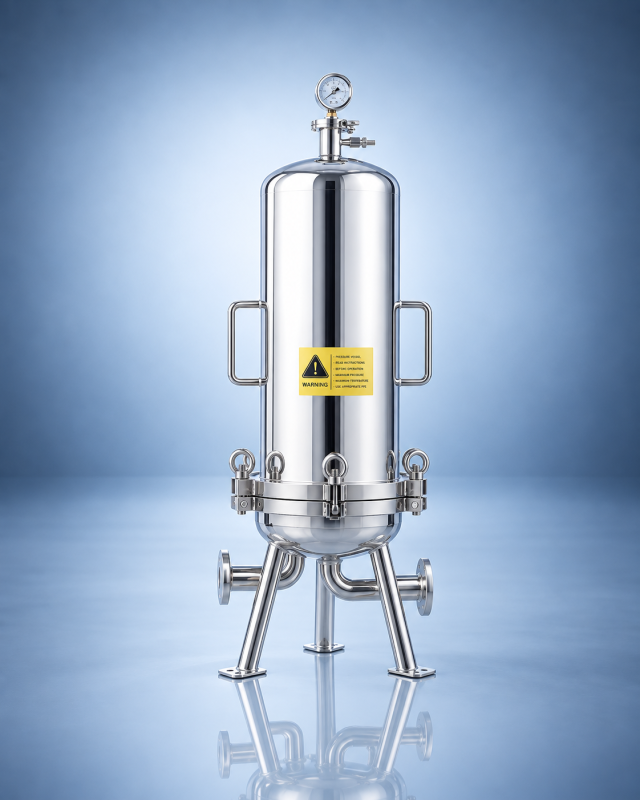
Single versus multi-cartridge construction
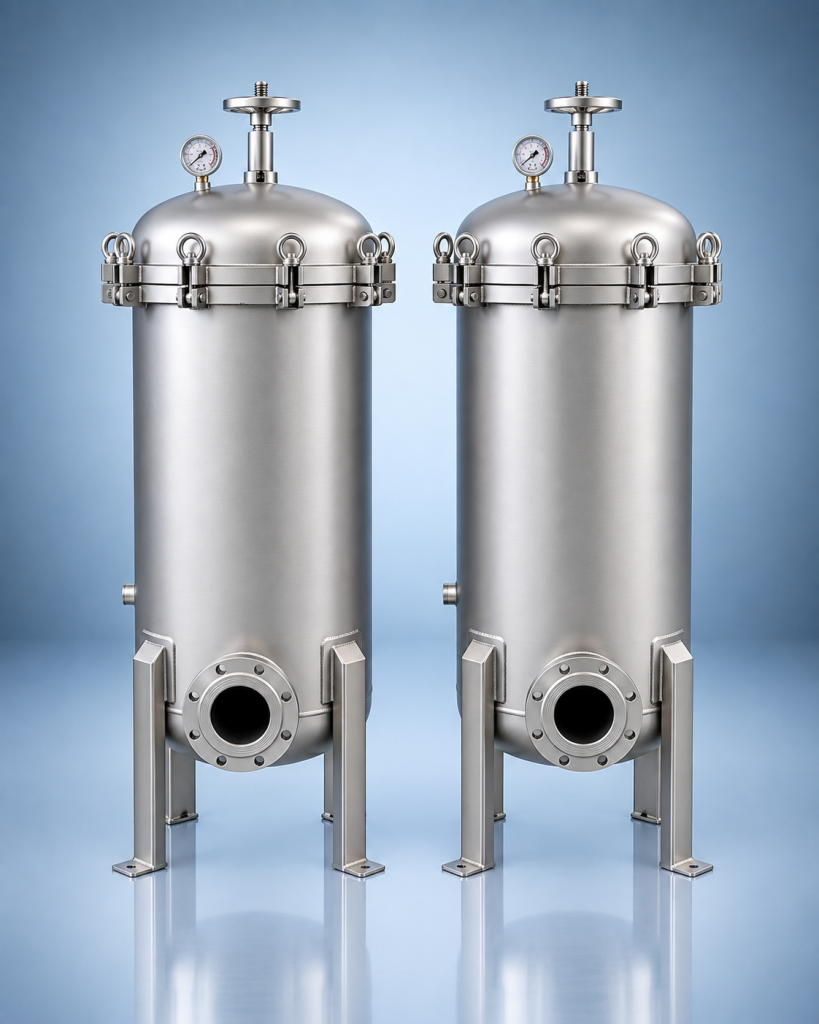
A single-cartridge arrangement can suit a compact duty when one properly selected element provides the required performance. A multi-cartridge vessel places several elements in one housing. Adding elements may provide more available media area, but total flow must still be checked against the cartridge data, housing hydraulics and process conditions.
| Selection factor | Single-cartridge review | Multi-cartridge review |
|---|---|---|
| Required flow | Check one element at the real liquid conditions | Review total area, distribution and nozzle losses |
| Maintenance | Confirm removal clearance for the element | Confirm lid access, element handling and changeout time |
| Solids loading | Check expected service interval | Check fouling distribution and replacement scope |
| Installation | Check compact layout and connections | Check floor space, lifting and support requirements |
20 inch stainless steel cartridge filter housing
For a 20 inch stainless steel cartridge filter housing, specify whether 20 inches is the nominal cartridge length and provide the actual overall dimension. Confirm element diameter and both end configurations. The usable internal space must accommodate the cartridge, seal engagement and retaining system.
40 inch cartridge filter housing
A 40 inch cartridge filter housing may accommodate longer elements, but the vessel height is not the only installation dimension. Allow room above or beside the housing to withdraw the complete cartridge and operate the closure. Compare the proposed layout with platform height, piping, ceiling obstructions and safe maintenance access.
Do not assume a 40-inch element provides exactly twice the usable operating flow or lifetime of a 20-inch element. Confirm the manufacturer’s pressure-drop data for the selected media, rating and liquid. Nominal length is also insufficient to establish replacement compatibility.
One long element or several shorter elements?
Compare total filtration area, clean pressure drop, expected fouling, available height and replacement logistics. A lower vessel with more short elements may simplify clearance in one installation; a taller arrangement may be preferable elsewhere. An engineering review should establish the arrangement before a price comparison.
RFQ information for layout selection
- Normal and peak flow, liquid composition, viscosity and temperature.
- Filtration target and cartridge media.
- Cartridge number, nominal and actual length, diameter and end-cap drawing.
- Operating/design pressure and allowable differential pressure.
- Port standard, vent/drain requirements and material.
- Maximum installation height, removal space, quantity and destination.
Review the INCE Cartridge Filter Housing range for existing quantity and length configurations. For larger-diameter elements, compare the separate high-flow housing range. For sealing details, see the 222 and 226 compatibility checklist.
FAQ
Can a 20-inch housing take any 20-inch cartridge?
No. Actual dimensions, diameter, end caps and retaining arrangement must match.
Can I increase flow by installing a coarser cartridge?
A coarser rating changes filtration performance. Review the required downstream protection before considering a different rating.
What if the required cartridge count is unknown?
Send the process duty and selected cartridge details so the supplier can propose an arrangement with stated assumptions.
Request an INCE Filtration Proposal
Send your liquid, flow, pressure, temperature, cartridge details, material requirement and quantity. Include drawings or photos when replacing equipment.
Send Your Cartridge Filter Housing RFQ
View Cartridge Filter Housing Specifications · View High-Flow Housings
 WhatsApp