
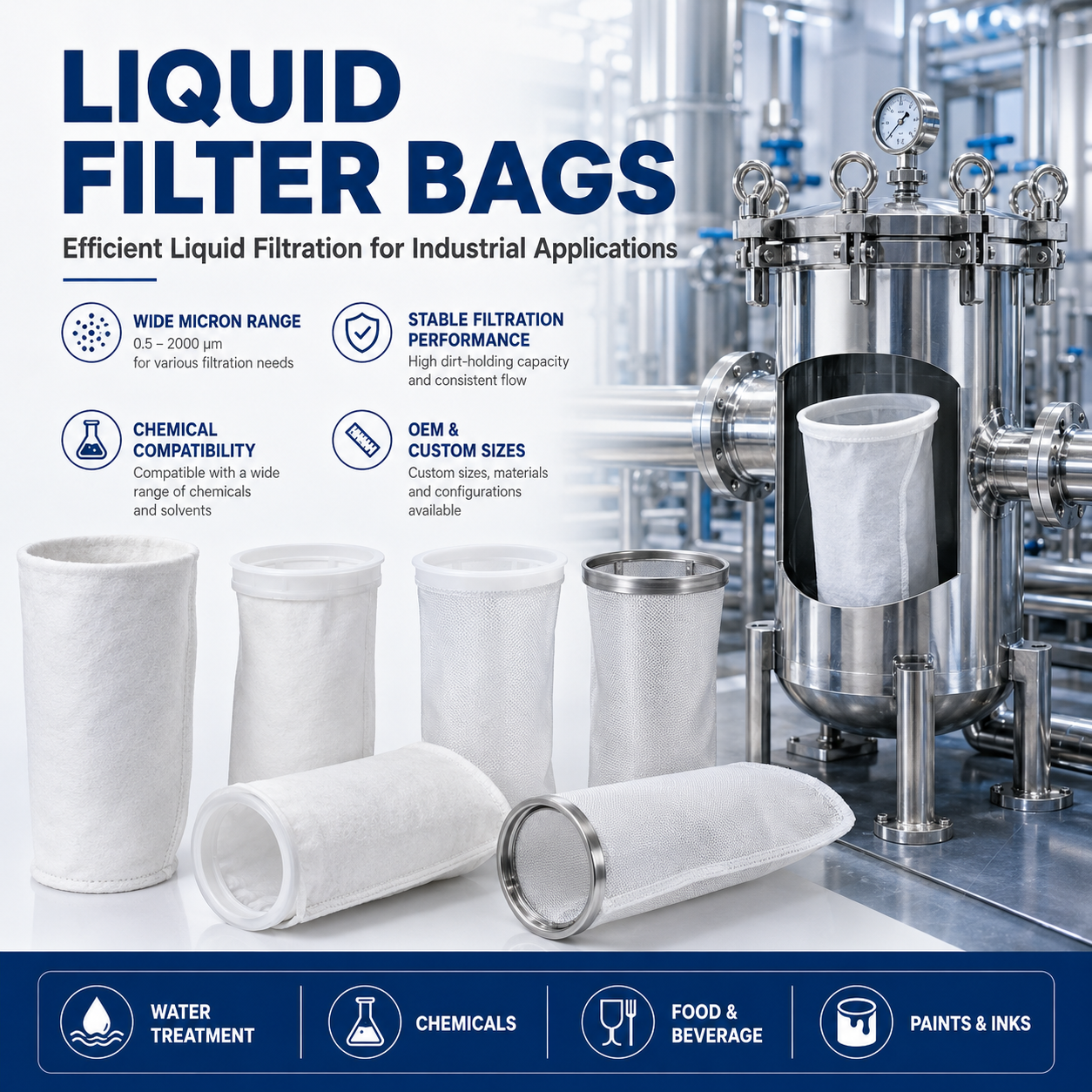
Removing activated carbon or catalyst fines with a filter bag is a solids-separation duty, not a generic micron-selection exercise. The RFQ should state where the filtration step sits in the process, whether the valuable product is the filtrate or retained solid, the particle distribution and loading, the chemistry, viscosity, temperature and required downstream result.
The featured image is representative of industrial liquid filter bags and housings. It does not prove carbon/catalyst retention, chemical compatibility or service life for a particular process.
Define the process objective
Common objectives can include recovery of a catalyst, removal of spent activated carbon after treatment, protection of a downstream cartridge or prevention of visible particulate in a finished liquid. Those duties can need different media, ratings, housing arrangements and handling controls. Eaton’s bag-housing brochure lists activated-carbon or catalyst removal as a demanding chemical-processing application; that manufacturer example does not establish an INCE micron rating or efficiency.
| Question | Buyer data | Decision affected |
|---|---|---|
| What must pass? | Product liquid, solvent, reactant or wash fluid | Media compatibility and filtrate acceptance |
| What must be retained? | Carbon/catalyst type, particle-size evidence and fines fraction | Rating, media structure and trial method |
| How much solid arrives? | Concentration, batch mass, upset maximum and frequency | Bag area, number of stages and change-out frequency |
| What result is required? | Turbidity, particle count, gravimetric residue, visual or downstream limit | Acceptance test and rating basis |
| Which phase is valuable? | Filtrate, retained solid or both | Recovery, heel volume, washing and disposal plan |
Do not convert a particle size directly into a bag rating
A nominal or absolute label is incomplete without the test method and efficiency at the stated particle size. Fine carbon can have a broad distribution and may form a cake that changes retention and differential pressure during the run. Agglomerates can also break during pumping or mixing. Provide an actual sample or particle data and use the filter bag efficiency report guide to request evidence in a comparable format.
A 75 or 250 µm bag may be useful as a coarse guard stage when large agglomerates or debris are present, but neither value should be presented as a universal carbon-removal solution. If staged filtration is proposed, define what each stage removes and how the final result is measured.
Screen the media against the complete chemistry
State every solvent, acid, alkali, salt, additive and cleaning fluid, plus minimum/normal/maximum temperature and contact time. A PP Filter Bag or polyester filter bag should be selected only after checking the exact media, seam, ring/collar and any gasket against the full exposure. A general polymer-compatibility statement is not a guarantee for a finished bag or a mixed process stream.
Include the possibility of static, flammability, toxic exposure and pyrophoric or reactive catalyst residues in the plant hazard review. The filter supplier cannot define disposal, inerting or operator-protection procedures without the process safety data.
Size for solids loading and viscosity
Housing sizing requires more than liquid flow. Provide batch volume, operating time, viscosity at filtration temperature, clean and terminal differential pressure, solids mass/concentration, pump curve and desired run length. A single-bag housing can support a controlled pilot. Higher loading or continuous duty may justify a multi-bag housing, but bag count must come from hydraulic and solids-loading evidence rather than a generic flow-per-bag assumption.
Trial plan
- Record the feed batch, temperature, viscosity, particle/loading data and mixing history.
- Install the agreed bag and verify collar seating, restrainer basket and housing condition.
- Record starting flow and clean differential pressure at controlled conditions.
- Take timed samples upstream and downstream using the agreed test method.
- Track flow, differential pressure, run time, processed volume and any bypass or seal observation.
- At change-out, record wet mass, retained solids, cake condition, product heel and handling exposure.
- Compare the downstream result and run economics against the approved acceptance limits.
Do not infer production service life from a short clean-liquid fit test. The trial should include representative fines loading and, where possible, an upset case or margin agreed by the process owner.
RFQ checklist
- Carbon/catalyst identity, safety data, particle distribution and solids loading.
- Process stage and whether filtrate, retained solid or both are valuable.
- Liquid chemistry, temperature, viscosity, density and batch/continuous flow.
- Required downstream result, test method and rating/efficiency basis.
- Bag size, collar, media/seam preference and existing housing details.
- Clean/terminal differential pressure, pump data and target campaign length.
- Trial quantity, annual demand, packaging, traceability and certificates.
- Change-out, recovery, washing, exposure and waste-handling constraints.
Source note
- Eaton bag filter housings brochure: manufacturer application overview listing activated-carbon or catalyst removal in chemical processing. Its product performance is not transferred to an INCE offer without model-specific evidence.
Send your specification for review
Send the carbon or catalyst data, particle/loading evidence, complete chemistry, temperature/viscosity, batch or flow duty, existing housing, acceptance test and trial quantity for a filtration trial proposal.
Frequently asked questions
What micron filter bag removes activated carbon fines?
There is no universal micron value. Use particle data, the required downstream result, rating/efficiency evidence and a representative trial because fines distribution and cake formation change performance.
Can a 75 or 250 micron bag be used for carbon removal?
It may serve as a coarse guard stage when large agglomerates or debris are present, but it should not be assumed to deliver a fine polishing result without test evidence.
What data are needed to size the bag housing?
Provide flow or batch volume, viscosity at temperature, solids loading, clean and terminal differential pressure, pump data, target run time, bag size and the required downstream result.
 WhatsApp