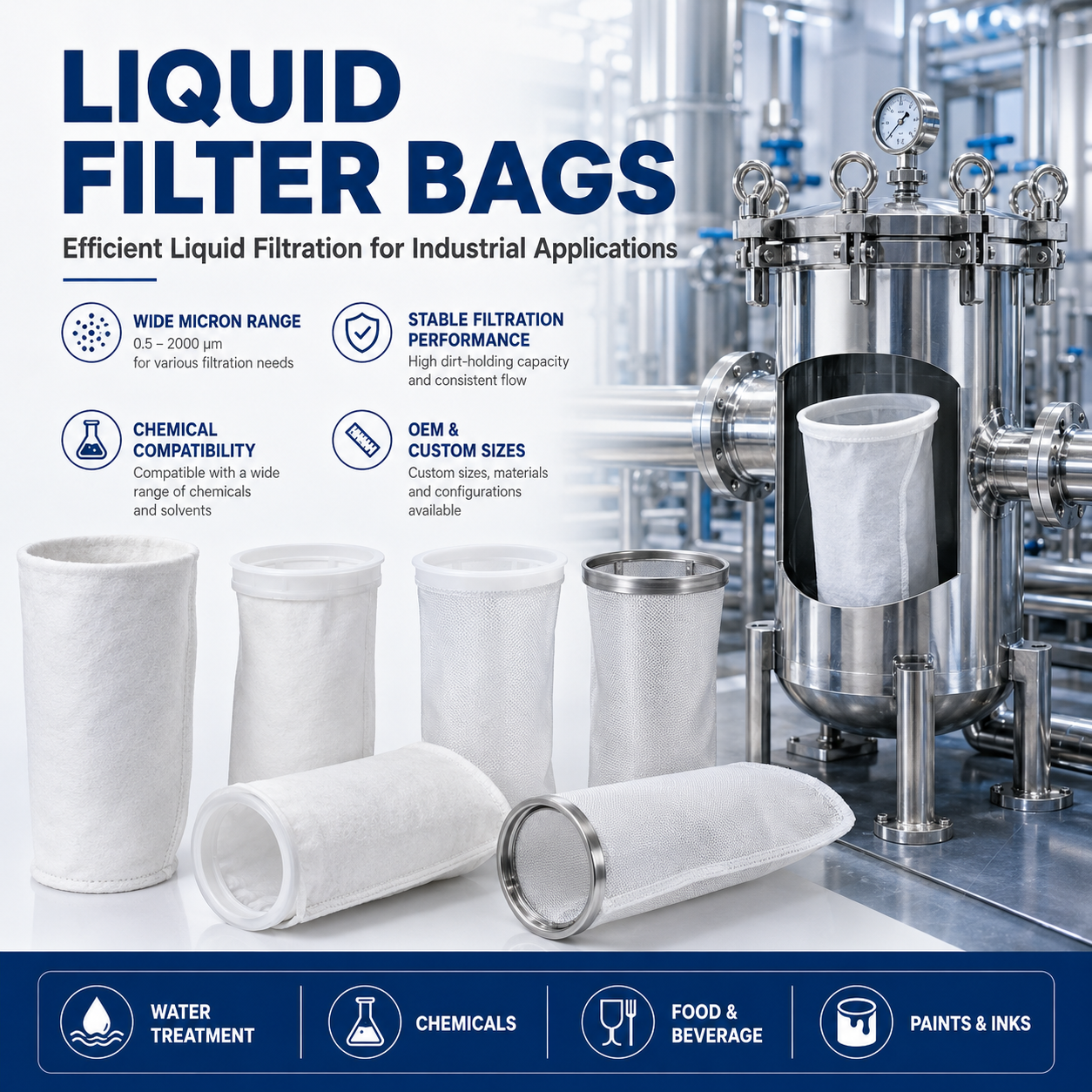
A polypropylene bag is not fully specified by the word “PP” and a micron number. A buyer must also state whether the duty calls for a fibrous needle felt or an open monofilament mesh, how the retention rating is defined, and how the finished bag must seal in the basket. Two bags marked 75 µm can behave differently when their media structures and rating methods are different.
The product photograph is representative of industrial liquid filter bags. It does not prove a particular micron rating, construction or application suitability.
Start with the particle-retention duty
Needle felt is a three-dimensional fibrous medium. Particles can be captured through part of the media depth as well as at the upstream surface. Monofilament mesh is woven from individual filaments and is normally purchased around a defined opening and surface-screening duty. That distinction affects solids release, cleaning trials, pressure-drop behavior and the evidence a purchaser should request.
Eaton’s current filter-bag overview separates monofilament mesh from needle-felt product families and lists both media type and fabrication method as ordering variables. Its brochure is useful evidence that “micron” is only one line in a complete specification; it is not a universal performance certificate for another manufacturer’s product.
| RFQ question | PP needle felt | PP monofilament mesh |
|---|---|---|
| Primary capture description | Fibrous depth/surface combination; ask how the stated rating was established | Woven opening used mainly for surface screening; ask for aperture and construction evidence |
| Rating language | Do not assume “nominal” means one common efficiency across suppliers | Do not equate an aperture value with guaranteed removal of every particle of that size |
| Solids behavior | May retain solids within the felt structure | Screened solids are concentrated mainly on the surface |
| Cleaning or reuse | Must be qualified for the actual contaminant and acceptance limit | May be evaluated for washing, but seams, distortion and cleanliness still need acceptance criteria |
| Finished construction | Specify singed or glazed finish only when required and verified | Specify weave, seam protection, seam type and edge condition |
How to write 75 and 250 micron requirements
For a 75 micron filter bag, do not send only “PP, 75 µm.” State whether the project needs felt or mesh, the target contaminant, the acceptable downstream result and whether the rating is nominal, absolute, or an aperture designation supported by an agreed test. If a previous bag worked, include its label and a clear photograph.
For a 250 micron PP filter bag, identify whether the task is coarse straining, recovery of reusable solids, protection of a pump or nozzle, or the first step in staged filtration. A large opening does not establish system flow capacity. Clean differential pressure, viscosity, temperature, basket geometry and solids loading still influence the result.
The Eaton overview shows that manufacturer ranges can use different media, seams, seal rings and available grades. Therefore, do not transfer one supplier’s grade table or temperature limit to an unverified replacement. Ask the proposed supplier to return a model-specific data sheet and declaration for the offered construction.
Seven fields that prevent an ambiguous quote
- Fluid: composition, concentration, temperature range and any cleaning exposure.
- Contaminant: particle description, approximate loading and whether solids are hard, soft, fibrous or deformable.
- Filtration result: what measurement or downstream observation will define an acceptable trial.
- Media: PP needle felt or PP monofilament mesh, including the requested rating terminology and evidence.
- Bag fit: size, ring or molded collar, basket dimensions and housing model.
- Fabrication: sewn or welded seams, bottom construction, surface finish and handle requirements.
- Commercial data: annual quantity, trial quantity, packing, labeling, lot traceability and documents required.
Use a controlled sample trial
A defensible trial compares one change at a time. Record starting fluid condition, flow, temperature, clean and terminal differential pressure, batch duration, solids collected and downstream result. If 75 and 250 µm candidates are being compared, keep the bag size and housing configuration consistent where practical. A short run that does not reach representative solids loading should not be reported as a service-life guarantee.
Choose from the broader PP filter bag range only after the duty and construction are clear. The housing basket and seal interface should be checked at the same time; a media decision cannot correct a bag that does not seat properly.
Source notes
- Eaton Filter Bags Overview: distinguishes needle felt, monofilament and finished-construction variables in its own ranges.
- Eaton Monofilament Filter Bags technical data sheet: provides a manufacturer example of monofilament materials and seam details.
Send your specification for review
Send the fluid, temperature, contaminant, target result, micron terminology, bag size, collar or ring, seam preference and expected quantity. INCE can review the fit and prepare a model-specific quotation rather than guessing from the micron number.
Frequently asked questions
Is a 75 micron PP felt bag equivalent to a 75 micron PP mesh bag?
No equivalence should be assumed. Felt and woven mesh use different structures, and the rating terminology or test basis may differ. Compare the media construction, efficiency or aperture evidence, finished bag and actual trial result.
Is 250 micron always a monofilament mesh specification?
No. A request must name the media and rating basis. The micron value by itself does not identify felt versus mesh, construction, flow capacity or filtration efficiency.
What should be supplied for an OEM PP filter bag quote?
Provide fluid and temperature, contaminant and loading, target result, media type, rating evidence, bag size, collar or ring, seam and bottom construction, quantity, packing and required documents.

 WhatsApp