
A high-flow filter cartridge replacement must match more than the nominal micron rating and cartridge length. An incorrect end cap, seal material, seal location or flow direction can prevent installation or create a bypass path inside the filter housing.
This guide is an industrial buyer’s compatibility checklist for high-flow cartridge seals and end caps. It applies when evaluating replacement-style elements for Pall-, Parker-, 3M-style and custom high-flow housings, without assuming that products from different families are interchangeable.
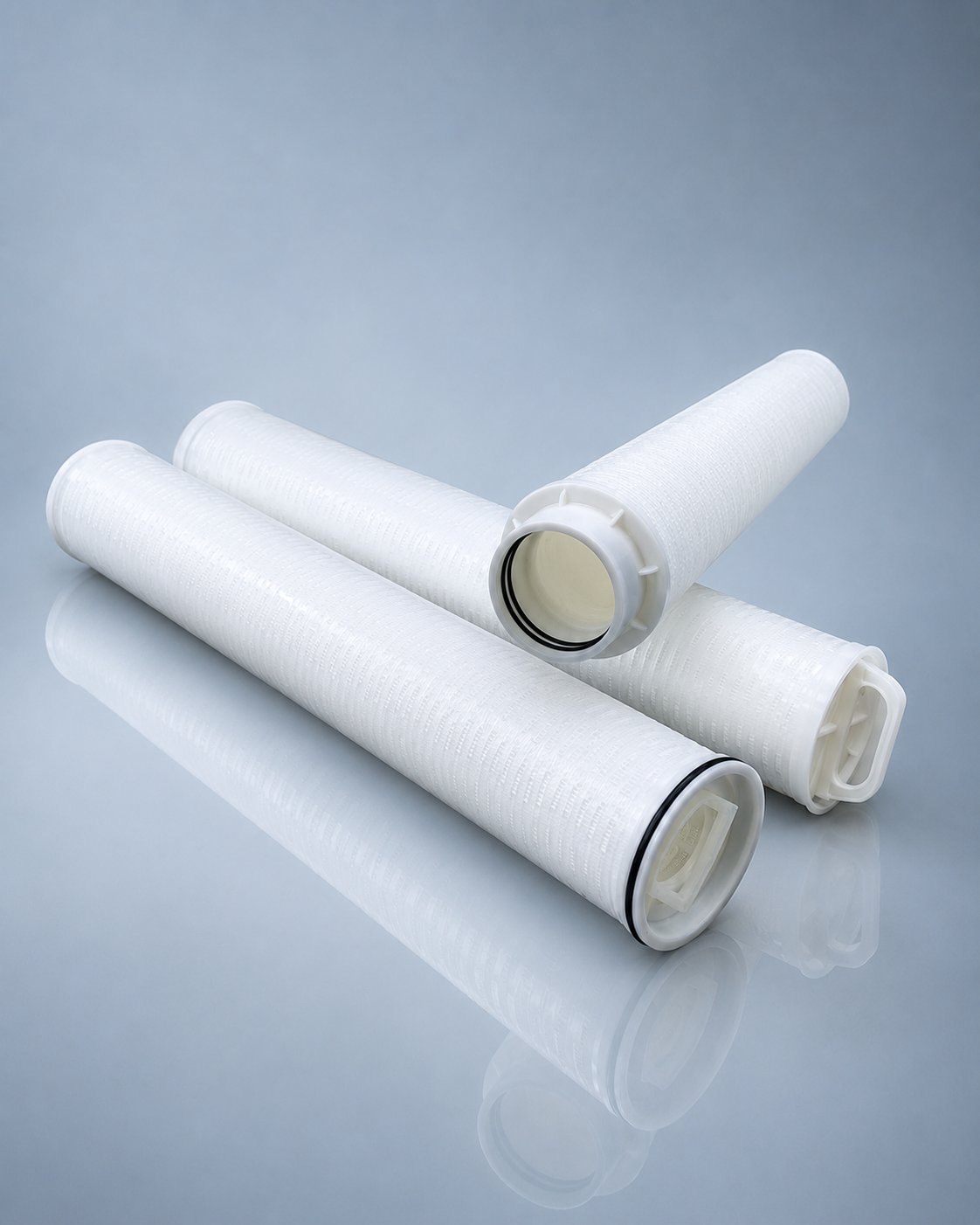
Compatibility Checklist: Six Items to Verify
| Item | What to confirm | Risk if incorrect |
|---|---|---|
| Overall length | Installed length and housing clearance | Element may not seat or fit |
| Outside diameter | Cartridge body and basket clearance | Interference or inadequate support |
| End-cap interface | Connection profile, locating features and adapter geometry | Improper installation or sealing |
| Seal location and dimensions | O-ring or gasket position, size and compression arrangement | Bypass or leakage |
| Seal material | Chemical, temperature and cleaning compatibility | Swelling, hardening or degradation |
| Flow direction | Inside-out or outside-in as specified by the cartridge/housing | Unexpected pressure behavior or damage |
Why “20, 40 or 60 Inch” Is Not a Complete Specification
High-flow elements are often offered in 20-, 40- and 60-inch families, but nominal length does not define the interface. Some designs use a single open end, some include locating or handle features, and sealing geometry varies. Confirm the original part number, drawing and measured dimensions before ordering.
For available categories, review the High Flow Filter Cartridge range.
End-Cap Compatibility: What Photos Should You Request?
- Full-length photograph of the used cartridge, including any printed label
- Close-up of the open end and its sealing surfaces
- Close-up of the opposite end, handle or locating feature
- Seal location with a scale or dimension reference
- Housing model/nameplate and adapter or support plate, if accessible
- Existing cartridge model, micron rating and flow-direction information
Photographs are a useful starting point, but they do not replace dimensional confirmation for a critical fit.
Choosing Seal Materials: EPDM, NBR and Silicone
Elastomers are selected according to the specific process fluid, concentration, temperature, cleaning chemicals and pressure conditions. EPDM, NBR and silicone may be offered for some cartridge designs; however, no one material is universally suitable.
Before requesting a different seal material, confirm the original specification and consult compatibility information for the exact chemical service. A replacement seal should also match the required cross-section and seating arrangement; using a chemically compatible material of the wrong size can still lead to bypass.
Pall, Parker and 3M Style Interfaces Are Not Automatically Interchangeable
Market descriptions such as “Pall style” or “Parker style” identify a replacement direction, not a universal standard interface. Some retrofit products are designed for particular existing housings, but that does not establish compatibility with every cartridge in a brand family.
Use the corresponding product pages to narrow the reference format:
For Parker-specific model identification, see the Parker High Flow Cartridge Replacement RFQ Guide.
Replacement Approval Workflow
- Collect the reference: old model number, photos, drawing and housing information.
- Match the interface: confirm end cap, seal geometry, element length and outside diameter.
- Confirm process compatibility: liquid, micron rating, media, seal chemistry, temperature and pressure.
- Review flow and loading: account for cartridge area, pressure drop and solids load.
- Trial the replacement: verify fit and operation according to the site’s qualification procedure.
- Release the RFQ/PO: include approved dimensions, model reference, quantity, packaging and sample requirements.
When the Housing Must Be Reviewed Too
For a new vessel or a change of cartridge family, the adapter, support structure and seal arrangement may need engineering review. The High Flow Filter Housing product page and Housing Sizing Guide cover vessel selection considerations.
High-Flow Cartridge Replacement RFQ Checklist
- Original brand and exact cartridge model number
- Cartridge overall length, outside diameter and end-cap photos
- Seal material and seal dimensions if known
- Micron rating, media and nominal/absolute requirement
- Flow direction and process flow rate
- Liquid, temperature, operating pressure and cleaning conditions
- Housing model and cartridge count
- Sample requirement, order quantity, OEM labels and packing
Need a High-Flow Cartridge Compatibility Review?
Send the original model number, photos of both ends, seal details, micron rating and process conditions. INCE filtration can review the specification for a replacement-style or custom high-flow cartridge quotation.
Frequently Asked Questions
Can high-flow cartridges from different brands be installed in the same housing?
Not automatically. End-cap geometry, adapter, seal location, element dimensions and flow direction must all match the housing and the approved cartridge model.
Which seal material should I specify for a high-flow filter cartridge?
Choose the elastomer from the actual fluid chemistry, concentration, temperature and cleaning exposure. EPDM, NBR and silicone are possible options in some designs, but suitability must be verified.
Is a matching cartridge length enough to prove compatibility?
No. Overall length alone does not establish end connection, seal compression, diameter, support and flow-direction compatibility.
What photos help quote a replacement high-flow cartridge?
Provide the full cartridge, printed model number, both ends, seal location and a dimension reference; include the housing nameplate where possible.
How can I reduce the risk of bypass after replacement?
Verify the correct interface and seal, inspect installation surfaces, follow housing procedures and use the applicable integrity or performance checks before service.
Pall, Parker and 3M are trademarks of their respective owners. References are for identifying compatibility requirements only and do not imply endorsement or original-brand manufacture.

 WhatsApp