
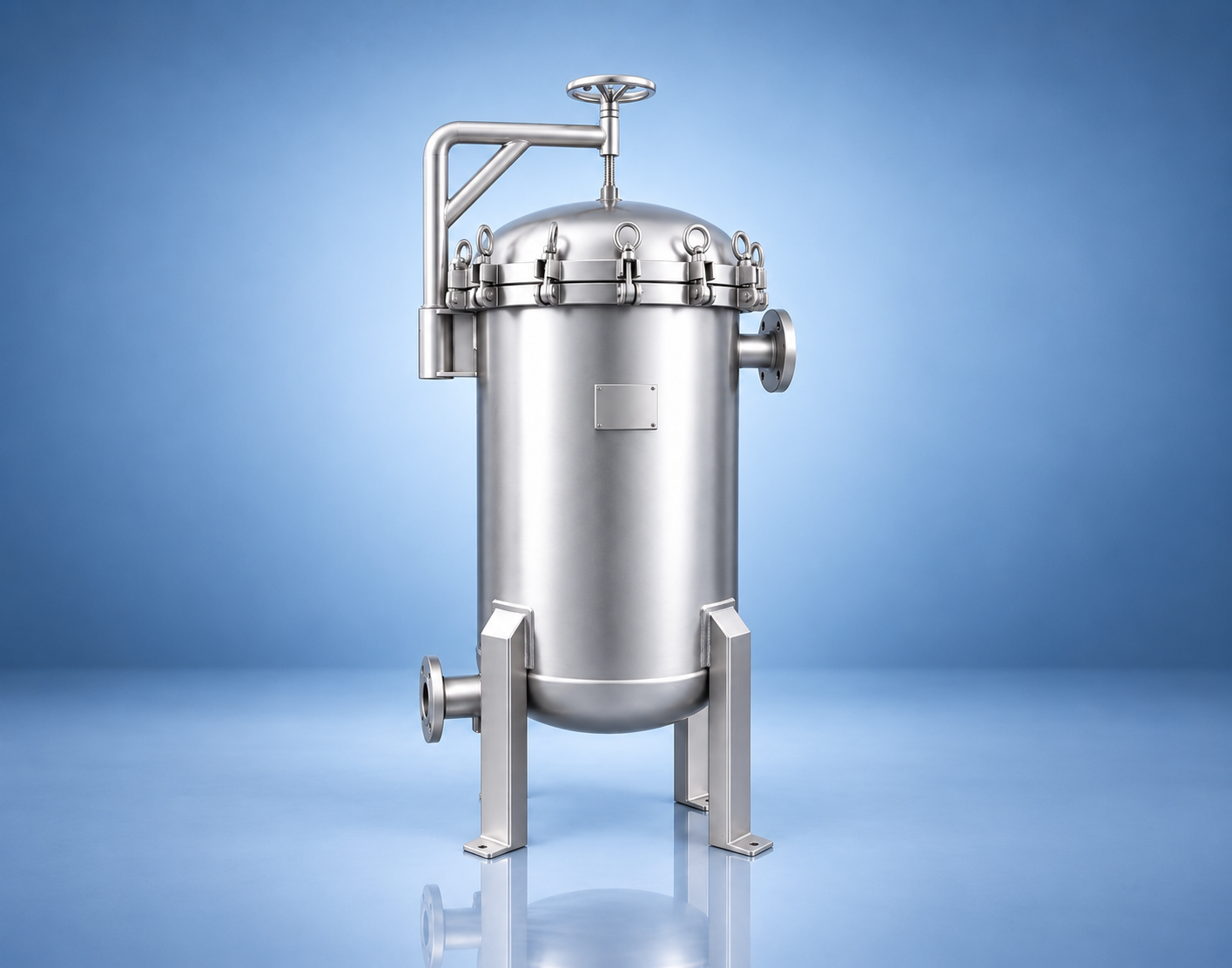
A filter housing can fit its installation footprint and still lack enough space for maintenance. The purchase drawing should show the cover movement, bag or cartridge extraction path, handling equipment and operator access—not only the closed vessel’s height and diameter. Review the required layout with the single bag, multi bag or high flow cartridge housing supplier before fabrication.
Representative multi bag housing with a cover-handling arrangement. The photograph provides no dimensions, lifting capacity or approved service envelope.
Separate the closed envelope from the service envelope
The closed envelope describes the installed vessel and its fixed attachments. The service envelope includes the space used while opening it, extracting internals and handling removed components. Ask the supplier to draw both against a common datum, such as the finished floor or mounting surface, with the orientation and connection positions identified.
Do not derive overhead clearance by adding the catalog height to a nominal bag or cartridge length. The seat elevation, opening arrangement, extraction movement, attached handle and chosen handling method may change the required space. A nominal element size is not a complete maintenance dimension.
Describe the actual removal task
Identify whether routine work removes a bag alone, a bag and basket, individual cartridges or a larger internal assembly. Tell the supplier what operators are expected to handle and where removed components will be placed. Request a removal sequence or arrangement from the manufacturer for the quoted design; a purchasing sketch should not become an improvised operating procedure.
Eaton’s housing ergonomics overview distinguishes cover-lifting mechanisms, closures and installation orientations. It includes manual and assisted arrangements and selected inclined or horizontal configurations. The useful purchasing lesson is that maintenance access depends on the chosen design, not just the number of filter bags. These Eaton examples do not establish that the same options are available on every INCE vessel.
| Layout item | Information to request | Site information to provide |
|---|---|---|
| Cover movement | Raised or open position and any swing envelope | Nearby piping, walls, cable trays and overhead obstructions |
| Element extraction | Required removal path and clear access | Ceiling height, aisle limits and working platform |
| Handling equipment | Proposed device, attachment and documented limitations | Available hoist access and site handling requirements |
| Drainage and service access | Drain location, access to connections and maintenance points | Collection route, floor conditions and available service area |
| Removed parts | Space required for temporary support or staging | Defined clean/dirty staging and disposal route |
Specify handling requirements without inventing a load rating
Ask the vendor to state the mass and handling assumptions for the components relevant to maintenance. Distinguish dry equipment information from a potentially liquid-filled or solids-loaded component. The site must define the expected service condition and have the responsible personnel review handling provisions.
A cover-support mechanism is not automatically a certified lifting device for a basket, cartridge bundle or the complete vessel. Do not assume a pictured handwheel, davit or attachment has spare capacity for another task. Request the intended use, limitations and applicable documentation for the quoted arrangement, and leave lifting selection and approval to competent personnel.
Check the assembled skid, not an isolated vessel model
Provide a layout showing fixed equipment and realistic access restrictions. Include nearby valves, instrument connections, insulation, supports and any pipework that may obstruct cover movement or extraction. A bare vessel may have adequate clearance while the assembled skid does not. Ask the supplier to identify any items that must be disconnected for the documented maintenance arrangement.
Also identify the location for residual-liquid collection and access to vents and drains required by the actual design. These layout provisions do not authorize opening equipment under pressure. Maintenance must follow the manufacturer’s instructions and the site’s approved isolation, pressure-release, drainage and safe-work procedures; this article is not a shutdown or lifting instruction.
Resolve layout changes before approving the order
If overhead access is restricted, ask whether a different configuration can satisfy the duty and constraints. Do not rotate a vessel designed for vertical service into a horizontal position without manufacturer review. Element support, drainage, connections and handling arrangements must remain appropriate for the approved orientation.
Keep capacity selection separate from access planning. The multi bag sizing guide addresses the process duty, while the connection guide addresses piping interfaces. Neither substitutes for a project-specific general arrangement with maintenance dimensions.
Before purchase approval, agree who checks the site measurements, which drawing revision is accepted and what constitutes a layout change. Identify exclusions such as platforms, lifting equipment or skid piping in the quotation so they are not discovered only during installation.
Send a dimensioned installation envelope
Provide available floor area and overhead space, required bag or cartridge arrangement, site obstruction drawing, intended maintenance task and handling constraints. Ask INCE for a proposed service envelope, relevant component information and a clearly scoped quotation for review.
Frequently asked questions
Is the closed vessel height the required maintenance height?
No. Cover movement and element extraction require a separate service-envelope review for the actual design.
Does a cover davit automatically lift the basket or complete vessel?
No. Confirm its intended use, limitations and documentation; do not infer additional lifting capacity from appearance.
Can a vertical housing be installed horizontally to save height?
Only if the manufacturer confirms an appropriate design and orientation for the duty. Do not rotate an existing arrangement without review.
Design reference
Eaton: bag housing ergonomics overview. Product-specific options remain subject to the actual vendor’s drawing and instructions.


 WhatsApp