
A duplex filtration arrangement and a single multi-bag vessel solve different problems. A multi-bag vessel places several bags in one pressure boundary to provide filtration area. A properly engineered duplex arrangement provides separate flow paths so an isolated side can be serviced while the remaining side carries the required duty.
More bags in one vessel do not, by themselves, guarantee uninterrupted filtration during bag replacement. Start the RFQ with the allowable process interruption and required off-line capacity, then select vessel size and arrangement together.
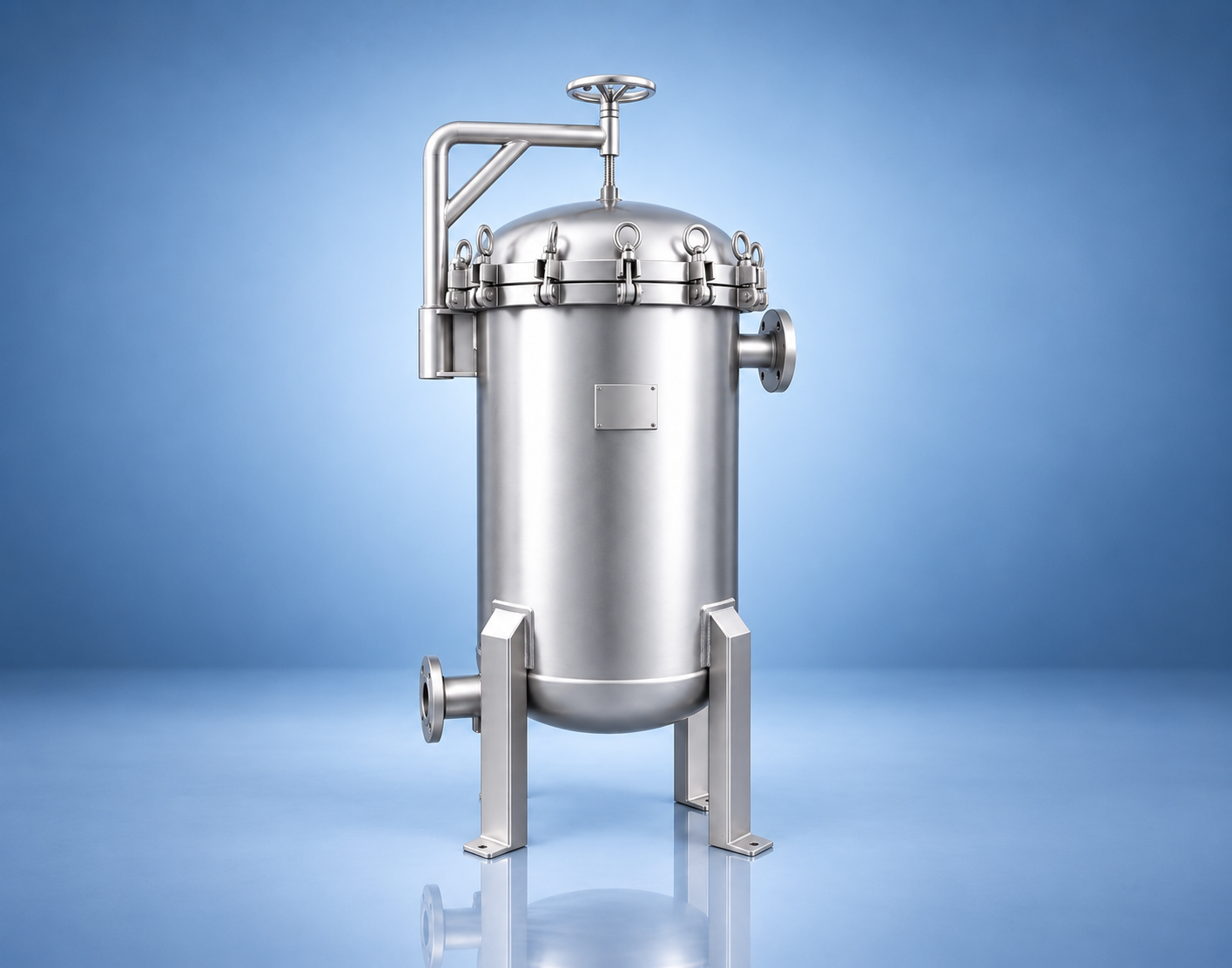
Representative multi-bag vessel, not a duplex skid. This image does not show valves, standby capacity or a continuous-flow system.
Compare the maintenance boundary, not only the bag count
| Arrangement | Main selection question | Important limitation |
|---|---|---|
| One single-bag vessel | Is the available area and service interval adequate? | Its isolated flow path is unavailable during bag change-out |
| One multi-bag vessel | How much shared vessel area is required? | Several bags in one vessel do not create an independent standby path |
| Duty/standby duplex arrangement | Can the remaining side carry the required duty during service? | Capacity, valves and isolation must be engineered for that condition |
| Larger banked arrangement | What duty remains with a bank off-line? | Normal all-online capacity is not the same as maintenance-mode capacity |
The terminology can vary between suppliers. Eaton, for example, describes its DUOLINE system as two single-bag housings connected with a changeover valve arrangement for continuous filtration. Its product-family name includes “multi-bag,” but its run-and-standby layout is different from multiple bags inside one vessel. Ask for the arrangement drawing rather than relying on the product name.
Size the off-line condition explicitly
State the process flow that must continue when one side or bank is unavailable. For a simple duty/standby requirement, the operating side must be capable of that required duty with the selected medium and actual liquid. Do not add the two vessel catalogue flow figures and assume that sum is available while one side is isolated.
Include liquid viscosity and temperature, solids loading, micron-rating basis and allowable pressure-drop behavior. A water-based reference flow is not a guarantee for a viscous or solids-laden process. Evaluate expected loading near the planned change-out condition as well as a clean-start condition.
Valves and piping belong in the quotation
Request the proposed piping and instrument arrangement, valve schedule and normal operating states. Review the additional pressure loss of the flow path with the qualified system designer. Identify which components are included in the supplier’s scope: vessels, baskets, valves, instruments, skid and connection work should not be assumed to be one package.
The design must support the site’s approved isolation and maintenance procedure. A changeover label is not proof that an isolated vessel is depressurized or safe to open. Do not improvise valve sequences or alter a pressurized assembly from a general purchasing guide.
Check service access and contamination control
Compare access for cover removal, basket and bag handling, lifting devices where applicable, and collection of residual liquid. Ask how clean and dirty sides are separated during maintenance and how standby condition is maintained. Consider the actual space available around each vessel rather than only the skid footprint.
A duplex concept can also use larger vessels or banks when the duty requires it. Whether that is appropriate depends on engineering review, available space, operating practice and cost; this article does not claim that INCE stocks every duplex configuration.
Use the existing commercial pages for model review
Start with Single Bag Filter Housing or Multi Bag Filter Housing for vessel requirements. The Multi Bag Sizing Guide addresses area and bag-count considerations; add the maintenance-mode requirement rather than repeating a normal-flow RFQ.
If also evaluating a high flow cartridge housing, apply the same availability question but obtain its own cartridge interface and hydraulic data. A change in element technology does not automatically provide standby operation.
Continuous-service RFQ checklist
Provide normal and peak flow, minimum required flow during maintenance, allowable interruption, liquid conditions, media and bag size, operating and design requirements, connection standard, installation drawing and service clearance. Ask the supplier to identify exclusions, off-line capacity assumptions and documentation requirements. Code or certification requirements must be confirmed for the actual quotation and destination.
Need a Vessel Arrangement Reviewed?
Send the required flow with one side off-line, liquid conditions, current vessel details and installation sketch. Request a confirmed scope and model-specific quotation rather than assuming a complete duplex package.
Frequently Asked Questions
Does one multi-bag vessel provide continuous filtration during bag replacement?
Not by bag count alone. An independent suitably designed filtration path is needed if the process must continue while that vessel is isolated.
Can I add both vessel flow ratings when sizing a duty/standby arrangement?
Not for the off-line condition. Confirm that the remaining operating path can carry the required duty with the actual medium, liquid and system losses.
Is the pictured multi-bag vessel a duplex filter system?
No. It illustrates a single multi-bag vessel. Duplex operation requires an appropriate separate flow-path, valve and control arrangement.
Manufacturer example: Eaton DUOLINE run-and-standby product information, reviewed 16 October 2026. Brand-specific ratings, certifications and warranties are not INCE claims. Arrangement comparisons are engineering procurement guidance, not operating instructions.
 WhatsApp