
Nylon filter mesh open area is the proportion of the projected fabric surface occupied by openings. For an ideal regular square-opening weave, estimate it as 100 × [opening ÷ (opening + thread diameter)]², using the same units throughout. This geometry calculation is not a measured permeability or filtration-efficiency rating.
When comparing nylon filter mesh, ask for more than a micron label. Opening, thread diameter, weave, thickness and the specification’s measurement conditions help distinguish constructions that may behave differently in an application.
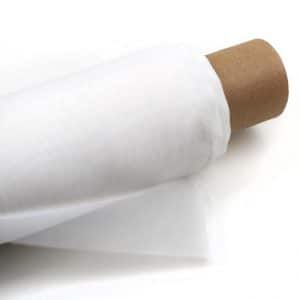
Representative nylon filter mesh roll. The worked examples below are geometric examples, not specifications for the pictured material.
Opening, pitch and count describe different things
Opening, written here as w, is the clear space between adjacent threads. Thread diameter d describes the thread dimension used in the calculation. Pitch p is the center-to-center repeat distance; in the ideal square model, p = w + d.
Mesh count states how many repeats or threads occur over a specified length. Specify whether the count is per inch or per centimetre; an unqualified number can lead to a different construction being quoted. Nominal yarn diameter before weaving may differ from dimensions assessed in the finished cloth. Ask which basis the supplier’s datasheet uses.
Calculate ideal open area step by step
- Confirm that the square-opening model is appropriate for the weave.
- Express opening and thread diameter in the same units.
- Add them to obtain the ideal pitch.
- Divide the opening by the pitch and square the result.
- Multiply by 100 to express the area ratio as a percentage.
For illustration only, w = 75 µm and d = 45 µm give p = 120 µm. Ideal open area = 100 × (75/120)² = 39.0625%, or approximately 39.1%.
| Illustrative construction | Opening w | Thread d | Ideal pitch | Calculated open area |
|---|---|---|---|---|
| Example A | 75 µm | 45 µm | 120 µm | 39.1% |
| Example B | 75 µm | 75 µm | 150 µm | 25.0% |
These examples have the same ideal opening but different open areas. They are not stocked INCE models, production tolerances or a claim that either construction is available. They demonstrate why the same micron opening can be an incomplete purchasing description.
Why open area does not predict a guaranteed flow rate
Open area is a geometric ratio. Liquid flow through an installed screen also depends on liquid properties, fabric thickness and structure, usable screen area, support restrictions, pressure difference and solids accumulation. Increasing calculated open area by a given percentage does not prove the same percentage increase in flow or service life.
Likewise, open area does not establish particle-removal efficiency or an absolute retention rating. Particle shape and the complete installed component matter. Request measured data under relevant test conditions when a throughput, retention or pressure-drop requirement must be guaranteed.
Know when the simplified formula is not enough
Do not apply this square-opening calculation unchanged to dense or non-square structures, deformed openings, coated fabrics or a multilayer assembly. If warp and weft dimensions differ, a directional geometric model may be required. A measured finished-mesh specification takes priority over an estimate made from incomplete nominal values.
Manufacturer terminology provides a useful cross-check: Haver & Boecker defines square-aperture open screening area from aperture and pitch, while Sefar’s filtration documentation distinguishes mesh opening, open area and yarn diameter. These are definition references, not certification of an INCE product or a claim of medical suitability.
Prepare a construction-level enquiry
For rolls, provide polymer requirement, clear opening, count with units, thread diameter, weave, usable width, roll length and quantity. Ask which values are nominal, measured or controlled by an agreed tolerance. Include liquid composition, cleaning exposure and temperature for suitability review.
For fabricated screens or mesh discs, add finished dimensions, support design, edge details and drawing revision. If the end product is a nylon mesh filter bag, also specify seams and closure: fabric open area does not define whole-bag bypass behavior.
Need a Nylon Mesh Construction Compared?
Send the current roll label or datasheet, required opening, thread information, width, quantity and application. Ask for confirmation of the offered construction and relevant measured data.
Frequently Asked Questions
Can two nylon meshes have the same opening but different open areas?
Yes. Different thread dimensions and constructions can produce different projected open areas even when the specified opening is similar.
Does 40% open area mean 40% filtration efficiency?
No. Open area describes geometry, not particle-removal efficiency or an absolute retention rating.
Can the square-weave formula be used for every filter fabric?
No. Confirm the weave and measurement basis. Dense, non-square, coated or multilayer structures need appropriate manufacturer data.
Definition references, reviewed 16 October 2026: Haver & Boecker woven wire cloth terminology; Sefar filtration fabric definitions. The examples are independently calculated, idealized geometry.

 WhatsApp