
For fine liquid filtration, choosing between 1, 2 and 5 micron filter bags can significantly affect particle retention, differential pressure, service life and operating cost. A finer micron rating captures smaller particles, but it can also load faster and create higher resistance if the process contains a heavy solids load.
This guide compares 1 micron, 2 micron and 5 micron filter bags from an industrial purchasing and process-selection perspective. It is designed for buyers who need to choose a fine filtration grade before requesting samples or pricing.
Quick Comparison: 1 vs 2 vs 5 Micron Filter Bags
| Micron Rating | Relative Fineness | Typical Role | Main Trade-Off |
|---|---|---|---|
| 1 micron | Finest | Fine particle removal and polishing | Highest risk of rapid loading when solids are high |
| 2 micron | Intermediate | Fine process filtration with slightly more open retention than 1 micron | Does not retain as fine a particle fraction as 1 micron |
| 5 micron | Coarsest of the three | Fine pre-filtration and general fine solids reduction | Allows smaller particles through compared with 1 or 2 micron |
The stated micron number is only one part of the specification. Filter media, nominal or absolute retention behavior, bag size, flow rate, pressure, temperature and liquid chemistry should also be confirmed before purchase.
When to Choose a 1 Micron Filter Bag
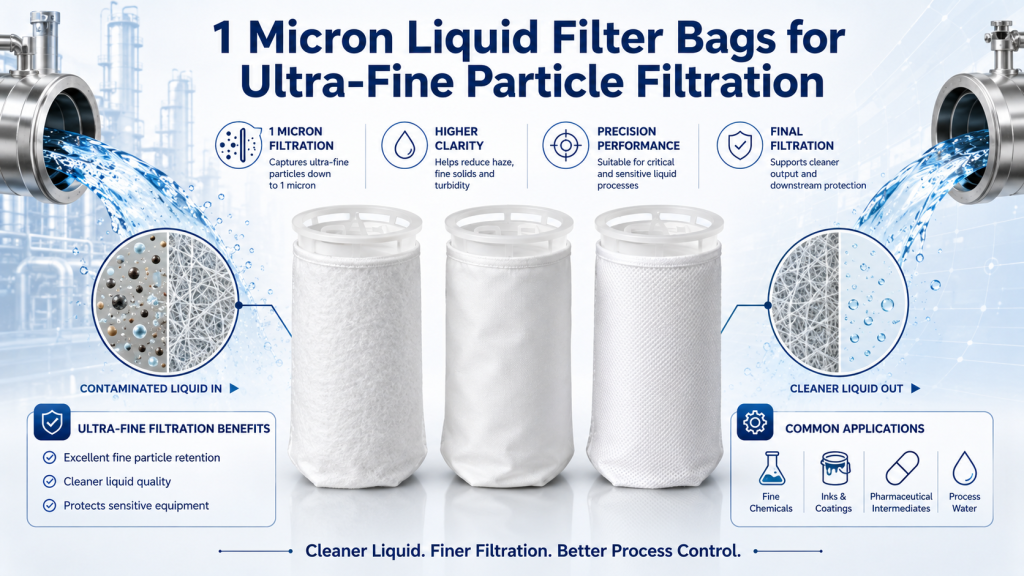
A 1 micron filter bag is the finest choice in this comparison. It is appropriate when the process requires tighter particle control and when downstream equipment or product quality cannot tolerate the particle fraction that passes through a coarser bag.
Consider 1 micron when:
- 5 micron filtration does not provide sufficient cleanliness.
- Fine suspended solids must be reduced before a sensitive downstream process.
- The bag is used as a polishing stage rather than only a coarse pre-filter.
- The system can tolerate the expected pressure drop and changeout frequency.
For applications with heavy solids loading, a staged approach using a coarser upstream bag may extend the service life of the 1 micron stage.
When 2 Micron Is a Useful Compromise
A 2 micron filter bag sits between 1 and 5 micron. It can be useful when 1 micron is tighter than necessary but 5 micron allows too much fine particulate through.
Typical reasons to test 2 micron include:
- Reducing pressure drop compared with a 1 micron stage.
- Improving particle retention compared with a 5 micron stage.
- Balancing cleanliness requirements with bag life.
- Protecting downstream cartridges, membranes, nozzles or process equipment.
When 5 Micron Is the Better Starting Point
A 5 micron filter bag is the most open option of these three and is often a practical starting point for fine industrial filtration.
5 micron may make sense when:
- The process needs fine solids reduction but not ultra-fine polishing.
- 1 or 2 micron bags load too quickly.
- The bag is protecting a finer downstream cartridge.
- Operating cost and service life are important purchasing considerations.
1 vs 2 vs 5 Micron: How to Choose
- Define the particle-removal requirement. Identify the smallest particle that must be controlled.
- Check whether the current filter is failing on cleanliness or service life. This determines whether to move finer or coarser.
- Review solids loading. A very fine filter can plug quickly if used directly on a dirty process stream.
- Confirm media construction. Needle felt, melt-blown and other media structures can behave differently even at similar nominal ratings.
- Check system pressure and flow. Fine filtration can create more resistance as the bag loads.
- Use staged filtration when appropriate. A 10 or 5 micron pre-filter ahead of 1 or 2 micron can reduce premature loading.
For a broader micron comparison, see the liquid filter bag micron size chart.
Why Media Type Matters at Fine Micron Ratings
A buyer should not assume that every “1 micron” or “5 micron” filter bag behaves identically. The retention mechanism depends on the media construction and whether the rating is described as nominal or absolute.
Needle Felt
- Uses a fibrous depth structure.
- Provides solids-holding capacity through the thickness of the media.
- Common in industrial liquid bag filtration.
- Available in materials such as polypropylene and polyester.
Mesh Media
Monofilament mesh is generally used for larger defined openings rather than ultra-fine 1–5 micron bag filtration. For very fine duties, buyers should verify that the stated rating and media construction match the actual process requirement.
Example Selection Scenarios
Scenario 1: 5 Micron Is Not Fine Enough
If product quality or downstream equipment still shows unacceptable fine solids after 5 micron filtration, test 2 micron first if you want an intermediate step before moving to 1 micron.
Scenario 2: 1 Micron Bags Plug Too Quickly
If a 1 micron bag reaches changeout pressure too quickly, review incoming solids loading. A 5 micron pre-filter, a larger filter area or a 2 micron stage may improve economics if the process specification allows it.
Scenario 3: The Bag Protects a Cartridge Filter
If the bag is only intended to protect a downstream cartridge, the best micron rating depends on which particle fraction is responsible for cartridge fouling. A 5 or 2 micron bag may provide sufficient protection without the operating cost of 1 micron filtration.
What to Include in an RFQ
- Required micron rating or current filter specification.
- Filter media and material.
- Bag size or dimensions.
- Ring/top style.
- Process liquid and chemical compatibility requirements.
- Operating temperature.
- Flow rate and pressure.
- Current changeout frequency.
- Required quantity, packing and sample requirements.
Need Help Choosing 1, 2 or 5 Micron?
INCE filtration supplies liquid filter bags in multiple fine micron ratings, materials, sizes and OEM configurations. Send your current bag specification and process conditions for selection support, samples or pricing.
Frequently Asked Questions
Is 1 micron finer than 5 micron?
Yes. A 1 micron rating is finer than 5 micron and targets a smaller particle size range.
Is 2 micron a good intermediate option?
Yes. It can be useful when 1 micron is tighter than necessary but 5 micron is not providing enough retention.
Will a 1 micron bag always give better filtration?
It provides a finer stated rating, but it is not automatically the best operational choice. Solids loading, pressure drop, media construction and required outlet cleanliness must be considered.
Can I use a 5 micron bag before a 1 micron bag?
Yes. Staged filtration can reduce the solids load reaching the finer stage and may extend 1 micron bag life.
What information is needed for a sample?
Provide the micron rating, material, bag size, ring style, liquid type, operating temperature and current filter specification so the sample can match the application as closely as possible.
 WhatsApp