
When choosing between a 10 micron and 25 micron filter bag, the main difference is particle-retention level.
A 10 micron filter bag provides finer filtration and is better suited to smaller suspended contaminants.
A 25 micron filter bag is coarser, but it can often provide better flow, greater tolerance to solids loading and longer service life when very fine filtration is unnecessary.
In simple terms:
Choose 10 micron when finer particle control is the priority.
Choose 25 micron when process flow, filter life and general solids removal are more important.
For a wider overview of all grades, see the Liquid Filter Bag Micron Size Chart: 1 to 500 Micron Selection Guide.
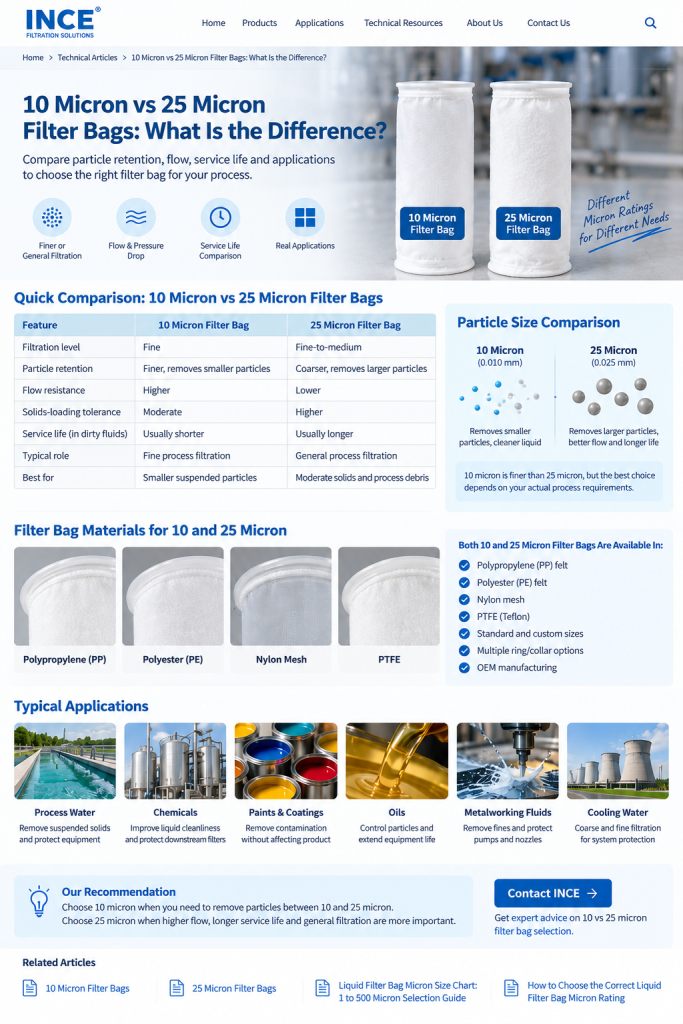
10 Micron vs 25 Micron Filter Bags: Quick Comparison
| Feature | 10 Micron Filter Bag | 25 Micron Filter Bag |
|---|---|---|
| Filtration level | Fine | Fine-to-medium |
| Particle retention | Finer | Coarser |
| Relative flow resistance | Higher | Lower |
| Solids-loading tolerance | Moderate | Higher |
| Service life in dirty fluids | Usually shorter | Usually longer |
| Typical role | Fine process filtration | General process filtration |
| Best for | Smaller suspended particles | Moderate solids and process debris |
The 10 micron option is not automatically better. The correct filter is the one that removes the particles causing the actual process problem without creating unnecessary pressure drop or filter changes.
What Does 10 Micron Mean?
One micron equals 0.001 millimeter, so 10 micron = 0.010 mm.
A 10 micron bag is used for fine industrial filtration of contaminants such as fine sediment, small rust particles, metal fines and small process debris.
It is commonly selected when 25 or 50 micron filtration does not provide enough particle control.
What Does 25 Micron Mean?
25 micron = 0.025 mm.
A 25 micron bag targets larger particles than a 10 micron filter and is widely used as a general industrial process grade because it balances particle removal, practical flow and service life.
Typical contaminants include sediment, rust, process debris, metal particles and coating agglomerates.
How Much Finer Is 10 Micron Than 25 Micron?
In nominal particle-size terms, 10 micron is 15 µm smaller than 25 micron. But industrial filtration performance should not be treated as a simple mathematical ratio.
A 10 micron filter does not necessarily remove 2.5 times more contamination than a 25 micron filter. Actual performance depends on filter media, filtration efficiency, particle shape, flow velocity and solids loading.
The practical difference is that 10 micron filtration is designed to retain a greater portion of smaller suspended contaminants.
Which Filter Produces Cleaner Liquid?
If all other conditions are equal, a 10 micron bag will generally produce cleaner liquid than a 25 micron bag because it targets smaller particles.
This makes 10 micron more appropriate where fine contamination affects product quality, surface finish, spray equipment, downstream cartridges or sensitive process equipment.
However, if particles between 10 and 25 micron do not cause any process problem, removing them adds filtration load without necessarily adding value.
Which Has Better Flow?
A 25 micron filter generally has lower resistance than a comparable 10 micron filter.
This can mean higher practical flow, lower initial differential pressure, slower pressure increase and longer filtration cycles.
The difference becomes more important with high flow rates, viscous liquids and high solids loading.
Micron size is still only one part of flow performance. Filter area, housing design and media permeability also matter.
Which Filter Bag Lasts Longer?
In the same liquid and housing, a 25 micron bag will often last longer because it allows more fine particles to pass instead of capturing them.
If the liquid contains a large quantity of particles between 10 and 25 micron, the 10 micron bag will consume its dirt-holding capacity faster.
This does not make 25 micron better. It simply means that the process must decide whether those smaller particles actually need to be removed.
Which Is Better for High-Solids Liquids?
For moderate or heavy solids loading, 25 micron filtration is often easier to operate.
A 10 micron bag can load rapidly, causing pressure rise, reduced flow and frequent changes.
If solids loading is extremely high, even 25 micron may be too fine and a 50, 75 or 100 micron upstream stage may be appropriate.
See How to Choose the Correct Liquid Filter Bag Micron Rating for a process-based selection method.
10 vs 25 Micron for Process Water
Choose 10 Micron When:
- Fine sediment is a problem
- Water must be cleaner before sensitive equipment
- A downstream cartridge needs stronger protection
- 25 micron filtration is not clean enough
Choose 25 Micron When:
- General suspended solids are the main concern
- Higher flow is important
- Solids loading is moderate
- Fine polishing is unnecessary
A staged system can also use 25 micron → 10 micron.
10 vs 25 Micron for Paints and Coatings
Paint and coating filtration requires caution because the filter must remove unwanted contaminants without removing desirable formulation components.
A 10 micron bag may be appropriate for fine skins, small agglomerates and process debris. A 25 micron bag may be better when product viscosity is higher, pigments must remain in the formulation, or higher throughput is important.
Before moving from 25 to 10 micron, confirm that the finer media will not retain desired solids.
10 vs 25 Micron for Oils
Oil viscosity can significantly increase pressure drop.
Ten micron filtration is useful when fine wear particles need tighter control. Twenty-five micron can be more practical when general contamination control and better flow are more important.
Higher-viscosity applications may require more filtration area or lower flow per bag.
10 vs 25 Micron for Metalworking Fluids
Metalworking fluids can contain fine metal particles, grinding debris and abrasive contamination.
A 10 micron bag can provide stronger fine-particle control where surface finish or equipment wear is a concern. A 25 micron bag is often more practical for general recirculation with greater solids loading.
Where particle sizes are broad, a staged system such as 50 micron pre-filter → 25 micron → 10 micron final stage can improve filter life.
Which Is Better for Protecting Pumps and Nozzles?
The answer depends on the smallest particle that can cause blockage or damage.
If particles between 10 and 25 micron cause nozzle blockage, wear or product defects, 10 micron filtration is the stronger choice. If those particles are harmless, 25 micron may provide better operating economics.
Start with the downstream question: What particle size creates the problem?
Which Is Better Before a Cartridge Filter?
Both ratings can serve as cartridge pre-filtration.
A 25 micron bag is useful for reducing general solids loading before a finer cartridge. A 10 micron bag is useful when the final cartridge needs tighter upstream particle control.
Example sequences include 25 micron bag → 5 micron cartridge or 25 micron bag → 10 micron bag → fine cartridge.
Pressure Drop: 10 Micron vs 25 Micron
At equivalent bag size, media, flow rate and liquid viscosity, a 10 micron bag will usually create greater resistance than a 25 micron bag.
If pressure rises too quickly after changing to 10 micron, the process may need more filtration area, lower flow per bag, coarse pre-filtration or a less restrictive micron grade.
Dirt-Holding Capacity Is Not the Same as Micron Rating
Micron rating defines filtration fineness, not total solids capacity.
Felt depth media can hold contamination throughout its thickness, while mesh retains more particles at the surface. Multilayer media can distribute contamination across several zones.
Two 25 micron bags from different constructions can therefore have different service lives, and the same is true for 10 micron bags.
Nominal vs Absolute Rating
Many conventional felt filter bags are nominally rated.
A 10 micron designation does not automatically guarantee complete removal of every particle larger than 10 µm, and a 25 micron bag does not necessarily have a sharp 25 µm cut-off.
For critical processes, check filtration efficiency and the manufacturer’s test method in addition to the micron number.
When 10 Micron Is Too Fine
Ten micron may be unnecessarily fine when 25 micron already gives acceptable liquid quality, solids loading is high, pressure rises too rapidly, or fine particles do not affect the downstream process.
In these situations, 25 micron may reduce operating cost without reducing process performance.
When 25 Micron Is Too Coarse
Twenty-five micron may be too coarse when product defects continue, downstream cartridges plug too quickly, sensitive equipment still experiences particle-related problems, or liquid cleanliness remains insufficient.
Moving to 10 micron may then provide the additional retention required.
A Simple Decision Rule
Choose 10 micron if you need to remove particles between approximately 10 and 25 micron.
Choose 25 micron if particles below 25 micron are acceptable in the process.
This is more useful than choosing the finer grade simply because it sounds better.
10 Micron vs 25 Micron Selection Table
| Process Condition | Better Starting Choice |
|---|---|
| Fine suspended contamination | 10 micron |
| Moderate solids loading | 25 micron |
| Sensitive downstream equipment | 10 micron |
| Higher process flow | 25 micron |
| Longer bag life desired | 25 micron |
| Fine product polishing | 10 micron |
| General process filtration | 25 micron |
| Frequent 10 micron plugging | Try 25 micron or add pre-filtration |
| 25 micron not clean enough | Try 10 micron |
Can 10 and 25 Micron Bags Be Used Together?
Yes. A staged arrangement such as 25 micron → 10 micron can be useful when the liquid contains a broad particle distribution.
The first bag removes larger solids while the second handles smaller contamination. This can improve 10 micron bag life, differential-pressure stability and downstream cleanliness.
However, every added stage should solve a clear process problem.
What Should You Check Before Switching Micron Rating?
- Current filter bag life
- Differential pressure
- Liquid flow rate
- Particle contamination
- Required downstream cleanliness
- Liquid viscosity
- Filter media
- Bag size
- Solids concentration
- Downstream equipment
10 Micron vs 25 Micron FAQ
Is 10 micron finer than 25 micron?
Yes. A 10 micron filter provides finer particle retention than a 25 micron filter.
Which has better flow?
A 25 micron filter generally provides lower resistance and better flow than a comparable 10 micron filter.
Which lasts longer?
In the same contaminated liquid, a 25 micron bag often lasts longer because it captures fewer fine particles.
Which is better for fine filtration?
Ten micron is better when smaller suspended particles need to be removed.
Which is better for general industrial filtration?
Twenty-five micron is often a practical choice where very fine polishing is unnecessary.
Can I replace a 25 micron bag with a 10 micron bag?
Yes, if the housing and media are compatible, but expect potentially higher pressure drop and shorter service life.
Can I replace a 10 micron bag with a 25 micron bag?
Yes, provided the process can tolerate more particles between 10 and 25 micron passing downstream.
Choosing Between 10 and 25 Micron Filter Bags
The difference between 10 micron vs 25 micron filter bags is ultimately a balance between particle retention and process efficiency.
A 10 micron filter provides finer particle control and stronger protection from smaller contaminants.
A 25 micron filter provides lower resistance, better tolerance to solids loading and potentially longer service life.
The key question is not simply which filter is finer. It is: Does your process actually need to remove particles between 10 and 25 micron?
If yes, choose 10 micron. If not, 25 micron may provide better overall filtration economics.
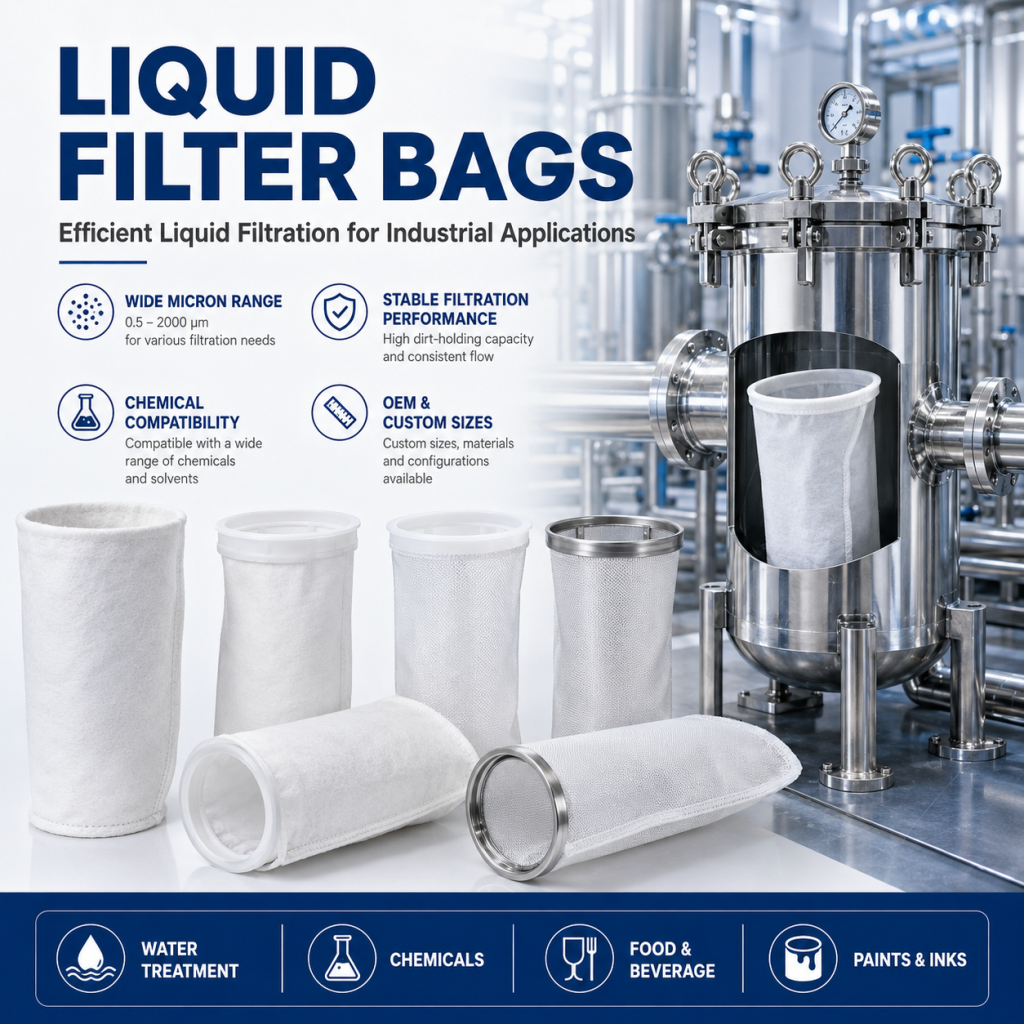
INCE filtration manufactures both 10 micron and 25 micron liquid filter bags for industrial process filtration. For broader selection help, use the 1–500 Micron Size Chart or the micron rating selection guide.
Contact INCE filtration for 10 vs 25 micron filter bag selection, replacement matching, OEM manufacturing or custom filtration solutions.
 WhatsApp