
A high flow cartridge’s water-based flow figure is not a guaranteed capacity for oil, resin or another viscous liquid. Before ordering, establish viscosity at the actual operating conditions, the required retention duty and the available pressure-drop budget. Ask for a model-specific evaluation rather than applying a universal derating factor.
This guide addresses fluid-property qualification. For vessel configuration, use the separate high flow housing sizing guide; for commercial product options, see high flow filter cartridges.
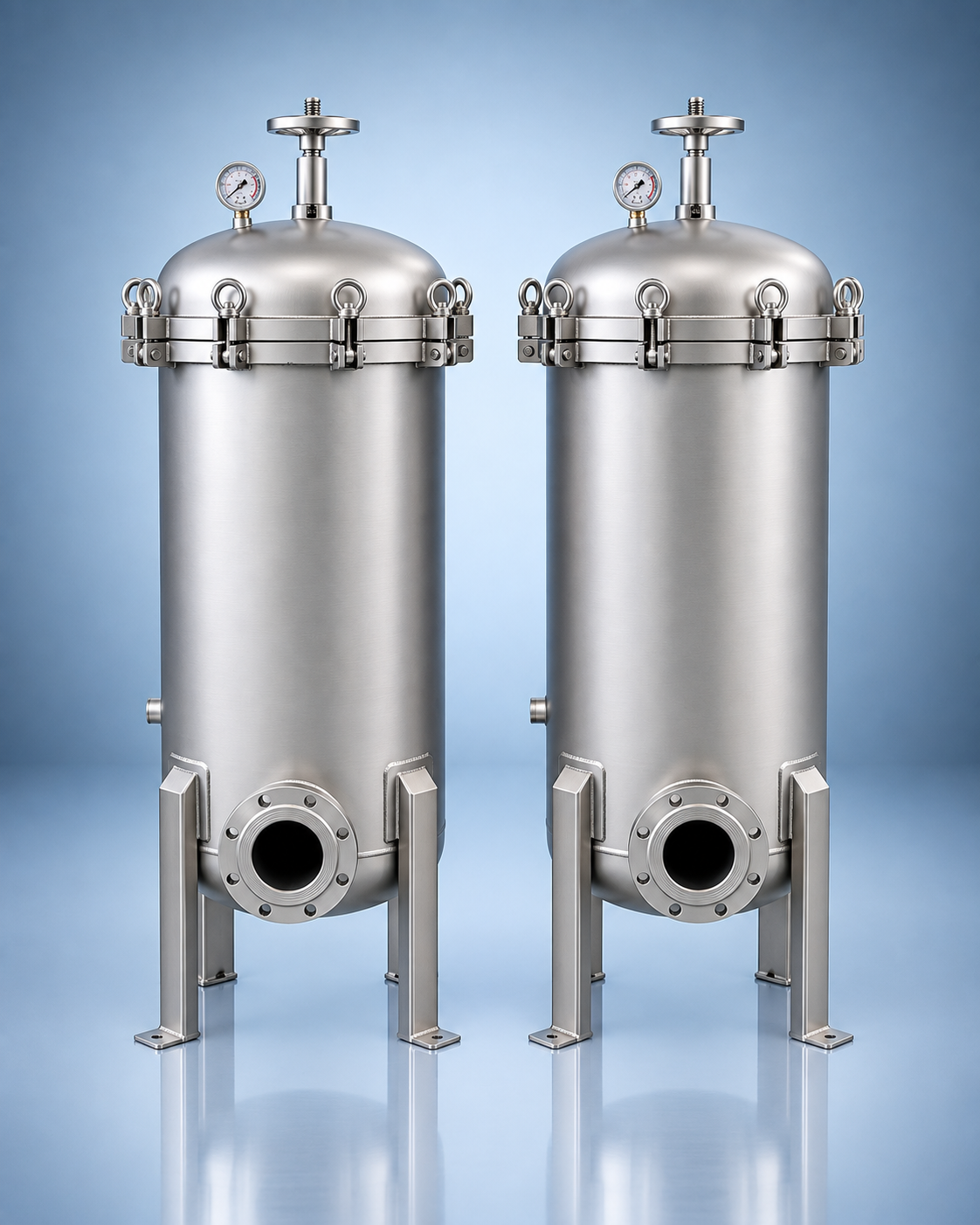
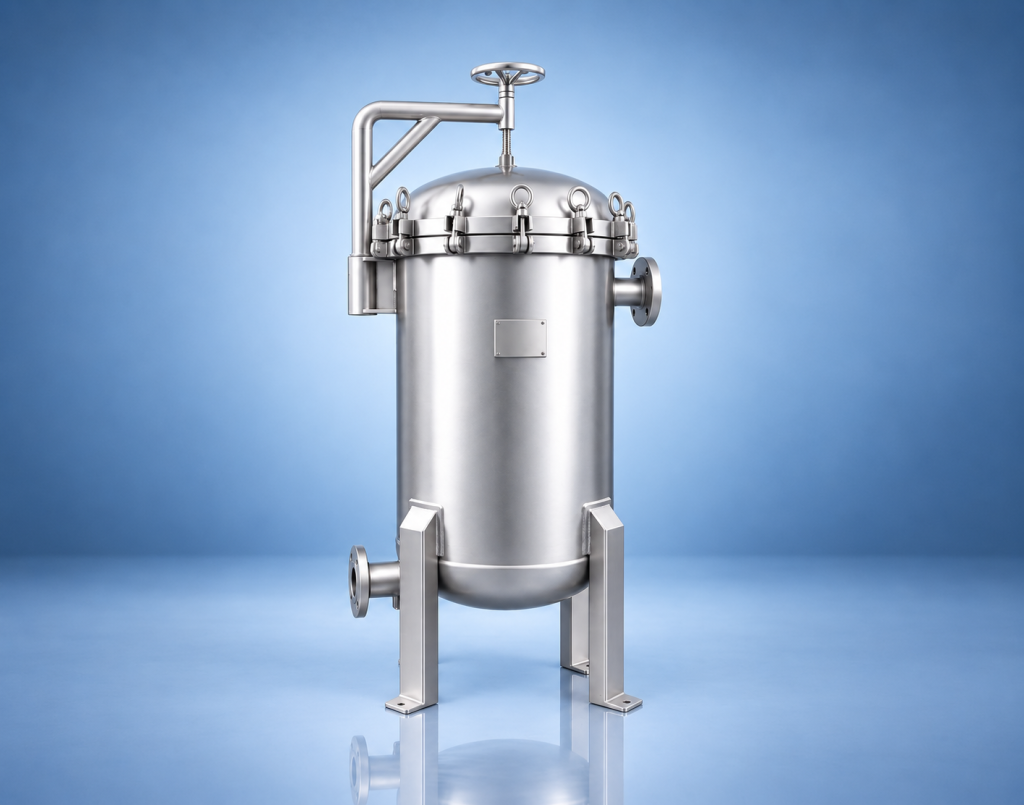
Representative high flow cartridge filter housings. The photograph does not establish cartridge count, viscosity capability, pressure rating or performance.
Read the conditions beneath a catalog flow figure
A flow recommendation may apply only to a specific cartridge length, media grade, liquid viscosity and clean differential pressure. Parker’s XtreamPure XP-L data sheet, for example, gives its flow recommendations at 1 cP viscosity and distinguishes grades of 10 micron and larger from finer grades requiring consultation. Those conditions are part of the recommendation, not optional notes.
That manufacturer example does not establish an INCE cartridge’s capacity. Require the offered model’s own curve or evaluation, with its reference liquid, temperature, grade, length and units identified. Do not transfer a water figure between Pall, Parker and 3M-style replacements merely because their nominal lengths appear similar.
Describe the fluid at startup and normal operation
| RFQ input | What to provide | Decision it supports |
|---|---|---|
| Dynamic viscosity | Value with units, temperature and measurement conditions | Evaluates resistance through the selected medium |
| Temperature range | Cold start, normal operation and credible maximum | Prevents a warm-only selection from ignoring startup duty |
| Flow requirement | Normal and peak flow, batch volume and transfer time | Defines the actual hydraulic target |
| Fluid behavior | Newtonian or shear-dependent behavior if known; solids and gels | Identifies when a simple correction may be inappropriate |
| Separation requirement | Target contaminant and required downstream quality | Avoids solving pressure drop by sacrificing retention |
| Equipment boundary | Pump information, housing, piping and pressure limits | Defines the available system budget |
Do not interchange dynamic viscosity in cP or mPa·s with kinematic viscosity in cSt without the appropriate density relationship. Include the original test result if the units or measurement basis are uncertain. For shear-dependent formulations, provide the measurement method and conditions rather than presenting one viscosity number as valid at every flow condition.
Allocate a clean pressure-drop budget
Distinguish the loss across the clean cartridge from losses through the housing, valves and connections. Confirm what the supplier’s curve includes and where pressure taps will measure the installed system. A cartridge-only result and a complete assembly result are not interchangeable.
Greater resistance at cold startup may leave less operating margin before the approved change-out point. However, do not raise a differential-pressure limit to achieve the requested flow. The element, support, seal and vessel each require evaluation within their documented limits. A vessel’s maximum operating pressure is not the cartridge’s allowable differential pressure.
What a credible supplier evaluation should return
- The exact proposed cartridge model, grade, length and number of elements.
- Predicted clean pressure drop at each stated flow and fluid condition, with assumptions identified.
- Separate housing or connection losses where relevant.
- Material compatibility covering media, supports, end caps, adhesives if present and seals.
- Operating limits and the conditions under which a process trial is still required.
For an existing installation, send the full part number and housing reference through the relevant Parker-style, Pall-style or 3M-style high flow cartridge inquiry path. These labels identify replacement families for review, not universal interchangeability or brand authorization.
Use a trial to test capacity and product quality together
Agree the trial liquid, temperature, flow, starting condition and sampling method. Record differential pressure alongside throughput and downstream quality. Evaluate an appropriate loading interval: a low clean pressure drop alone does not demonstrate acceptable service life, contaminant capacity or retention.
Do not make an unapproved heating change to reduce viscosity. Heating can affect chemistry, product quality and equipment limits. Any trial temperature and operating procedure must be approved by the responsible process and equipment personnel.
Request a viscosity-specific cartridge review
Send fluid identification, viscosity and temperature data, target flow, contaminant duty, current element code and housing information. Ask INCE to confirm a proposed cartridge and supporting performance evidence before placing a bulk order or selecting a high flow filter housing.
Frequently asked questions
Can I apply one viscosity correction to every high flow cartridge?
No. Use the offered model’s documented method and its applicable fluid and flow conditions. Shear-dependent fluids and complete assembly losses can make a simple correction inappropriate.
Is the clean pressure drop enough to predict service life?
No. Solids loading, contaminant behavior, retention duty and process conditions also matter. Evaluate an agreed process trial rather than treating clean flow as a life guarantee.
Does a matching nominal cartridge length confirm replacement suitability?
No. Confirm the full mechanical interface, flow direction, materials, operating limits and performance evidence for the actual duty.
Technical reference
Parker XtreamPure XP-L technical data sheet, DS-XTREAMPURE-XPL-231017 — a model-specific example of stated viscosity and grade conditions, not an INCE performance specification.
 WhatsApp