A filter housing surface-finish specification should define which surfaces are controlled, how they are treated and how acceptance is checked. “Polished stainless steel” or a shiny exterior photograph is not a complete requirement for the wetted interior, welds and nozzles.
Use this guide when preparing a single bag, multi bag or high flow cartridge housing inquiry. It does not claim that INCE automatically supplies electropolishing, a specified Ra value, passivation records or hygienic certification.
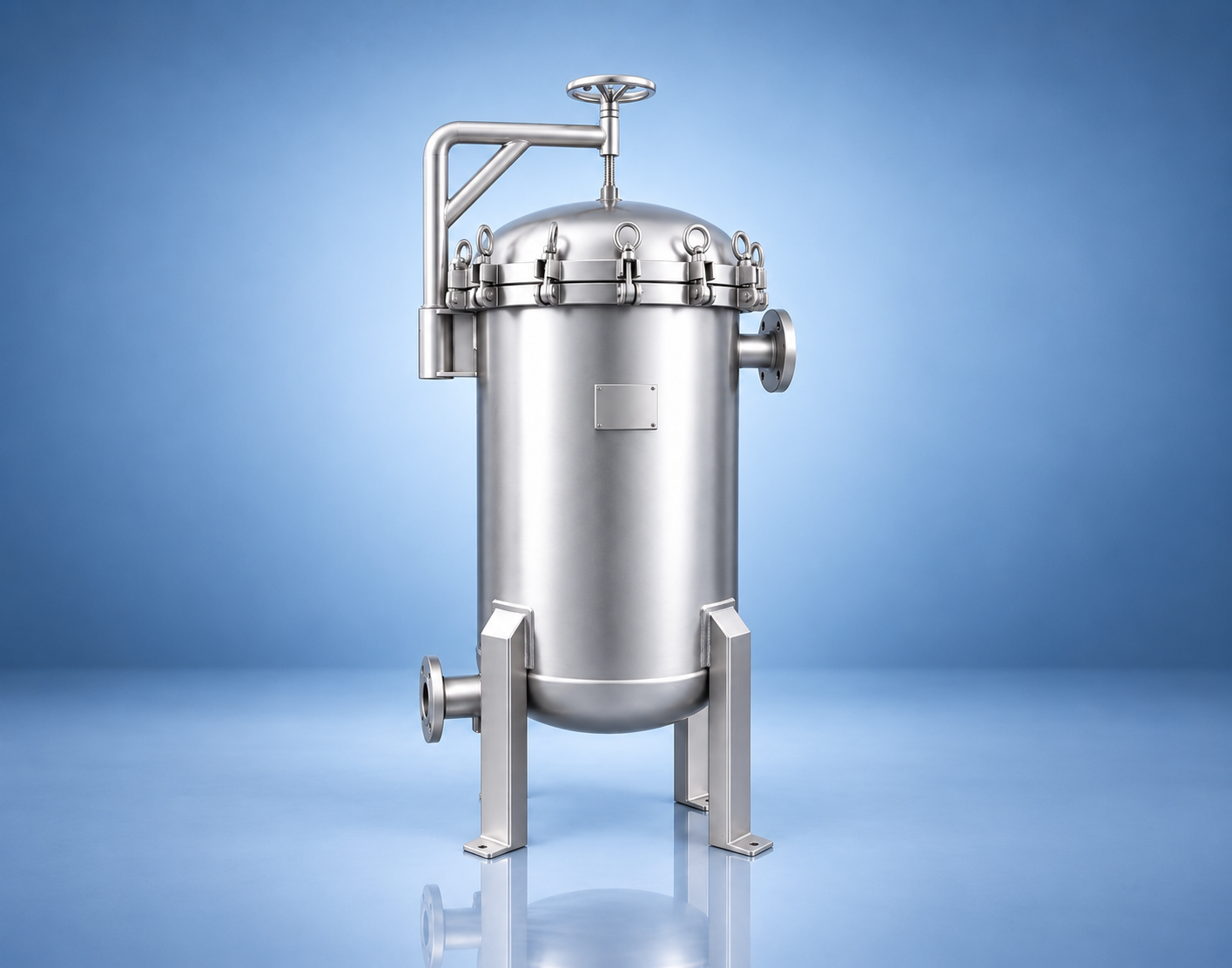
Representative filter vessel. Its appearance does not establish interior roughness, weld treatment, passivation or a documented surface-finish class.
Separate roughness, surface treatment and cleanliness
Ra is a profile roughness average. It is not a description of every peak, scratch or surface defect. Alfa Laval’s explanation of stainless-steel tube finishes illustrates that surfaces with similar Ra values can have different topography; therefore the number alone does not describe the complete surface quality.
Mechanical polishing, pickling, passivation and electropolishing are also not interchangeable purchasing terms. Outokumpu distinguishes these post-fabrication processes: pickling removes oxide scale and an affected surface layer, while electropolishing is an electrochemical surface-removal process. The appropriate treatment depends on the component and duty. Do not add a treatment name to a purchase order without defining its scope and acceptance evidence.
| Requirement | Specify | Avoid assuming |
|---|---|---|
| Surface roughness | Parameter, limit, units and measurement method | A grit label guarantees a particular Ra result |
| Treatment | Named process, applicable procedure and treated areas | A polished appearance proves passivation |
| Weld condition | Permitted condition and inspection criteria | Parent-sheet finish describes every completed weld |
| Cleanliness | Final cleaning, protection and release requirements | A low Ra value proves a contaminant-free assembly |
Make the controlled surfaces visible on the drawing
Identify the shell interior, lid underside, nozzle bores, weld regions, basket supports and other wetted features as applicable. Separate product-contact requirements from cosmetic external requirements. If inaccessible areas require a different inspection approach, resolve that before fabrication.
Clarify whether the stated value is a maximum acceptance limit, a target or another agreed criterion. Also identify whether the requirement applies before or after welding and final treatment. A certificate for the starting sheet is not automatically a report on the finished vessel.
Check the units before comparing quotations
Micrometres and microinches are different units. For illustration, 0.8 µm is approximately 31.5 µin, commonly rounded to about 32 µin. This arithmetic example is not an INCE capability claim or a recommended limit for every process.
A drawing should state the parameter as well as the unit; do not silently treat another roughness parameter as Ra. Agree the measurement locations, direction, instrument and evaluation method with the responsible quality team. Ask how measurements near a weld, nozzle or curved region will be recorded.
Review treatment scope with the actual alloy and service
Send the process liquid, concentration, temperature and cleaning exposure for suitability review. A surface treatment does not turn an unsuitable alloy into a universally compatible material. Keep alloy, pressure design and corrosion considerations separate from cosmetic finish.
Outokumpu also notes that properly pickled stainless steel can passivate spontaneously; a separate chemical passivation step is not automatically needed in every case. The purchaser and fabricator should agree the required procedure rather than treating a longer list of treatment names as proof of better quality.
This article does not provide acid recipes or a site treatment procedure. Chemical and electrochemical finishing require qualified personnel, controlled processes and appropriate safety and waste-management arrangements. On-site repair or retreatment should follow an approved plan.
Ask for evidence matched to the accepted scope
- Approved drawing revision identifying the controlled surfaces.
- Agreed treatment procedure and the operations included in the quotation.
- Roughness measurements identified by location and method where required.
- Weld and surface inspection records required by the project.
- Final cleaning, packaging and protection requirements.
- Explicit deviations and the approval process for any nonconformance.
A material certificate, roughness report and treatment record answer different questions. Do not use one as a substitute for another. Likewise, a surface-finish requirement alone does not establish compliance with a hygienic equipment standard or validate the plant’s cleaning process.
Request a finish-defined housing quotation
Send the housing duty, alloy, drawing, controlled surface areas, required roughness parameter and units, treatment scope and documentation needs. Ask INCE to confirm achievable requirements, inspection access, costs and any deviations before manufacture.
Frequently asked questions
Does a mirror-like exterior prove the interior meets the specified Ra?
No. Identify the controlled interior surfaces and obtain the agreed inspection evidence for the finished component.
Are polishing and passivation the same operation?
No. They describe different aspects of surface preparation and treatment. Specify the required process and scope rather than relying on appearance.
Does a low Ra value establish hygienic certification?
No. Surface roughness is only one requirement. Equipment design, fabrication, inspection, documentation and application validation must be addressed separately.
Technical references
Alfa Laval: interpreting surface finish and Ra; Outokumpu: post-fabrication treatment. Their product specifications and certifications do not apply automatically to an INCE housing.

 WhatsApp