

The cover closure is more than a convenience item on a bag filter housing. It affects opening time, available maintenance space, operator handling and the way the cover load is applied. A buyer should not request a “quick-open housing” without defining pressure, temperature, bag-change frequency, site rules and the closure arrangement that the supplier is actually offering.
This guide compares common closure concepts for single bag filter housings and multi-bag filter housings. It is an RFQ framework, not permission to interchange closure parts between different vessels.
Common closure concepts
V-clamp closure
A V-clamp can provide fast access on compact housings. Eaton’s ECOLINE literature is one manufacturer example using a V-clamp closure on stainless-steel housings for bag sizes 01 through 04. The allowable pressure, clamp design, gasket and tightening method belong to the specific housing model. A V-clamp from another vessel should never be treated as a generic replacement.
Central T-bolt closure
A central T-bolt is designed to reduce the number of fasteners handled during opening. Eaton’s SIDELINE T-bolt data sheet describes quick access without tools or wrenches and lists different pressure versions by housing size. Those published values apply to that product family only; an RFQ for another housing must request its own rated drawing and operating instructions.
Multiple eye-bolt or swing-bolt closure
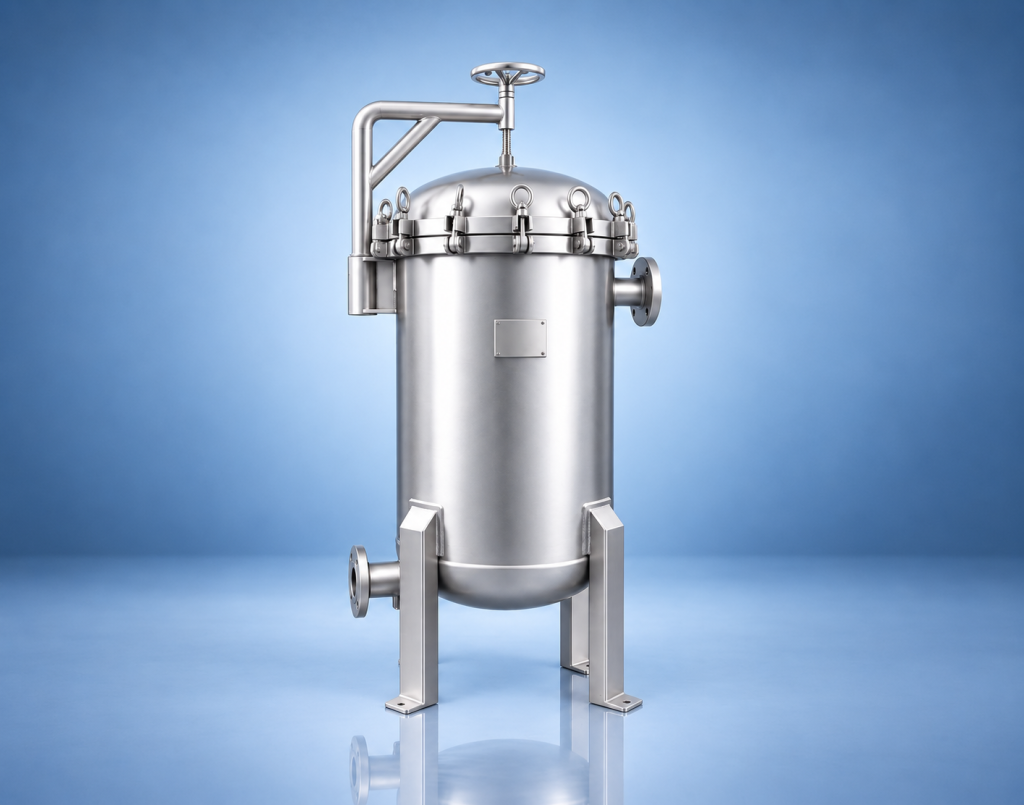
Eye-bolt closures distribute the cover load across several fasteners and are common on heavy-duty or larger vessels. Eaton’s MAXILINE literature provides a multi-bag example with a rugged eye-bolt cover. More fasteners can increase opening steps, but the arrangement may suit a larger cover, higher load or plant preference. The supplier must define the tightening sequence and inspection criteria.
Do not select by opening speed alone
| RFQ factor | Why it matters |
|---|---|
| Design pressure and temperature | Closure, cover, seal and vessel are one rated assembly |
| Normal operating pressure | Defines the real duty but does not replace design conditions |
| Bag-change frequency | Frequent opening can make ergonomics and wear inspection more important |
| Cover weight | May require hinge, davit, spring assistance or lifting provision |
| Maintenance clearance | Controls cover swing, bolt travel and element-removal space |
| Process liquid | Determines seal, wetted material, draining and cleaning requirements |
| Site safety procedure | Defines isolation, depressurization, lockout and proof of zero energy |
| Code requirement | May affect vessel design, documentation and approved closure arrangement |
No closure should be opened while the vessel is pressurized or contains hazardous retained energy. A “quick opening” feature does not remove the need to isolate, depressurize, vent and drain the housing. The approved operating manual and site procedure govern the sequence.
Specify the complete operating envelope
Send minimum, normal and maximum flow; liquid identity; solids; viscosity; normal and upset temperature; normal and maximum operating pressure; design pressure; required code; corrosion allowance; connection standard and bag size. State whether the housing will be indoors, outdoors, washed down or exposed to corrosive atmosphere.
Also identify how often the cover is expected to open. A housing changed once per month has a different ergonomics priority from one changed several times per shift. Eaton’s ergonomics literature notes spring-assisted mechanisms and inclined or horizontal arrangements as options used to reduce effort; any such option should be confirmed on the supplier’s drawing.
Drawing checks before approval
- Closure type and number of fasteners
- Cover hinge or davit direction
- Opening envelope and overhead clearance
- Vent and drain locations
- Seal profile and part number
- Fastener material, lubrication and tightening instruction
- Positive indication that pressure has been relieved, if specified
- Nameplate design conditions and code marking
- Spare closure and seal kit list
Cross-check the drawing against the maintenance-clearance guide, pressure data-sheet guide and vent and drain checklist.
Inspection and lifecycle questions
Ask the supplier to identify wear points and rejection criteria for clamps, T-bolts, eye-bolts, nuts, hinges and cover sealing faces. Request the correct replacement part numbers rather than buying by appearance. The maintenance plan should include cleanliness of the sealing surfaces, condition of threads, corrosion, deformation, missing hardware and verification that the cover seats uniformly.
For a replacement housing, provide photographs of the existing installation, piping orientation, available access and lifting restrictions. Do not ask a new supplier to duplicate a closure from one photograph; supply dimensions, duty and required documentation so a complete housing can be engineered.
Request a closure-specific quotation
Request a Quote with flow, pressure, temperature, bag size, process liquid, opening frequency, available clearance, preferred closure and applicable vessel code. Ask INCE to return a general arrangement drawing, closure description, seal material, spare-parts list and operating limitations for review.
FAQ
Is a V-clamp always limited to low pressure?
No universal limit can be inferred from the closure name. Use the rating and manual for the complete housing model and operating temperature.
Can an eye-bolt cover be converted to a T-bolt?
Not as a field assumption. A closure change affects the rated vessel assembly and requires the original manufacturer or qualified designer’s approval.
Which closure is fastest for frequent bag changes?
A V-clamp or central T-bolt can reduce fastener handling, but the correct choice also depends on pressure, cover weight, ergonomics, maintenance space and site procedures.

 WhatsApp