
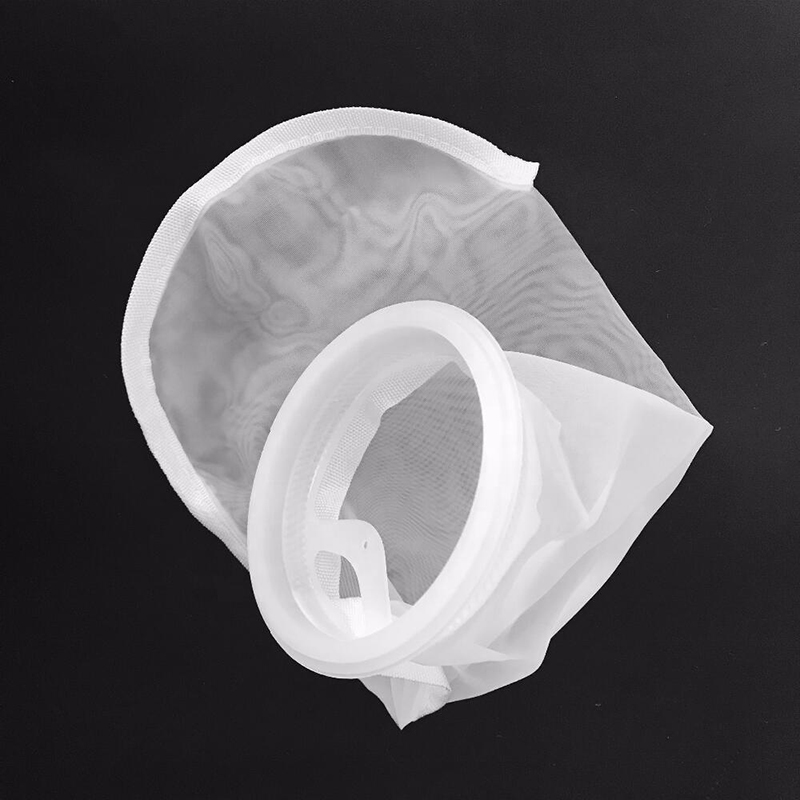
A custom filter bag drawing should define what is measured, where it is measured and the condition of the bag during measurement. “Width × length” is often incomplete: width may mean laid-flat width or installed diameter, while length may include or exclude a collar.
Use this worksheet when preparing a new OEM liquid filter bag or replacing a nonstandard sewn bag. These are proposed drawing conventions to agree with the supplier, not universal manufacturing tolerances.
Distinguish three sets of dimensions
| Dimension type | Meaning | How to use it |
|---|---|---|
| Cut-panel dimensions | Fabric dimensions before seams, folds or attachments are made | Manufacturing pattern; not normally the final customer acceptance size |
| Finished laid-flat dimensions | The completed bag measured flat under stated conditions | Incoming inspection where an agreed flat measurement is practical |
| Installed dimensions | The shape and clearance in the intended basket or support | Fit approval in the actual assembly |
Keep these dimensions separately labelled. A supplier needs to account for seam allowances and construction details when developing the pattern; adding an allowance to a finished-size requirement without identifying it can make the bag oversized.
Use the flat-width relationship only as a starting estimate
For an ideal thin, ungusseted tube flattened without stretching, the circumference is approximately twice its laid-flat width: C ≈ 2W. Its equivalent circular diameter is therefore D ≈ 2W/π.
Illustrative example: a 150 mm laid-flat tube corresponds to about 300 mm circumference, or 95.5 mm equivalent diameter. This geometric estimate excludes fabric thickness, seam construction, gussets, tension and a rigid collar. It is not an approved fit dimension or a recommended clearance.
A circular ring should have its own measured dimensions. Do not calculate its sealing diameter from the fabric body’s flat width. Use the ring and collar fit checklist for that interface.
Mark the measurement points on the drawing
- Length datum: identify whether length starts at the top of the ring, underside of the ring or fabric attachment line.
- Bottom endpoint: distinguish the external bottom from the internal usable depth, especially for rounded or reinforced bottoms.
- Width location: mark a straight body section away from seams, hems, tapers or gussets.
- Seam orientation: show the seam position and whether it faces inward or outward in use.
- Attachment details: identify handles, loops, drawstrings, flanges and their positions.
- Measurement condition: state dry or conditioned, laid flat without intentional stretch, and any agreed measuring load.
Include units on every drawing and assign tolerances to the dimensions that control fit. Avoid copying a tight tolerance from a metal component onto flexible textile dimensions without discussing how it can be measured and manufactured.
Specify material and construction alongside dimensions
Identify the polymer, media construction, micron requirement and its performance basis. A mesh bag and a felt bag with similar external dimensions need not have the same retention or hydraulic behaviour. List thread material, seam type, collar material and any required surface finish.
Where a seam affects the useful filtering area or creates an installation obstruction, show its location and extent. For fabricated mesh parts, the mesh edge-quality guide explains what to identify at cut edges.
Approve a first sample in the real support
Check a production-intent sample against the controlled drawing, then fit it in the intended basket or equipment. Confirm that the collar seats as designed, the body is properly supported and handles do not obstruct closure. Record the drawing revision, material lot, measured results and photographs.
If wetting or cleaning changes a critical dimension, agree a service-conditioning check before approving repeat production. A sample that looks similar to a worn used bag is not enough: the used bag may have stretched, shrunk or accumulated deposits.
Send a drawing package for a custom quotation
Request a custom filter bag drawing review from INCE filtration with the drawing revision, photographs, support dimensions, liquid, temperature, flow, micron requirement, trial quantity and repeat-order quantity. If only a physical sample is available, identify which dimensions are known and ask for a proposed drawing to approve before production.
FAQ
Should I provide the cutting pattern or finished size?
Provide the functional finished-size requirement. If you also supply a pattern, label it separately and agree which document controls acceptance.
Can a supplier quote from a photo alone?
A photo can support an initial discussion, but it does not reliably establish dimensions, materials, tolerances or sealing fit.
 WhatsApp