
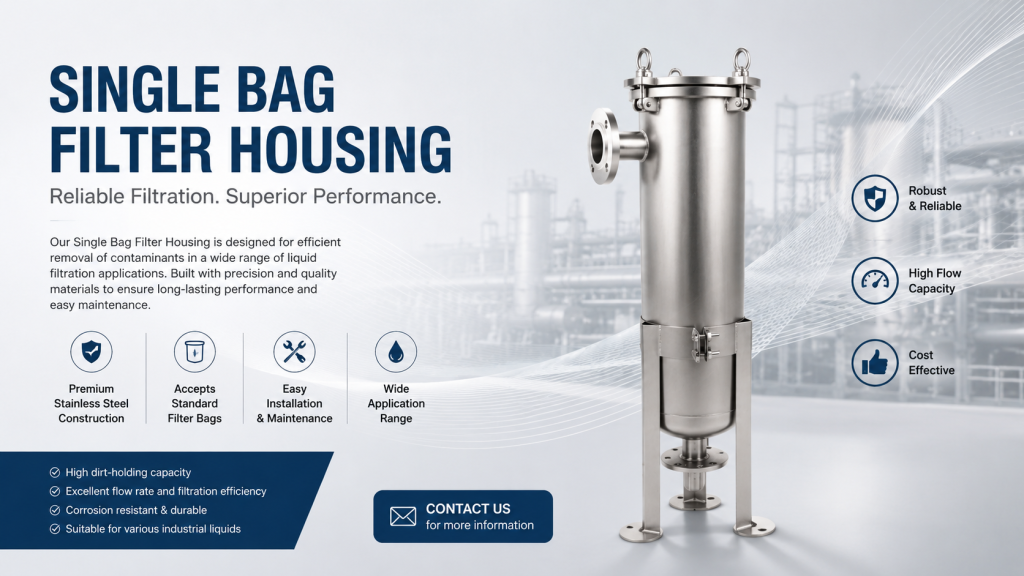
If you need a single bag filter housing for industrial liquid filtration, you can buy one directly from a filtration equipment manufacturer, an authorized distributor, an industrial filtration supplier, or an online B2B marketplace.
For most industrial projects, buying directly from a specialized single bag filter housing manufacturer is usually the better option when you need customized materials, connections, pressure ratings, filter bag sizes, or documentation.
Before requesting a quotation, however, do not choose a filter housing based only on price.
A suitable single bag filter housing should be selected according to:
- Liquid being filtered
- Required flow rate
- Filtration micron rating
- Operating pressure
- Operating temperature
- Liquid viscosity
- Housing material
- Filter bag size
- Inlet and outlet size
- Connection standard
- Gasket material
- Required certificates or testing
This guide explains where to buy a single bag filter housing, how to compare suppliers, what specifications to provide, and what to check before placing an order.
Quick Answer: Where Can You Buy a Single Bag Filter Housing?
There are four main purchasing channels.
| Buying Option | Best For | Main Advantage | Main Limitation |
|---|---|---|---|
| Direct Manufacturer | Industrial projects and OEM buyers | Customization and factory pricing | International shipping may be required |
| Local Distributor | Replacement and urgent requirements | Faster local support | Higher purchasing cost |
| Industrial Equipment Supplier | Standard applications | Convenient purchasing | Limited customization |
| B2B Marketplace | Comparing multiple suppliers | Many choices | Supplier quality varies |
For a standard replacement housing, a local distributor may be convenient.
For an OEM project, new filtration system, chemical application, special connection, higher operating pressure, or larger purchasing quantity, working directly with a bag filter housing manufacturer is generally more practical.
1. Buy Directly From a Single Bag Filter Housing Manufacturer
For industrial buyers, engineering companies, distributors and OEM customers, purchasing directly from a manufacturer offers the greatest flexibility.
Manufacturers can normally provide different configurations such as:
- SS304 filter housing
- SS316L filter housing
- Carbon steel filter housing
- Single bag housing
- Multi-bag housing
- Top-entry design
- Side-entry design
- Flanged connections
- Threaded connections
- Tri-Clamp connections
- Customized inlet and outlet orientation
- Different pressure ratings
- Different surface finishes
Direct manufacturing also makes it easier to match the housing with your existing filtration system.
For example, instead of simply ordering a “stainless steel bag filter,” you may specify:
Single Bag Filter Housing
Housing Material: SS316L
Filter Bag: Size #2
Filtration Rating: 10 micron
Flow Rate: 25 m³/h
Operating Pressure: 4 bar
Operating Temperature: 60°C
Connection: DN50 PN16 flange
Seal: EPDM
A specialized manufacturer can evaluate these conditions and determine whether the proposed configuration is suitable.
When Should You Buy Directly From a Manufacturer?
Direct purchasing is especially suitable when you need:
- Customized dimensions
- OEM production
- Private labeling
- Special flange standards
- Different inlet/outlet configurations
- High-pressure designs
- Chemical-resistant materials
- Sanitary construction
- Multiple units
- Filter bags and housings supplied together
- Technical drawings before production
- Material certificates
- Pressure testing documentation
For this reason, searching for a single bag filter housing manufacturer rather than simply searching for a filter housing may produce better results for industrial sourcing projects.
2. Buy From a Local Filtration Distributor
A local filtration distributor can be a good choice when delivery speed and local technical support are more important than customization.
Distributors commonly stock standard configurations such as:
- Size #1 bag filter housings
- Size #2 bag filter housings
- 304 stainless steel housings
- 316 stainless steel housings
- 2-inch threaded connections
- Standard flange connections
- Replacement baskets
- Replacement seals
- Liquid filter bags
This purchasing route is particularly useful when you are replacing an existing housing and already know the exact specifications.
Advantages
Local distributors may offer:
- Faster domestic delivery
- Easier communication
- Local payment
- Replacement parts
- After-sales support
- Known industrial brands
Disadvantages
The main limitation is that distributors normally sell preconfigured models.
If your application requires a special pressure rating, unusual flange, sanitary surface finish or custom inlet orientation, factory-direct purchasing may provide more options.
3. Buy From an Industrial Filtration Supplier
Another option is a supplier that carries several filtration product categories.
These companies may supply:
- Bag filter housings
- Liquid filter bags
- Cartridge filter housings
- Filter cartridges
- Basket strainers
- Pipeline filters
- Pumps
- Valves
- Filtration accessories
This can be useful when purchasing an entire filtration package rather than one housing.
For example, a complete package might include:
Pump → Single Bag Filter Housing → Filter Bag → Pressure Gauge → Valves → Pipeline Connections
Buying compatible filtration components from one supplier can simplify procurement and reduce the risk of dimensional mismatches.
4. Buy a Single Bag Filter Housing From China
China is one of the major sourcing locations for industrial filtration equipment, particularly for buyers seeking customized stainless steel filter housings or OEM manufacturing.
Searching for terms such as:
- single bag filter housing manufacturer China
- stainless steel bag filter housing supplier China
- SS316L bag filter housing manufacturer
- industrial bag filter housing factory
- custom bag filter housing China
will usually return manufacturers, exporters and trading companies.
The important question is not simply whether you should buy from China, but how you identify a capable manufacturer.
What Should You Check?
Before placing an order, ask the supplier to provide information about:
Manufacturing capability
Can the supplier actually fabricate pressure housings, or are they only reselling products?
Material
Confirm the stainless steel grade.
Common choices include:
SS304
Often selected for general water and many industrial liquid applications.
SS316L
Usually selected when improved corrosion resistance is required, particularly for certain chemical, food, pharmaceutical and corrosive liquid applications.
Material compatibility should always be verified against the actual liquid composition and operating conditions.
Welding quality
Ask for close-up photographs or videos of:
- Body welds
- Inlet welds
- Outlet welds
- Support legs
- Cover assembly
- Basket
- Internal surface
Pressure testing
Ask whether the finished housing is pressure tested before shipment.
If pressure test documentation is important for your project, include this requirement in the purchase specification.
Material documentation
Depending on the project, buyers may request documentation such as:
- Material certificate
- Inspection report
- Pressure test report
- Dimensional inspection
- Welding inspection
- Packing list
- Product drawing
Do not assume every certificate is automatically included. Specify your documentation requirements before ordering.
5. What Size Single Bag Filter Housing Should You Buy?
This is one of the most important questions in the purchasing process.
Two widely used industrial liquid filter bag sizes are Size #1 and Size #2.
Typical nominal dimensions are approximately:
| Filter Bag | Approximate Diameter | Approximate Length |
| Size #1 | 7 in / 180 mm | 17 in / 430–440 mm |
| Size #2 | 7 in / 180 mm | 32 in / 810 mm |
Size #2 has a larger filtration area than Size #1 and is therefore commonly selected for higher flow applications or when longer operating time between bag changes is desired.
However, you should not select a housing based on flow rate alone.
Actual performance also depends on:
- Liquid viscosity
- Particle loading
- Filter bag material
- Micron rating
- Pipe diameter
- Allowable pressure drop
- Pump pressure
- Process conditions
A clean water application and a high-viscosity resin application may require very different housing selections even when the stated flow rate is the same.
6. How Much Flow Can a Single Bag Filter Housing Handle?
There is no universal maximum flow rate for every single bag housing.
As a general reference, commercially available #1 and #2 industrial housings are frequently designed around flow ranges extending from relatively small flows to several tens of cubic meters per hour.
But statements such as:
“Size #2 = 40 m³/h”
should not automatically be treated as a guaranteed operating flow for every liquid.
A better approach is:
Required flow + viscosity + micron rating + contamination load + allowable differential pressure → housing selection
For example:
Application A
Liquid: Clean process water
Flow: 20 m³/h
Filtration: 50 micron
Viscosity: Similar to water
A single Size #2 housing may potentially be appropriate depending on the selected filter bag and allowable pressure drop.
Application B
Liquid: High-viscosity resin
Flow: 20 m³/h
Filtration: 5 micron
The same housing may produce excessive pressure drop.
The supplier should therefore evaluate the actual process conditions before recommending the housing.
7. Should You Buy SS304 or SS316L?
Material selection is one of the most common questions asked before purchasing a stainless steel bag filter housing.
SS304
SS304 is widely used for:
- Industrial water
- Cooling water
- General process water
- Some paints and coatings
- Lubricants
- General industrial liquids
It is normally more economical than SS316L.
SS316L
SS316L offers improved corrosion resistance in many environments and is frequently selected for:
- Chemical processing
- Food and beverage
- Pharmaceutical processing
- High-purity water
- Certain solvents
- More corrosive process liquids
However, SS316L is not universally resistant to every chemical.
Before purchasing a housing for acids, alkalis, solvents or aggressive chemicals, provide the manufacturer with:
- Chemical name
- Concentration
- Temperature
- Operating pressure
Material compatibility should then be evaluated for the complete wetted system, including the housing, basket, seals and filter bag.
8. What Micron Rating Should You Buy?
One common misunderstanding is that the filter housing itself determines the filtration micron rating.
Normally, it does not.
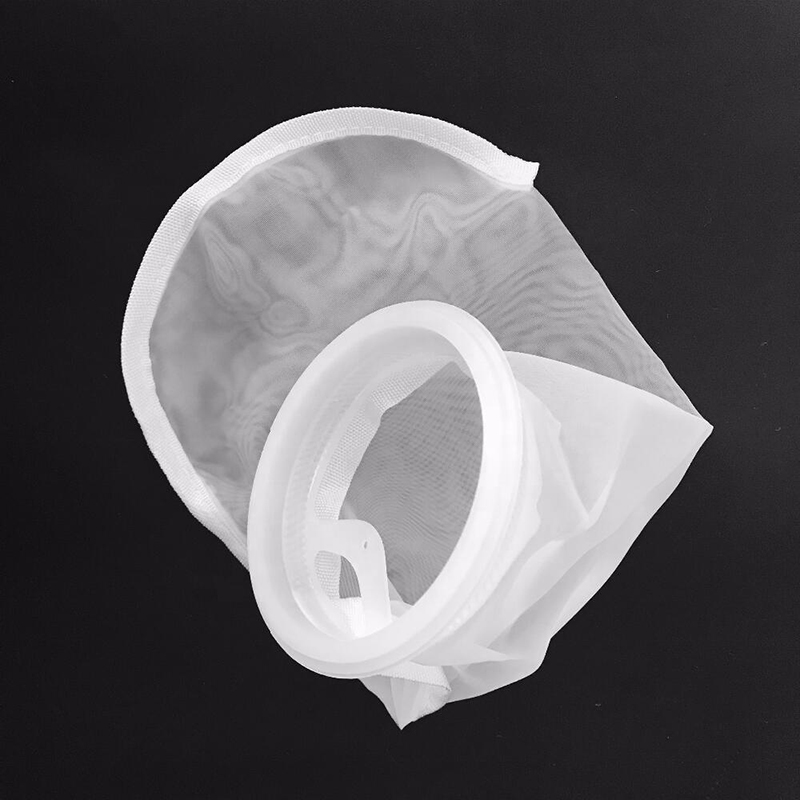
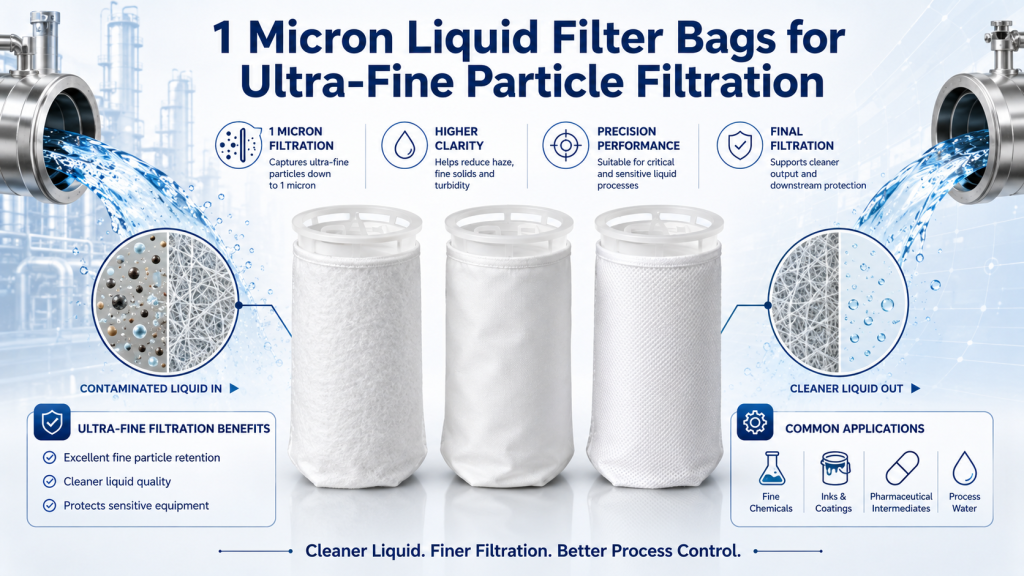
The filter bag installed inside the housing determines the particle retention rating.
Common liquid filter bag micron ratings include:
- 1 micron
- 5 micron
- 10 micron
- 25 micron
- 50 micron
- 75 micron
- 100 micron
- 150 micron
- 200 micron
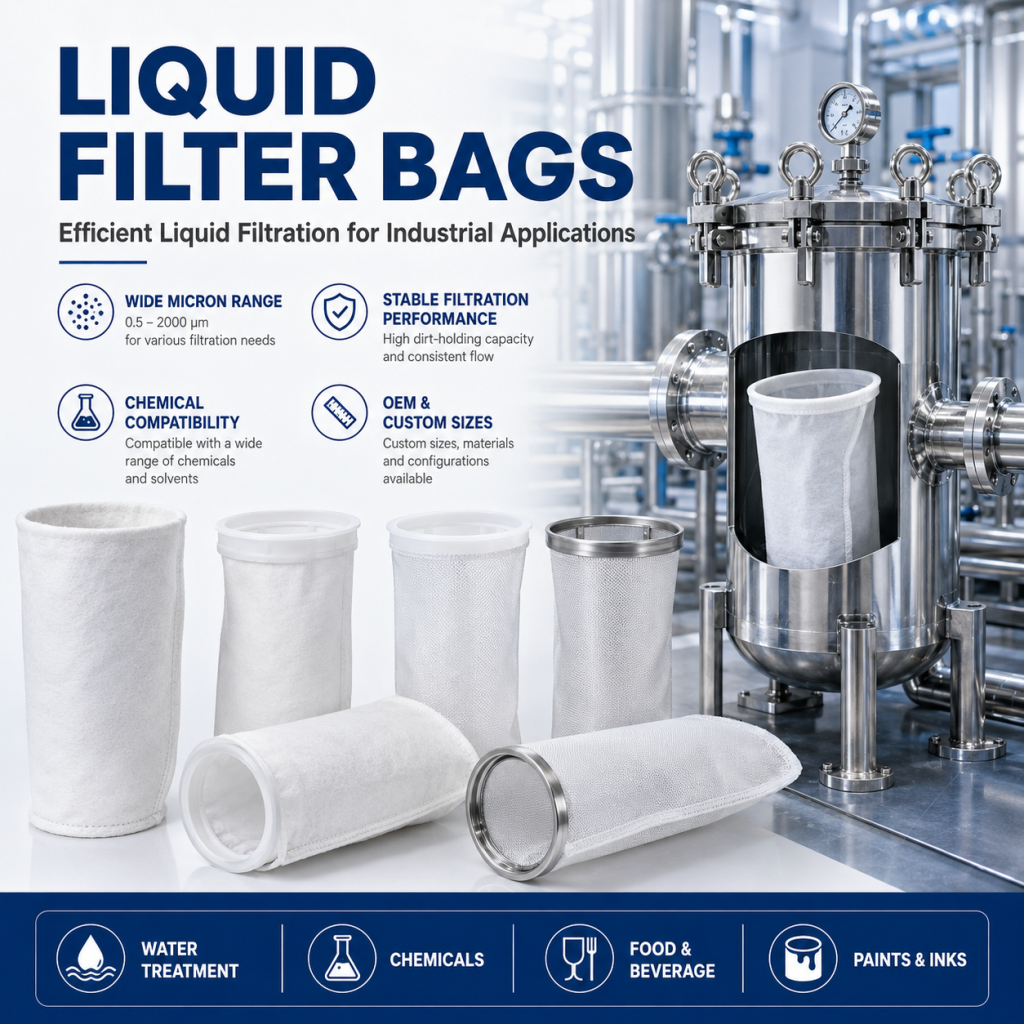
Different filter media are also available, including:
- Polypropylene felt
- Polyester felt
- Nylon mesh
- Polypropylene mesh
- PTFE
- Other specialty media
Therefore, when buying a single bag filter housing, consider purchasing the correct filter bags at the same time.
This allows the supplier to confirm compatibility between:
Housing + Basket + Bag Size + Bag Ring + Filter Media + Seal
9. Which Connection Type Should You Buy?
Single bag filter housings can be manufactured with several inlet and outlet connection types.
Threaded Connection
Common for smaller industrial systems.
Examples include:
- NPT
- BSP
- Female thread
- Male thread
Flanged Connection
Common for industrial process systems.
Possible standards include:
- ANSI / ASME
- DIN / EN
- JIS
- GB
Always specify both the nominal diameter and flange standard.
For example:
DN50 PN16 flange
provides much more information than simply saying:
2-inch connection
Tri-Clamp Connection
Often selected for sanitary applications such as:
- Food
- Beverage
- Pharmaceutical
- High-purity processing
If your existing piping already uses a particular connection standard, send a drawing or photograph to the manufacturer.
10. Top-Entry or Side-Entry: Which Housing Should You Buy?
Single bag filter housings are available in several flow configurations.
Two common designs are:
Side-In / Bottom-Out
The liquid enters from the side and exits through the bottom.
This is a widely used industrial configuration.
Top-In / Bottom-Out
The liquid enters through the upper section and exits from the bottom.
Top-entry designs can offer advantages in certain applications because the incoming liquid is directed toward the filter bag from above.
The best configuration depends on:
- Available installation space
- Pipeline layout
- Maintenance access
- Flow direction
- Cleanliness requirements
- Drainage requirements
Do not redesign your entire pipeline around a standard housing if the manufacturer can customize the housing connection orientation instead.
11. What Pressure Rating Should You Buy?
Never select an industrial filter housing without confirming pressure.
You should distinguish between:
Operating Pressure
The normal pressure during operation.
and
Design or Maximum Allowable Pressure
The pressure for which the equipment is designed.
These values should not be assumed to be the same.
For example, if your process normally operates at 6 bar, simply buying a housing advertised as “6 bar” without understanding its design basis may not provide an appropriate engineering margin.
Provide the supplier with:
- Normal operating pressure
- Maximum possible pressure
- Pump pressure
- Temperature
- Any pressure surge conditions
Applications with significant pressure should be reviewed according to the relevant engineering and regulatory requirements for the installation location.
12. What Gasket Material Should You Choose?
The sealing material is small in size but critical to filter housing reliability.
Common options include:
- NBR / Buna-N
- EPDM
- FKM / Viton
- Silicone
- PTFE
The correct seal depends on:
- Chemical compatibility
- Temperature
- Pressure
- Food-contact requirements
- Cleaning chemicals
Do not choose a gasket only because it is the most expensive option.
The correct choice is the material that is compatible with your process.
13. How Much Does a Single Bag Filter Housing Cost?
There is no single standard price.
The price of a single bag filter housing depends on several factors:
1. Housing Material
SS316L is normally more expensive than SS304.
2. Bag Size
Size #2 housings are larger than Size #1 housings and require more material.
3. Pressure Rating
Higher-pressure construction may require thicker materials, heavier closures and additional fabrication requirements.
4. Connection
Threaded connections are usually simpler than large industrial flanges or sanitary connections.
5. Surface Treatment
Options may include:
- Standard industrial finish
- Sandblasting
- Mechanical polishing
- Internal polishing
- External polishing
6. Accessories
Additional components may include:
- Pressure gauge
- Differential pressure gauge
- Vent valve
- Drain valve
- Adjustable legs
- Casters
- Special basket
- Special gasket
7. Certification and Testing
Additional inspection or project-specific documentation may increase the cost.
8. Quantity
OEM or project quantities can usually be priced differently from a single replacement unit.
For this reason, comparing suppliers only by the headline price can be misleading.
A $500 housing and a $1,000 housing may have completely different:
- Material
- Wall thickness
- Pressure rating
- Flange standard
- Surface treatment
- Documentation
- Accessories
Compare technical specification against technical specification, not price against price.
14. What Information Should You Send to Get a Quotation?
If you want an accurate quotation, provide the following information.
Single Bag Filter Housing RFQ Checklist
1. Liquid:
What liquid will be filtered?
2. Flow Rate:
Example: 20 m³/h or 100 GPM
3. Filtration Rating:
Example: 5 micron, 10 micron or 100 micron
4. Operating Pressure:
Example: 4 bar
5. Maximum Pressure:
If known
6. Operating Temperature:
Example: 60°C
7. Viscosity:
Especially important for oils, resins, paints and other viscous liquids
8. Housing Material:
SS304, SS316L or another material
9. Filter Bag Size:
Size #1, Size #2 or manufacturer recommendation
10. Inlet / Outlet Size:
Example: DN50
11. Connection:
NPT, BSP, ANSI flange, DIN flange, Tri-Clamp, etc.
12. Seal Material:
EPDM, NBR, FKM, PTFE, etc.
13. Inlet / Outlet Orientation:
Top-in, side-in, bottom-out or customized
14. Surface Finish:
Industrial, sandblasted, polished or sanitary
15. Quantity:
Number of housings required
16. Documentation:
Material certificate, pressure test report, drawing, inspection report, etc.
Sending this information at the beginning can significantly reduce unnecessary communication.
15. Example of a Good Single Bag Filter Housing RFQ
Instead of sending:
Please quote one bag filter.
Send:
We need a single bag filter housing for process water.
Flow rate: 25 m³/h
Filtration rating: 10 micron
Liquid: Process water
Operating pressure: 4 bar
Temperature: 40°C
Housing material: SS304
Connection: DN50 PN16 flange
Filter bag: Size #2 preferred
Quantity: 5 setsPlease recommend the appropriate model and provide technical drawings, filter bag specification, lead time and quotation.
This gives the supplier enough information to make a meaningful recommendation.
16. How Do You Compare Single Bag Filter Housing Suppliers?
Do not compare suppliers only by their websites or advertised price.
Use the following checklist.
| Item | What to Check |
| Manufacturing | Manufacturer or reseller? |
| Material | Is the stainless steel grade specified? |
| Design | Is a detailed drawing available? |
| Pressure | Are operating/design pressures clearly stated? |
| Testing | Is pressure testing available? |
| Welding | Can welding quality be inspected? |
| Connections | Can flange/thread standards be customized? |
| Filter Bags | Can matching bags be supplied? |
| Documentation | Are required reports available? |
| Customization | Can dimensions and orientations be changed? |
| Experience | Does the supplier understand your industry? |
| Support | Can engineers help with selection? |
A technically competent supplier should ask questions about your application before recommending a model.
Be cautious if the only questions are:
“How many pieces?”
and
“What price do you want?”
For industrial filtration equipment, proper selection should start with the process conditions.
17. Warning Signs When Buying a Bag Filter Housing
Consider investigating further if a supplier:
- Cannot identify the stainless steel grade
- Cannot provide a dimensional drawing
- Does not ask about pressure
- Does not ask about temperature
- Guarantees a flow rate without asking about the liquid
- Cannot explain the filter bag size
- Cannot identify the flange standard
- Cannot explain the gasket material
- Has no clear testing procedure
- Gives inconsistent technical specifications
- Uses the same specification for every application
The housing is part of a pressurized liquid system.
The lowest purchase price should therefore not be the only selection criterion.
18. Should You Buy a Single Bag or Multi-Bag Filter Housing?
A single bag housing is often appropriate for:
- Small to medium flow rates
- Batch processing
- Prefiltration
- Process water
- Paint
- Ink
- Oil
- Chemical liquids
- Food-processing liquids
- General industrial filtration
When the required flow becomes too high for a practical single bag system, a multi-bag filter housing may be more suitable.
For example, instead of forcing a very high flow through one filter bag, several filter bags can operate in parallel inside one housing.
This increases total filtration area and may:
- Reduce pressure drop
- Increase dirt-holding capacity
- Extend operating time
- Reduce bag-change frequency
Therefore, if your required flow is relatively high, ask the supplier to compare:
Single Bag Housing vs Multi-Bag Housing
rather than automatically choosing the larger connection available on a single housing.
19. Where Is the Best Place to Buy a Single Bag Filter Housing?
There is no single best purchasing source for every buyer.
Choose according to your project.
Buy From a Local Distributor If:
- You need a standard model
- Delivery is urgent
- You need local inventory
- You already know the exact replacement model
Buy Directly From a Manufacturer If:
- You need customization
- You are building new equipment
- You are an OEM
- You require multiple units
- You need special materials
- You need special flange standards
- You need documentation
- You want factory-direct pricing
Buy From a Specialized Filtration Supplier If:
- You also need filter bags
- You need cartridges or other filtration products
- You want one supplier for the filtration package
The best supplier is not necessarily the cheapest one.
It is the supplier that can correctly match the filter housing to your liquid, flow rate, micron requirement, pressure, temperature and installation conditions.
20. Buying a Single Bag Filter Housing From Ince Filter
If you are looking for a single bag filter housing manufacturer in China, Ince Filter provides industrial liquid filtration solutions with different housing configurations available according to application requirements.
Single bag housings can be specified according to parameters including:
- Housing material
- Filter bag size
- Micron rating
- Flow requirement
- Operating pressure
- Operating temperature
- Connection size
- Connection standard
- Inlet/outlet orientation
- Seal material
- Surface treatment
- Accessories
Instead of choosing a housing only from a catalog model, send your actual filtration conditions for technical evaluation.
For the fastest recommendation, provide:
Liquid + Flow Rate + Micron Rating + Pressure + Temperature + Connection Size
Example:
Water / 25 m³/h / 10 μm / 4 bar / 40°C / DN50
Based on these conditions, an appropriate single bag housing configuration can then be evaluated.
Frequently Asked Questions
Where can I buy a single bag filter housing?
You can buy a single bag filter housing from a filtration equipment manufacturer, local distributor, industrial filtration supplier or B2B sourcing platform. Direct manufacturers are generally more suitable when customization, OEM production, special materials or project-specific documentation is required.
How do I choose a single bag filter housing?
Start with the liquid, required flow rate, micron rating, viscosity, operating pressure and temperature. Then select the housing material, filter bag size, inlet/outlet connections and gasket according to these process conditions.
What is the standard size of a single bag filter housing?
Size #1 and Size #2 are among the most commonly used industrial liquid filter bag formats. Size #1 bags are approximately 7 × 17 inches, while Size #2 bags are approximately 7 × 32 inches. Exact dimensions should be confirmed with the housing and bag manufacturer.
What is the difference between a Size #1 and Size #2 bag filter?
A Size #2 filter bag is approximately twice the length of a Size #1 bag and provides greater filtration area. This can support greater flow or longer operating periods, depending on the liquid and filtration conditions.
Is SS304 or SS316L better for a bag filter housing?
Neither material is automatically better for every application. SS304 is widely used for general industrial and water applications, while SS316L is often selected when greater corrosion resistance is needed. Chemical compatibility should always be checked against the actual liquid.
Can a single bag filter housing be customized?
Yes. Industrial manufacturers can commonly customize housing material, pressure rating, inlet/outlet size, flange standard, connection orientation, surface finish, support legs and accessories.
How much does a single bag filter housing cost?
Price depends on material, bag size, pressure rating, connection type, surface finish, accessories, testing requirements and order quantity. For accurate comparison, request quotations using the same technical specification.
What filter bags can be used in a single bag housing?
Depending on the housing design, common filter media include polypropylene felt, polyester felt, nylon mesh and other specialty materials. Micron ratings and bag-ring designs should be selected according to the application.
Can a single bag filter housing be used for chemicals?
Yes, but the compatibility of the housing material, filter bag and gasket with the chemical must be verified. Provide the chemical name, concentration and operating temperature to the supplier before selection.
Can a bag filter housing be used for high-viscosity liquids?
Yes, but viscosity can significantly increase pressure drop. High-viscosity applications such as resin, paint or oil should be evaluated using actual viscosity, flow rate and filtration rating rather than clean-water flow data.
When should I choose a multi-bag filter housing instead?
Consider a multi-bag housing when the required flow, contamination load or desired operating time exceeds what is practical for one filter bag. Increasing total filtration area can reduce pressure drop and bag-change frequency.
Final Buying Checklist
Before ordering your single bag filter housing, confirm:
- Liquid compatibility
- Required flow rate
- Micron rating
- Filter bag material
- Filter bag size
- Housing material
- Operating pressure
- Design pressure
- Operating temperature
- Gasket material
- Inlet size
- Outlet size
- Connection standard
- Inlet/outlet orientation
- Surface finish
- Required accessories
- Required documentation
- Pressure testing
- Quantity
- Lead time
A properly selected single bag filter housing should be treated as part of the complete filtration system rather than as an isolated stainless steel vessel.
The more information you provide about your application, the more accurately a manufacturer can recommend the correct housing.
Need help selecting a single bag filter housing?
Send your:
Liquid + Flow Rate + Micron Rating + Pressure + Temperature + Connection Size
and request a housing recommendation before placing your order.
 WhatsApp