
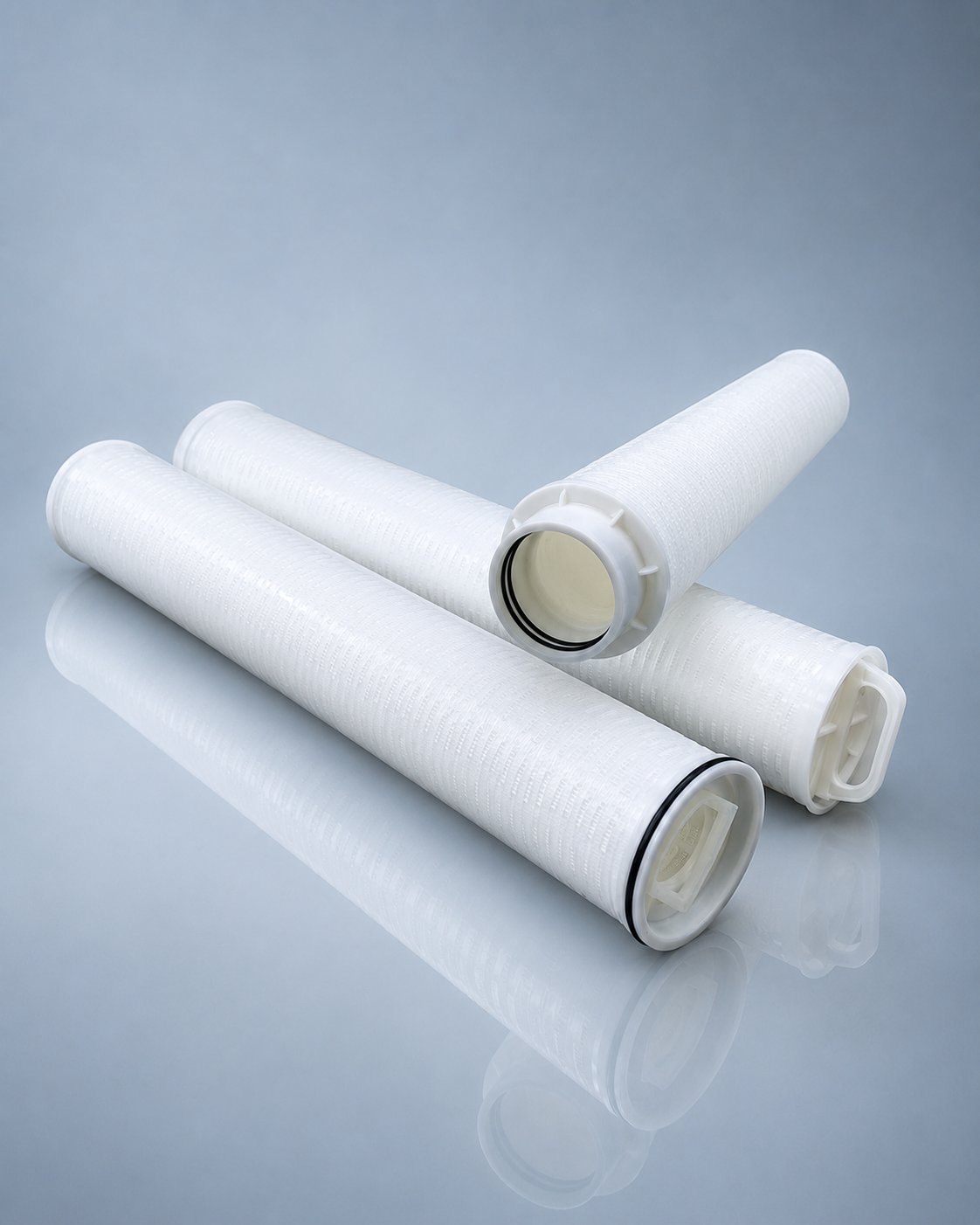
Two high flow cartridges can share the same nominal length and outside diameter yet use different media, support layers, end-cap materials and seals. Replacement selection should therefore begin with the liquid and performance requirement, not with length alone.
This high flow filter cartridge media selection guide compares polypropylene and glass-fiber constructions as an RFQ framework. Manufacturer data cited below are examples from specific Pall and 3M products; they must not be treated as universal INCE ratings.
The Media Decision Is More Than PP Versus Glass Fiber

| Selection question | Polypropylene construction | Glass-fiber construction |
|---|---|---|
| Chemical review | Often selected for broad aqueous and many chemical duties, subject to the exact fluid and temperature | Compatibility depends on fiber, binder or resin, support layers and the process liquid |
| Temperature | Limited by the complete cartridge construction, not the media name alone | May have a different temperature capability, but seals, supports and housing limits still govern |
| Efficiency basis | Ask whether the grade is nominal or absolute and request the test basis | Ask for the same efficiency definition; media labels alone do not prove equivalent retention |
| Clean pressure drop | Depends on media structure, area, viscosity, flow and cartridge size | Must be compared at the buyer’s actual flow and viscosity |
| Downstream cleanliness | Review extractables, fiber release and process compliance where relevant | Review binder, support and downstream cleanliness requirements where relevant |
Use the Existing Cartridge as a Measurement Reference
For a replacement request, record the manufacturer and full model code, installed length, outside diameter, inside diameter, flow direction, end connection, seal profile and housing model. Compare these details with INCE high flow filter cartridges and the appropriate high flow housing.
- Photograph the cartridge label, open end, closed end and seal arrangement.
- Measure length and diameter without compressing the gasket or end feature.
- Confirm whether flow is inside-to-out or outside-to-in.
- Record the operating and change-out differential pressure separately.
- Identify liquid composition, viscosity, temperature, solids and required filtrate quality.
- State whether the replacement is expected to match Pall-, Parker- or 3M-style hardware.
What Official Product Data Show
Pall lists several media families within its Ultipleat High Flow range, including polypropylene depth structures and a glass-fiber option with different support and end-cap materials. Its published operating limits also differ by media construction. The Pall Marksman PFT data sheet separately identifies polypropylene media, polypropylene support and reinforced polypropylene end caps.
The 3M High Flow brochure identifies polypropylene media, center core, end caps and outer sleeve for that specific product family, with multiple seal options. These examples demonstrate why a buyer must compare the entire construction and the stated operating conditions rather than replacing on micron rating alone.
Do Not Copy a Published Flow Rate Blindly
A published water-flow value is normally tied to a defined cartridge length, clean water, temperature and allowable pressure drop. Actual flow changes with viscosity, solids loading, media grade, housing pipework and the number of cartridges. Ask for a pressure-drop curve or project calculation at the stated operating point.
RFQ Data for a Media Conversion
- Current cartridge manufacturer, model and quantity per housing.
- Target micron rating and whether nominal or absolute efficiency is required.
- Liquid name, concentration, viscosity and operating temperature.
- Normal, maximum and clean differential pressure information.
- Flow per housing, duty cycle and current service life.
- Required seals, food-contact or process declarations, and sample quantity.
- Reason for changing media: compatibility, pressure drop, life, cleanliness, availability or cost.
Source Notes
Technical examples: Pall Ultipleat High Flow product data, Pall Marksman PFT data sheet and 3M High Flow system brochure.
Frequently Asked Questions
Can PP and glass-fiber high flow cartridges be exchanged at the same micron rating?
Not automatically. Confirm dimensions, flow direction, seals, efficiency basis, pressure drop, temperature and chemical compatibility.
Does the media determine the cartridge temperature limit?
Only partly. The complete construction, including support, end caps, adhesives or binders and seals, must be reviewed.
What is the fastest way to quote a replacement?
Send the complete model code, photos, measured dimensions, housing model, liquid, flow, temperature and target filtration result.
Request a High Flow Media Review
Use Request a Quote to send the existing model code and operating data. INCE can compare the requested construction with available replacement styles, including Pall-style, Parker-style and 3M-style high flow cartridges.
 WhatsApp