250 µm = 0.25 mm
Micron is a length unit. Here it expresses the target clear opening between adjacent nylon filaments.

Specify nylon filter mesh around a 0.25 mm opening target. Compare two listed constructions, select the aperture your process needs, and order rolls or custom fabricated parts.
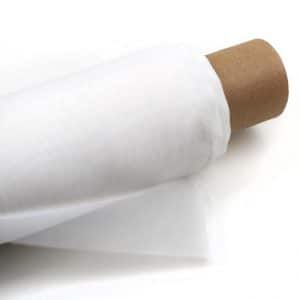
Reference values are taken from the Incefiltration Nylon Filter Mesh table. Availability, nylon grade and production tolerances must be confirmed with the quotation.
| Reference | Opening | Difference vs 250 µm | Mesh/cm | Mesh/inch | Thread diameter | Reference width |
|---|---|---|---|---|---|---|
| JPP237-71 | 237 µm | −13 µm (−5.2%) | 28 | 71 | 120 µm | 127 cm |
| JPP267-61 | 267 µm | +17 µm (+6.8%) | 24 | 61 | 150 µm | 127 cm |
Micron is a length unit. Here it expresses the target clear opening between adjacent nylon filaments.
The listed nearby constructions use different mesh counts and thread diameters. A 250 mesh/inch fabric is a different specification.
Aperture alone does not guarantee absolute retention. Validate particle capture, seal integrity and deformation in the finished assembly.
JPP237-71 uses 120 µm thread and is numerically closest to 250 µm. Review it when a smaller opening is acceptable; it is not automatically interchangeable with a 250 µm specification.
JPP267-61 uses 150 µm thread. Consider it only if your process permits the larger opening. The thicker thread and different mesh count also change fabric geometry.
Flow, pressure drop, strength and cleaning life depend on more than aperture. Ask for samples and evaluate them at the intended viscosity, flow and mechanical load.
Evaluate coarse suspended-solid screening before finer filtration. Match the downstream particle requirement and support the mesh against operating pressure.
Screen larger debris or agglomerates where nylon is chemically suitable. Assess whether the mesh also retains useful product components.
Consider ingredient or liquid screening only after confirming food-contact documentation, cleaning conditions and the exact material grade.
Use a properly supported screen to reduce larger debris where the chosen opening meets equipment requirements.
Review cleaning methods and inspect mesh, edges and joints before reuse. Reuse depends on condition and process acceptance criteria.
Convert the selected parent mesh into discs, inserts or screens, with tolerances and sealing defined by the equipment drawing.
State the 250 µm target, acceptable tolerance, selected JPP reference, nylon grade and any documentation requirements.
Provide liquid composition, temperature, viscosity, flow, pressure differential and cleaning method.
Include roll length or part dimensions, edge finish, drawing, samples, quantity and packaging requirements.
The current Incefiltration reference table lists 237 µm JPP237-71 and 267 µm JPP267-61 near the 250 µm target, rather than an exact 250 µm construction. If your drawing requires exactly 250 µm within a defined tolerance, request technical confirmation before accepting a substitute.
237 µm is 13 µm below the target; 267 µm is 17 µm above it. Proximity alone does not establish suitability. Specify the acceptable opening range and evaluate the finished screen under your process conditions.
No. 250 microns equals 0.25 mm and describes an opening target. Mesh count describes the number of mesh periods per unit length. Thread diameter must also be known to relate mesh count to opening size.
No. A woven opening describes mesh geometry. Particle shape, mesh tolerance, deformation, sealing and operating conditions affect retention. An absolute filtration claim requires a defined efficiency and test method.
Incefiltration can review rolls, cut pieces, discs, rings, tubes and drawing-based components made from the selected parent mesh. Provide dimensions, tolerances, edge treatment and quantity for confirmation.
Confirm the exact nylon grade and request food-contact documentation for the intended conditions and destination market. A nylon material description or micron designation alone is not a compliance statement.
Send your opening tolerance, operating conditions, dimensions and quantity. Incefiltration can review the 237 and 267 µm options or assess your exact requirement.
 WhatsApp